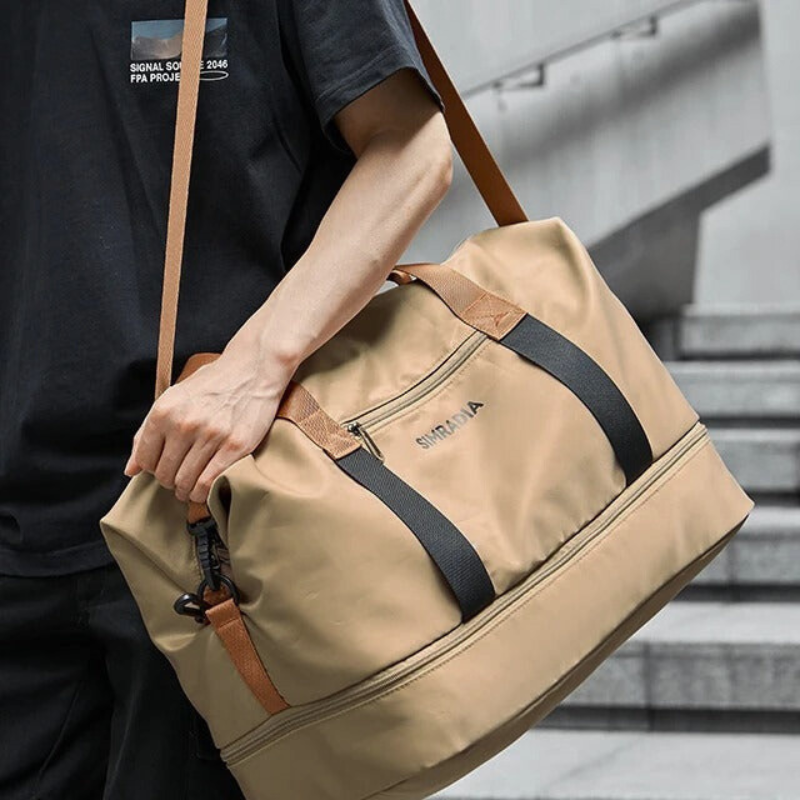



The Best Bags for Coworking Spaces in 2026: What to Carry When Your Office Changes Daily

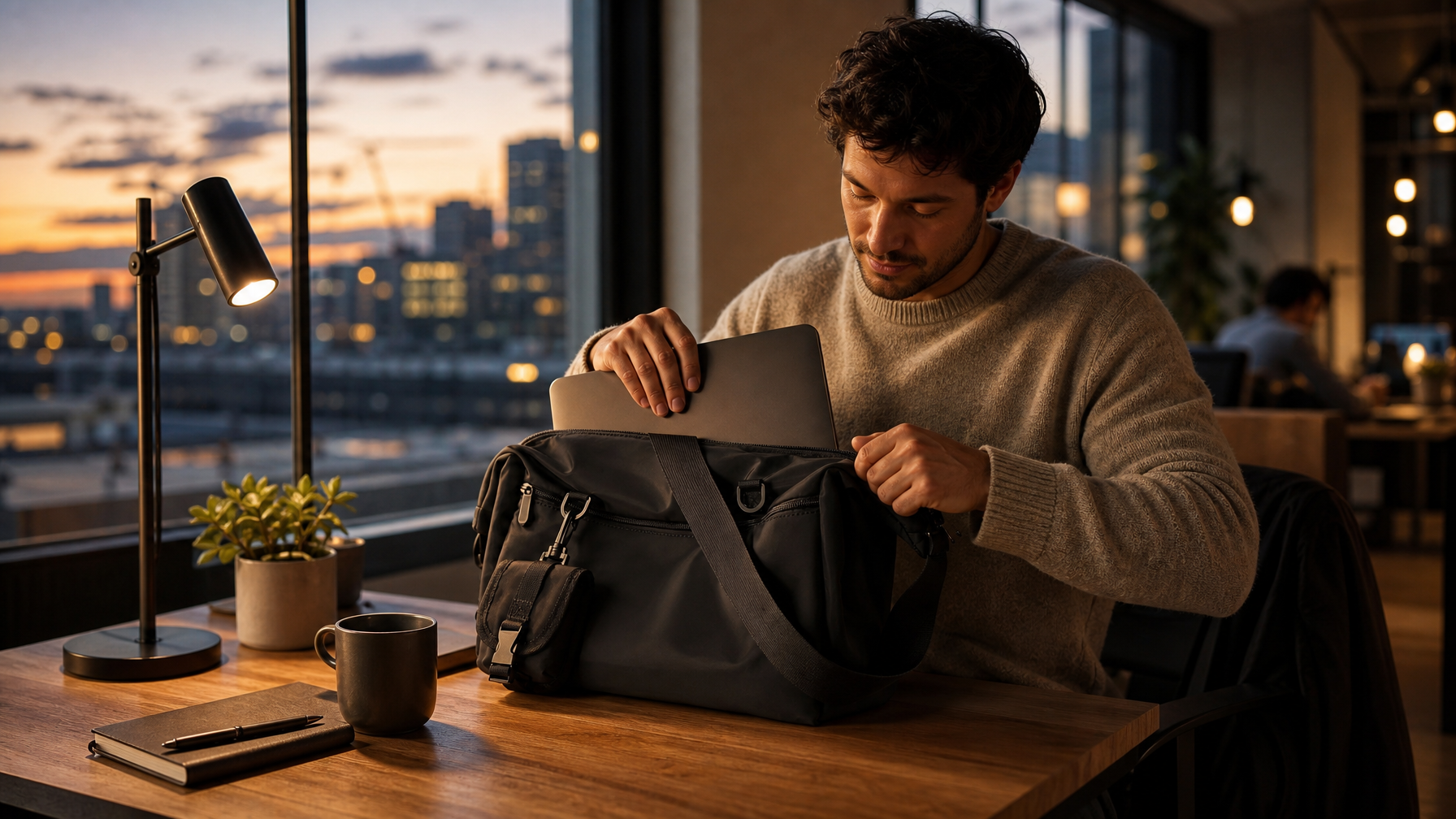
Coworking is a different carry problem than a fixed office or a coffee shop. Your desk may change by the hour. Lockers are optional. Meetings move between phone booths, glass rooms, and the main floor. You need a bag that opens cleanly on a shared table, closes fully when you step away, and never forces you to leave a half-unpacked pile that announces you are new here.
This guide is for people who work from coworking spaces a few days a week or full time: members, day-pass users, freelancers, and hybrid employees whose "office" is a rotating membership. It is not a furniture review. It is a practical system for choosing and packing a coworking bag so your first twenty minutes are work, not archaeology.
If remote work is your broader context, pair this with the coffee shop carry setup and how to stay focused when your office changes every day. For hybrid office-and-remote days more generally, see the best bags for hybrid work.
What coworking actually demands from a bag
1. Fast, quiet unpack and pack
You will sit down beside strangers. You want laptop, charger, notebook, and headphones out in under a minute without scattering cables across three seats. A bag with one clear main cavity plus a few known pockets beats a maze of zippers you relearn every Monday.
Prefer:
- A main compartment you can open fully on a table without dumping the bag
- A dedicated place for the laptop so you never dig under a water bottle
- Outer or front access for phone, member card, and keys while the bag stays closed
2. A closed bag is part of your etiquette
In a shared space, an open bag on the floor is a trip hazard and a quiet signal of chaos. When you leave for coffee, a call, or the restroom, zip or close the bag completely. Treat the bag as a portable drawer, not a permanent desk extension.
3. Security is situational, not theatrical
Coworking theft is usually opportunistic: a phone left on a table, a wallet in an open side pocket, a laptop left while you "just step away." Features help. Habits matter more.
- Keep high-value items in a pocket that sits against your body when you walk
- Do not leave the bag unzipped on a chair back in a busy aisle
- If the space has lockers, use them for gym clothes and spare layers, not for the laptop you need every hour
For feature-level detail on closures and pocket placement, see anti-theft bags for commuters.
4. Professional enough for client video, calm enough for all day
You may take a sales call from a booth twenty minutes after a casual stand-up. The bag should look intentional on camera in the background and still feel right for a full day of movement between floors. Loud logos, half-open totes, and overstuffed gym duffels fight that standard.
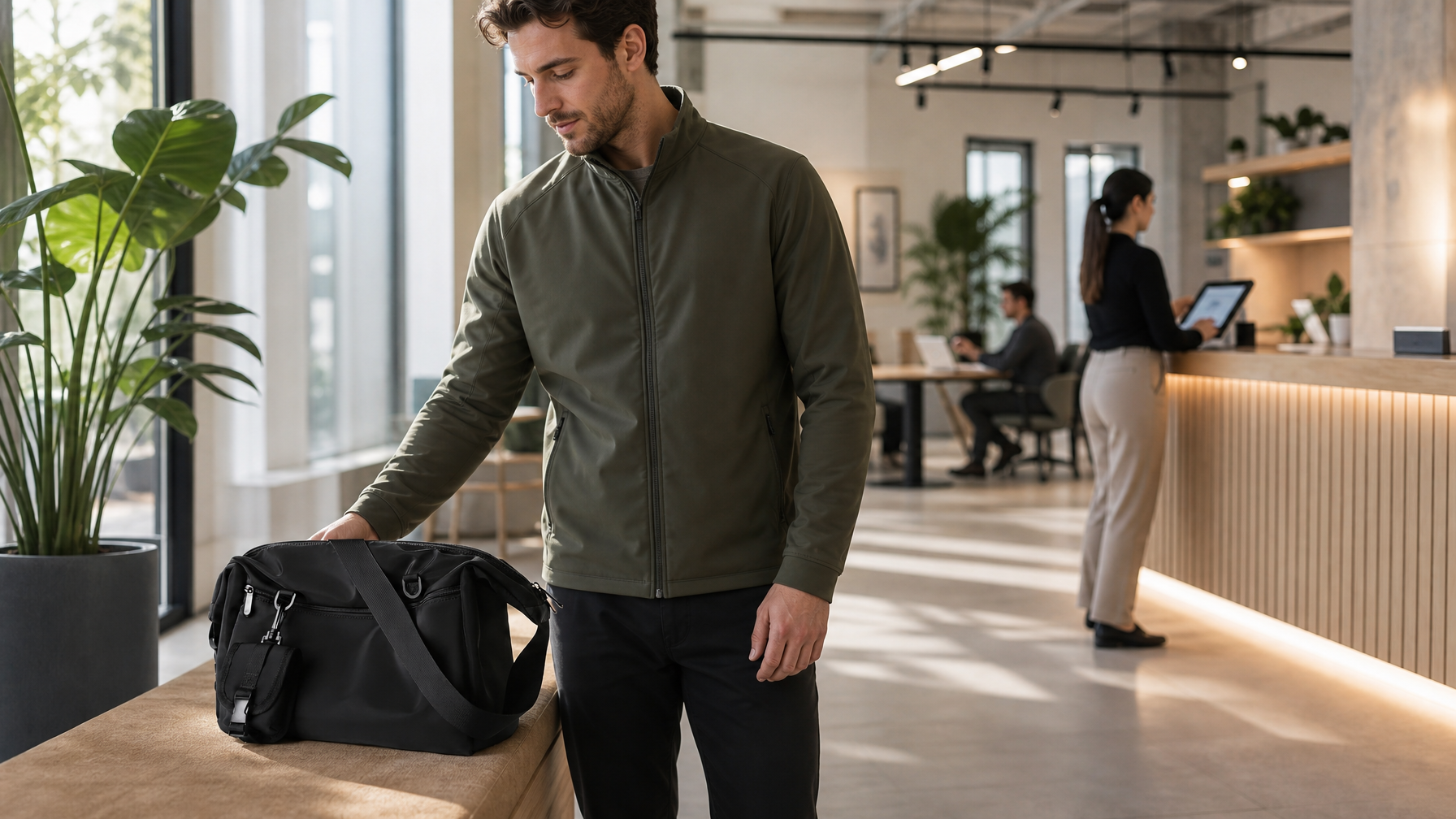
Build the coworking load, then stop
Pack for the day you booked, not for every future day you might have.
Always accessible without opening the main cavity
- Phone
- Wallet or slim cardholder
- Coworking member card or app on phone
- Keys (clipped or in a small dedicated pocket)
- Earbuds or compact headphones
Main compartment for the work block
- Laptop up to the size your bag actually accepts
- Charger and one short cable you use every day
- Notebook or tablet if you actually write on it
- Water bottle only if the bag has a stable place for it
- Light layer if the HVAC is unpredictable
Leave at home or in a locker
- Full gym load unless you planned a true gym-to-work day (see gym to office without switching bags)
- Extra chargers "just in case"
- Multiple notebooks you have not opened in a month
- Backup shoes that turn the bag into a suitcase
Organization beats capacity. Use the same zones every day so your hands know the map. The system in how to organize your bag and the weekly habit in the Sunday bag reset both apply cleanly to coworking memberships.
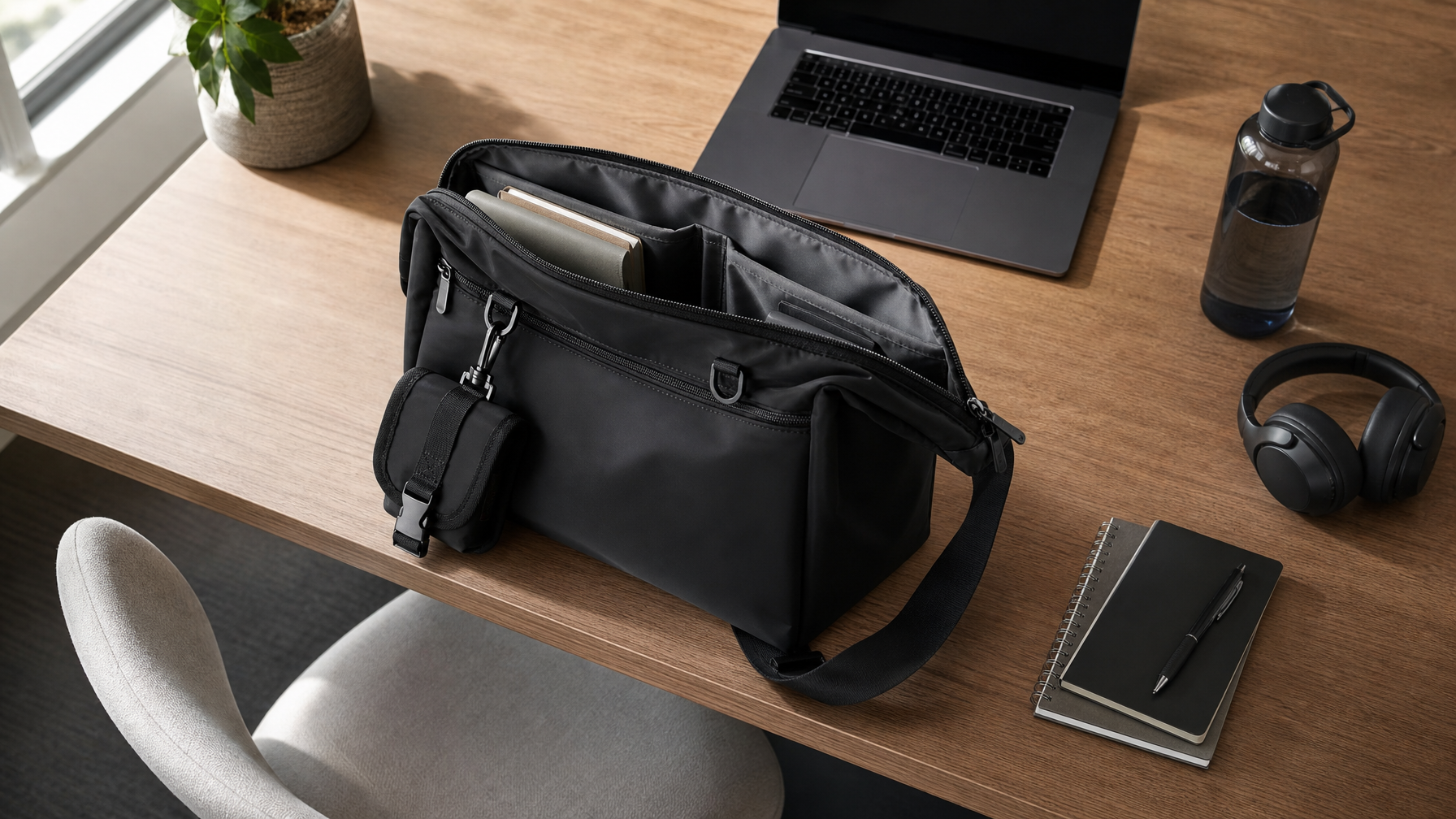
Format choice for rotating desks
Crossbody messenger hybrid
Best when you move between floors, take calls in booths, and want the bag on one side of your body without removing a pack every time you sit. You can swing it forward on your lap in a booth or keep it closed at your hip while you walk.
Watch for: shoulder fatigue if you overload the bag with gym gear and a large water bottle on top of a laptop. Fix the load before you abandon the format. If shoulder stress is already a pattern, read how heavy your everyday bag should be and adjust weight before you buy another silhouette.
Slim laptop brief
Best when client video, partner meetings, or a more polished floor culture is common. A structured brief looks intentional on a glass table and still carries a laptop with a tight kit.
Watch for: overpacking the main cavity until the brief loses its slim profile. A brief fails when it becomes a soft tote.
Compact backpack
Best when your walk to the space is long, your load is heavier, or you prefer two-strap weight distribution. Keep it fully closed in busy aisles. Do not leave it open on the floor behind a rolling chair.
Watch for: rear access that forces you to turn the whole pack toward the room every time you need a cable.
For broader format tradeoffs, see messenger bag vs backpack and sling bag vs crossbody.
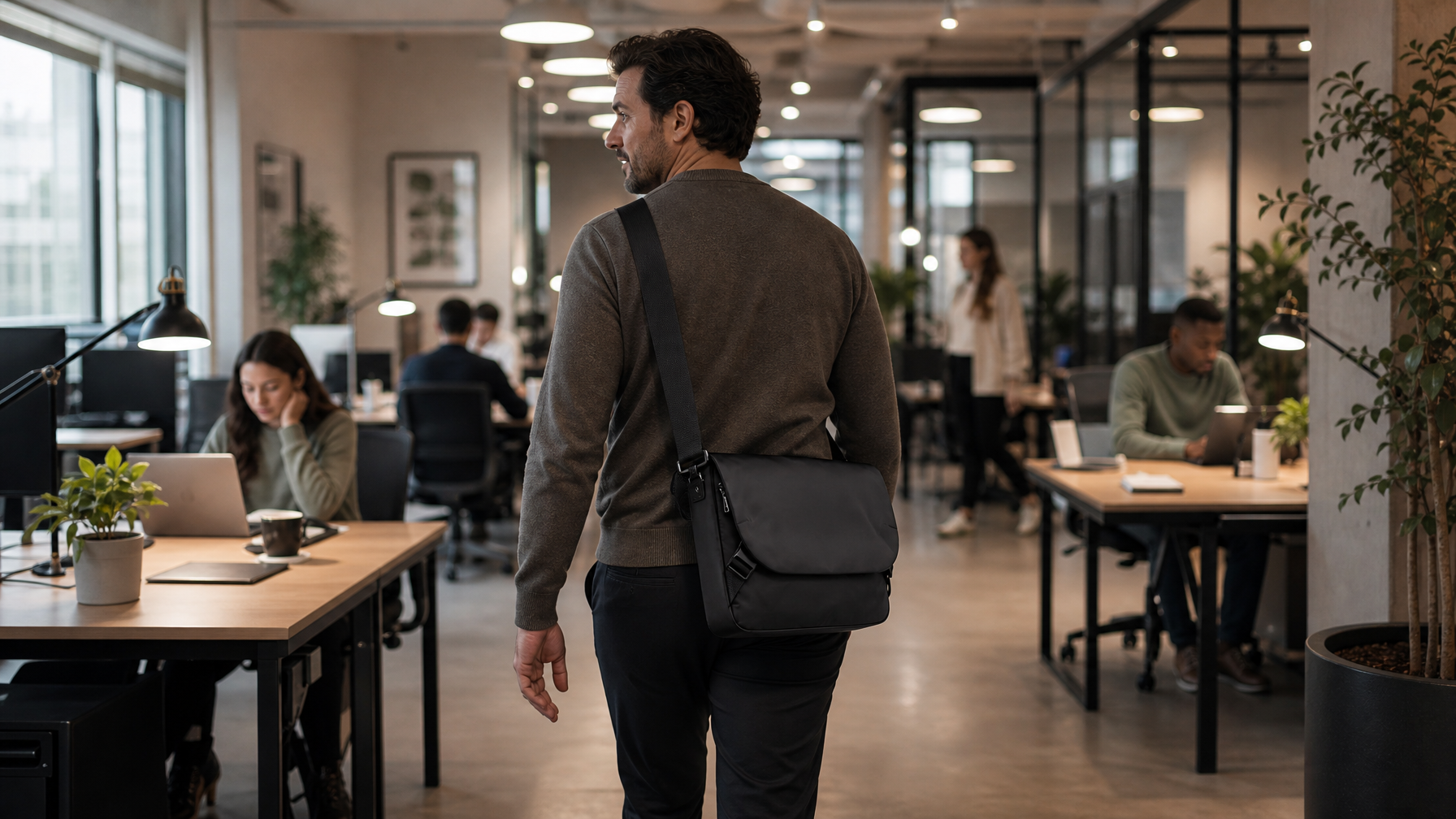
Field & Ash options that fit coworking days
Recommendations below match active catalog construction. Confirm current materials, device fit, and care language on each product page.
Haven Messenger ($89), Default rotating-desk carry
The Haven Messenger is a modern top-zip messenger hybrid built for everyday motion. The main compartment holds a laptop up to 14 inches directly (no dedicated padded sleeve). Two interior slip pockets, an interior zip pocket, and a mesh bottle pocket keep smaller essentials sorted. A detachable front pocket adds flexible storage for quick-access items. A separate back zip pocket sits against the body when the bag is worn crossbody. The shell is water-resistant 600D Oxford, not a sealed dry bag. Weight is about 1.21 lb.
Why it fits coworking: one bag that can sit closed beside a hot desk, open fully for a clean unpack, and move with you between floors without looking like airport luggage.
Metro Laptop Brief ($79–$99), Slimmer professional days
The Metro Laptop Brief is the office-forward option: flip-top structure, dedicated device sleeve for an 11-inch tablet or 14-inch laptop depending on size, and a compact footprint that reads polished on a shared table. Water-resistant Oxford shell with soft polyester lining. Strong pick when your coworking days include client video or partner sessions and you want a tighter silhouette than a full messenger hybrid.
Commuter Sling ($89), Light membership days
When the laptop stays home or already lives in a locker at the space, the Commuter Sling keeps phone, wallet, keys, and a thin tablet kit hands-free at 0.66 lb. Use it as a true light-day bag, not as a compressed backpack for a full workstation.
When the load is heavier
If you regularly carry a larger laptop, dual devices, or a full day of layers plus work kit, step up to the Apex Backpack ($139–$159) for capacity and two-strap comfort, or the Venture Backpack ($139) when you want organized daily backpack structure without expedition bulk. Match the bag to the heaviest day you actually live, not the heaviest day you imagine.
A simple coworking day sequence
- Night before: Charge laptop and top up the one cable you use. Stage phone, wallet, member access, and keys in outer access. Use night-before bag prep if mornings are already tight.
- Arrival: Find the desk, place the closed bag on the chair or under the table edge, then unpack only the work kit.
- Midday moves: Close the bag fully before every walk to coffee, booth, or exit. Do not leave cables draped across the chair.
- End of day: Reverse the unpack in the same order. Empty trash receipts. Reset zones so tomorrow is not a rebuild.
Common coworking bag mistakes
Buying for the tour, not the Tuesday. The space looks cinematic on Instagram. Your Tuesday is headphones, a charger, and three hours of deep work. Pack for Tuesday.
Leaving the bag open "just for a second." Seconds become minutes. Minutes become a missing cable or a worse day.
Treating a tote as a laptop system. Open-top totes dump under chair wheels and offer no structure when you stand up quickly for a room change.
Carrying a second bag for identity. One deliberate bag that matches your real load beats a "professional" bag plus a "real" bag you actually use. For multi-mode days, the framing in the capsule carry system keeps the kit honest.
How to choose in one minute
- Laptop most coworking days, moving between floors: start with the Haven Messenger.
- Client-facing or polish-first floor culture: start with the Metro Laptop Brief.
- Laptop already at the space or light admin days: start with the Commuter Sling.
- Heavy dual-device load or long walk in: start with Apex or Venture.
If you are still sizing the commute leg into the space, the complete commuter bag guide and what size bag you actually need will keep you from oversizing "just in case."
FAQ
Do I need a different bag for coworking than for a coffee shop?
Often the kit is similar, but coworking rewards a bag that closes fully and looks intentional on a shared floor for a full day. Coffee shops forgive a looser setup because you usually stay in one seat. Coworking multiplies short moves.
Should I use a locker for my laptop?
Use lockers for items you will not need for hours. If you need the laptop every work block, keep it in a closed bag at your desk or on your person when you move, rather than bouncing it in and out of a locker all day.
Is a backpack unprofessional in coworking?
No. A clean, fully closed backpack is normal in most spaces. What reads unprofessional is an open bag spilling cables into the aisle, or a pack so overloaded it blocks the chair behind you.
What about water bottles and lunch?
If lunch needs a hard container, consider a locker or a second short trip to the kitchen rather than forcing the work bag past its stable shape. A soft bag that cannot stand when full becomes everyone else's obstacle.
Carry deliberately: pick the bag for the day you booked, unpack the same way every time, and close it fully whenever you leave the desk. That is the coworking system. The bag is only the container.