


Messenger Bag vs. Backpack: Which Is Actually Better for Your Commute?

You've started timing how long it takes to dig out your transit card on the platform. Or your shoulder has been tight since the week you changed jobs and started carrying more. Or you just stood on a crowded subway car for twenty minutes with a backpack pressed into the person behind you, and something clicked. Whatever the moment was, it brought you here: which bag is actually right for your commute?
The messenger bag versus backpack debate has a longer history than it deserves and a shorter answer than most guides suggest. Neither bag is universally better. But for a given commute type, one is almost always clearly the better fit — and once you understand what your daily routine actually demands, the choice becomes straightforward.
The Question Nobody Answers Directly
Most messenger-vs-backpack content gives you a chart and a verdict that lands somewhere between "both are fine" and "it depends on you." That's technically accurate. It's also useless when you're trying to make a decision.
The answer does depend — but on four specific, knowable things about your commute: how you travel to work, how much you carry, how often you access your bag while moving, and what your working environment looks like once you get there. Work through those four questions against your actual daily routine and the right bag type becomes clear without reading a single review.
When a Backpack Is the Right Call
A backpack distributes weight across both shoulders, keeps your center of gravity close to your spine, and lets both arms swing freely. For certain commute types, those mechanical advantages matter more than anything else a bag can offer.
You walk a meaningful distance each way. Once your daily commute includes a mile or more on foot in each direction, weight distribution becomes a real physical variable — not a preference, but an ergonomic reality. A crossbody or shoulder bag shifts your torso over distance and creates asymmetric muscular loading. A properly fitted backpack keeps the load balanced and your posture neutral. For any pedestrian commute with serious distance baked in, this is the most decisive factor in the bag decision.
Your daily carry is consistently heavy. There is a meaningful weight threshold around 10 lbs. Below it, bag type matters less — the load is manageable either way. Above it, the difference becomes noticeable quickly, especially across a full week of daily commuting. If your regular load includes a full-size laptop, charger, lunch, a water bottle, and any kind of additional layer or kit, you are likely at or above that threshold. A two-shoulder carry handles that load more sustainably over time.
You cycle to work. On a bike, a messenger bag shifts constantly — forward as you brake, sideways as you corner, backward as you accelerate. Experienced couriers manage this through technique developed over years. For most cycling commuters, a backpack that stays close to your back and doesn't move independently is the more practical option. The ride is more balanced and your center of gravity is predictable.
You regularly combine gym and work in a single bag. A gym-to-office commute is one of the clearest use cases for a high-capacity backpack. You need room for workout clothes, toiletries, your work laptop, and the usual daily carry — and you need it organized enough that you can transition between contexts without unpacking everything. A 26-liter backpack like the Venture Backpack handles this without becoming unwieldy: organized enough for work, large enough for the gym addition, and built around a commuter's daily pattern rather than a hiker's. For particularly heavy loads — larger laptops, two separate devices, or a genuinely full daily kit — the Apex Backpack adds the capacity and structured compartmentalization that heavier daily carry actually requires, with S-curve shoulder straps and a padded air-cushion belt that distribute the load across the body properly.
The backpack earns its place when weight is real, distance is significant, or the mode of travel makes single-shoulder carry mechanically awkward. For commuters whose transit mostly consists of standing on a platform or sitting in a car, those conditions do not apply with the same force — and a different set of priorities takes over.

When a Messenger Bag Makes More Sense
For a different set of commutes, the messenger bag does not just hold its own — it wins on the criteria that actually matter every day.
Your commute runs on transit. Subway, bus, commuter rail — a transit commute puts you in tight spaces where the physical footprint of your bag matters as much as what's inside it. A crossbody messenger bag sits at your hip, does not extend behind you, and moves naturally through turnstiles and crowded platform entrances. On a packed subway car, a backpack on your back makes you effectively wider and forces the person behind you to manage it. A messenger bag does not. This is not an aesthetic point — it is a spatial one, and it plays out multiple times per commute, every day.
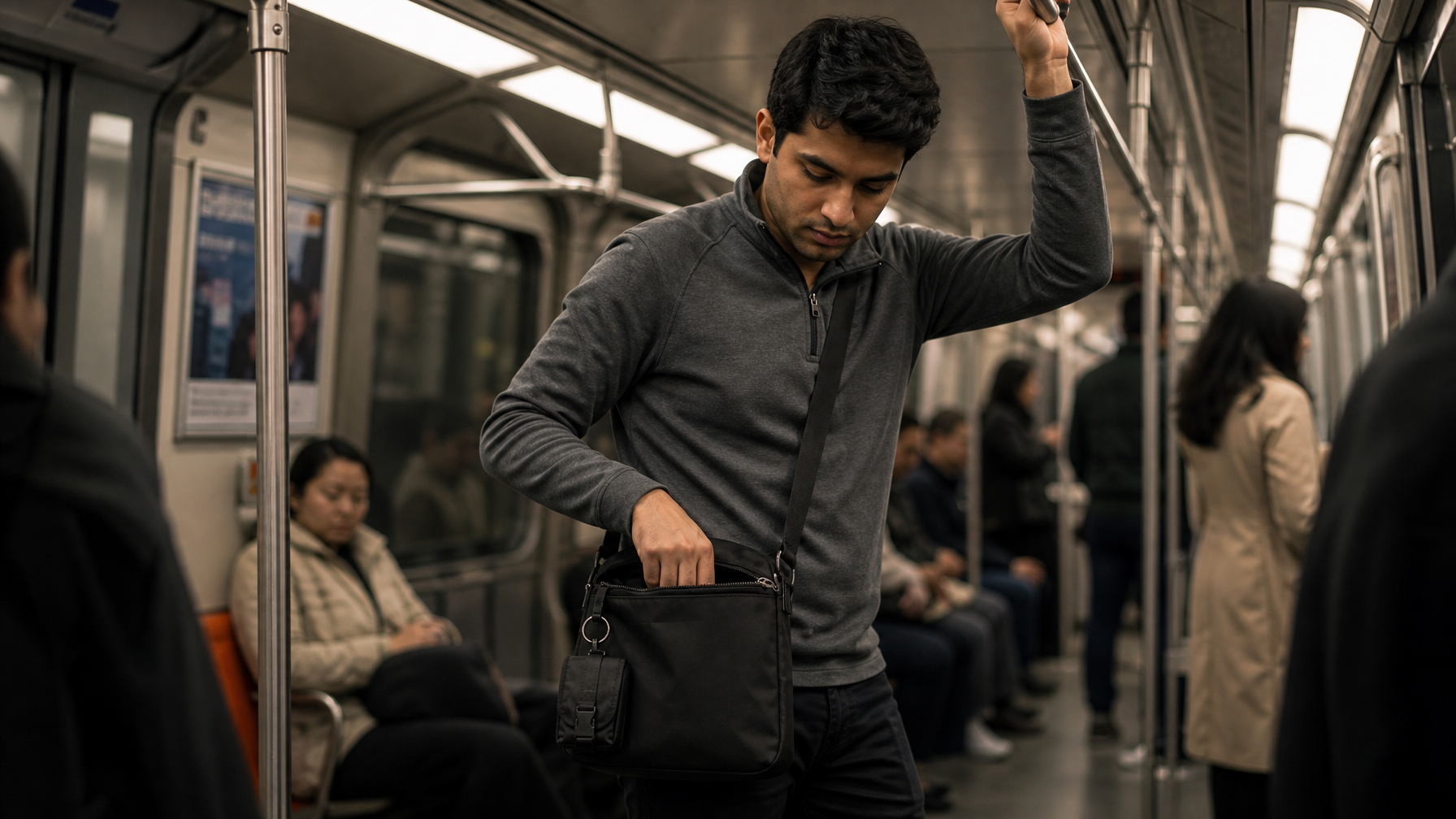
You access your bag while moving. On transit, you reach for things constantly: transit card at the gate, headphones on the platform, phone mid-ride, a snack or jacket layer at some point in between. Getting into a backpack on a moving subway car means either setting it on the floor or performing the over-the-shoulder unzip maneuver while holding a rail with your other hand. A top-zip messenger bag opens with one hand, bag at your hip, contents accessible, without removing it or losing your balance. Over the course of a week of commuting, this operational difference compounds into something you feel.
You work in a professional or client-facing setting. A well-structured messenger bag arrives at a meeting table without drawing attention. It sits closed beside the laptop, functions as a brief in professional environments, and integrates into office contexts without the visual footprint of a backpack parked against the wall. This is not about formal versus casual — it is about which bag disappears more naturally into the environments you spend your working day in. For a closer look at which messenger bags perform best in office settings, the guide to the best messenger bags for work covers the specific features that matter in professional and commuter contexts.
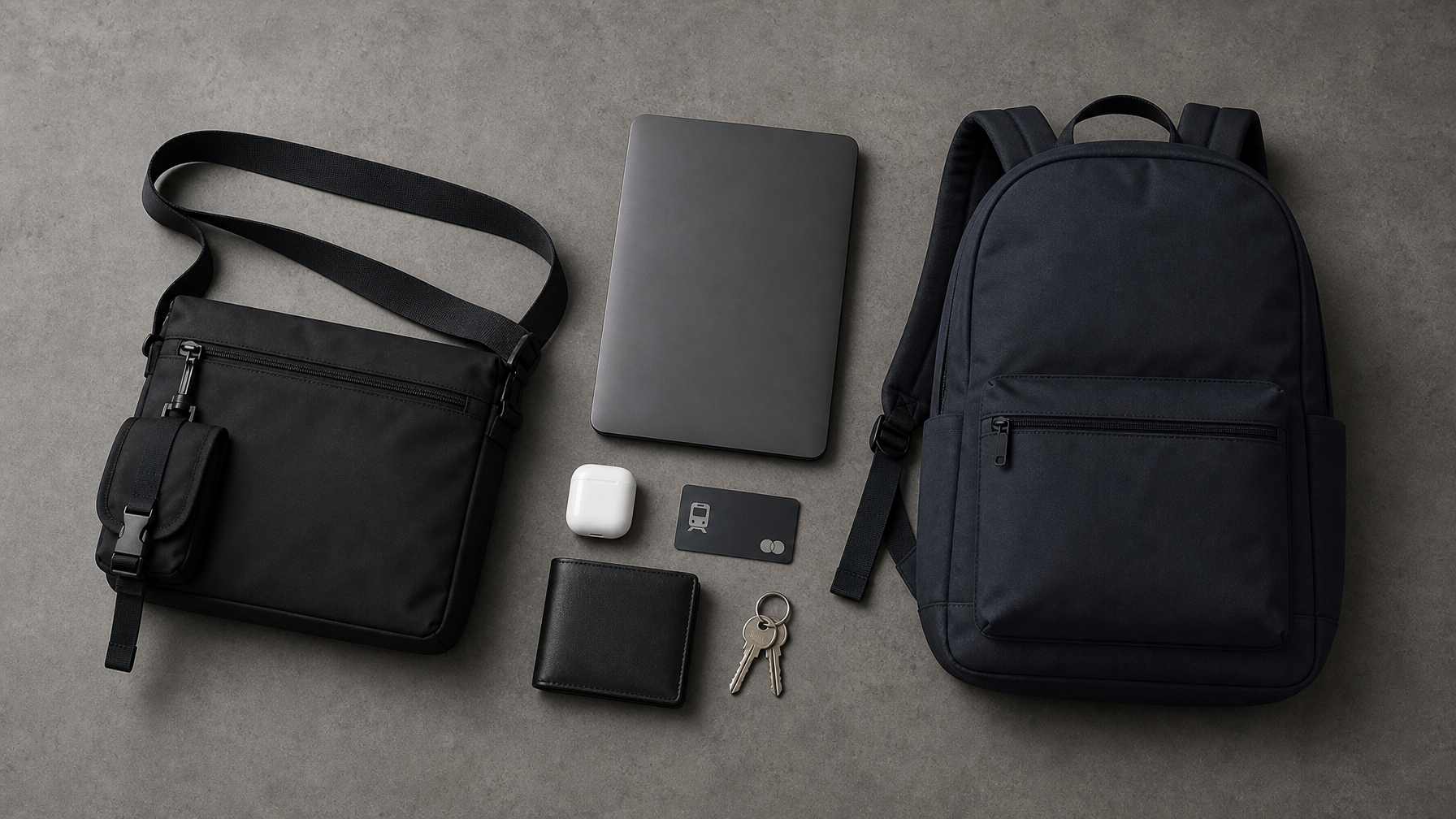
Your daily carry is a laptop and essentials, not a full kit. If your commute load is a 14" laptop, charger, notebook, earbuds, and the usual daily pocket items, a messenger bag handles it with room to spare and none of the unnecessary volume that comes with a backpack. The Haven Messenger fits this carry pattern cleanly: a padded 14" laptop sleeve, a front fast-access pocket for the things you reach for constantly, and an anti-theft back pocket that sits against your body on transit. At 1.21 lbs, the bag adds almost no overhead to the load itself. A well-chosen messenger bag for this carry situation weighs less, takes up less visual space, and gets out of your way faster than a backpack carrying the same items in more room than they need.
The Ergonomics Question
The most common concern about messenger bags is back and shoulder strain from single-strap carry. It is a fair question, and the honest answer is that the concern is real but frequently applied to the wrong commuter profile.
Single-shoulder carry does create asymmetric loading. Carrying significant weight on one side over time can create muscular imbalances and contribute to neck and shoulder tightness. This is a genuine ergonomic issue — for a commuter carrying a heavy bag over a long distance, which is a backpack use case regardless of the ergonomics question.
The relevant variable is not bag type. It is weight over distance. A crossbody messenger bag with a light-to-moderate load — under 8 to 10 lbs — on a short transit commute creates no meaningful ergonomic strain for most people. You are commuting twenty minutes on a subway, not hiking. The asymmetric load is real but brief, and a wide crossbody strap distributes it across the torso rather than concentrating it on one shoulder.
One practical note worth knowing: crossbody carry, where the strap crosses the chest diagonally and the bag rests at the hip, distributes the load across the torso significantly better than single-shoulder carry, where the strap hangs from one shoulder with the bag swinging at your side. Most messenger bag discomfort comes from the latter. The fix is not always a different bag — it is often adjusting the strap so it crosses the chest rather than hangs. If you carry a crossbody messenger bag and experience shoulder tightness, check the carry position first. For a detailed look at managing the daily laptop commute, the guide to commuting with a laptop every day walks through the setup decisions that reduce carry friction over a full week.

Making the Call
If your commute is consistent and recognizable from the descriptions above, the answer is probably already clear. For genuinely mixed commutes — some transit, some driving, the occasional walking day — run through these five questions and let the answers point you:
- Do you walk more than a mile each way? If yes, lean toward a backpack. Weight distribution across distance is the backpack's clearest functional advantage, and it compounds over a five-day week.
- Do you consistently carry more than 10 lbs? If yes, lean toward a backpack. Two-shoulder carry makes a real ergonomic difference at that load level, especially for longer carries.
- Do you cycle to work? Use a backpack. A shifting messenger bag on a moving bike is an unnecessary variable in a commute that already has enough variables.
- Is transit your primary commute mode? If yes, lean toward a messenger bag. The combination of access speed, spatial footprint in tight spaces, and natural fit for urban transit movement tilts clearly in the messenger's direction.
- Do you access your bag multiple times per commute while moving? If yes, lean toward a messenger bag. The operational convenience difference is genuine and daily — it is not a marginal preference.
Most commutes map clearly to one column or the other. The edge cases are genuinely mixed commutes where the same bag travels by transit some days and by foot or car on others. In those situations, the transit days tend to be the deciding factor. A backpack works fine in a car and at a desk. A messenger bag serves transit commuters in ways a backpack simply cannot replicate. The Complete Commuter Bag Guide goes deeper on commute-type matching if your daily routine involves more than one regular mode of travel.
The Bottom Line
Messenger bags are built for transit commuters with light-to-moderate loads who need access while moving and work in environments where a structured bag integrates naturally. Backpacks are built for pedestrian or cycling commuters with heavier loads who need even weight distribution over distance and capacity for a full daily kit.
The commuter who is best served by a messenger bag is often the one who has been carrying a backpack out of habit — because it is what everyone carries, because it is what they have always had. And the commuter drawn to a messenger bag because it looks better at the desk might genuinely need a backpack once they account for what their mornings actually look like.
Figure out the commute first. The bag follows naturally from there.
Frequently Asked Questions
Is a messenger bag or backpack better for your back?
It depends on how much you carry and how far you walk. A backpack distributes load across both shoulders, which matters for heavy loads over long distances. A crossbody messenger bag with a light-to-moderate load — under 8 to 10 lbs — on a short transit commute creates no meaningful ergonomic difference for most people. The key variable is weight over distance, not bag type in isolation.
Can a messenger bag hold a laptop?
Yes. Most commuter messenger bags designed for daily use include a padded laptop sleeve sized to 13", 14", or 15" screens. Look for a dedicated padded sleeve rather than a general main compartment — it keeps the laptop stable during transit and protects it from impact. A messenger bag without a dedicated laptop sleeve is not a commuter laptop bag, regardless of how it is marketed.
Are messenger bags professional enough for the office?
In most modern professional environments, yes. A structured messenger bag sits on a meeting room table, integrates into client settings, and reads as deliberate carry rather than casual habit. Highly formal or traditional corporate environments may call for a slim briefcase instead — in those cases, a structured messenger bag is still a better fit than a backpack, even if neither is the default carry in that context.
Which is better for a subway or bus commute?
A messenger bag. Transit commutes involve crowds, turnstiles, packed cars, and frequent access to bag contents while standing. A crossbody messenger bag at your hip moves naturally through all of these. A backpack on your back makes you physically wider in tight spaces and requires removing the bag or performing the standing-unzip when you need to access it mid-ride. For subway and urban transit commuters, the messenger bag's operating advantages are genuine and daily.