


The Complete Commuter Bag Guide

The wrong commuter bag makes every day harder than it needs to be. The right one disappears into your routine. The difference comes down to five things: laptop protection, weatherproofing, access speed, the right capacity, and a carrying style that fits your commute. This guide covers all of it.
You picked up a bag two years ago because it was the right size. At the time it seemed fine. Now it's overpacked, the laptop sleeve isn't a real sleeve, and finding anything in the bottom takes the better part of a minute on a moving train.
The wrong commuter bag isn't just inconvenient. It adds friction to a part of your day that already has enough of it. A jammed zipper when you're running late. A damp laptop because the bag "water-resistant" rating turned out to mean nothing in real rain. An aching shoulder by Wednesday.
None of that is inevitable. The right bag makes the commute cleaner, faster, and less annoying — and once you've chosen it well, you stop thinking about it entirely. That's the actual goal.
What Makes a Commuter Bag Different from Any Other Bag
A weekend bag, a gym bag, a travel backpack — all of these solve different problems. A commuter bag's job is narrower and more specific: it has to perform reliably, five days a week, through weather, transit systems, and variable daily loads, while looking like it belongs in a professional context.
That means the selection criteria are different from general bags. The things that matter most for commuting are:
- Weather protection — your bag will get rained on
- Laptop safety — daily bumps and transit vibration add up
- Access speed — you shouldn't have to stop and reorganize to find your phone
- Body-friendliness — carrying weight in the wrong position causes real fatigue
- Security — transit environments are where theft happens
Most bags solve one or two of these adequately. A good commuter bag addresses all of them without compromise.
The Main Commuter Bag Types
Before getting into features, it's worth understanding which bag categories actually suit commuting — and which ones are marketed toward it without really being built for it.
Crossbody Commuter Bags and Modern Messenger Hybrids
The strongest category for most urban commuters. Crossbody bags sit against the side or front of the body on a single diagonal strap, which distributes weight differently from a backpack and keeps the bag accessible without removing it. Modern versions designed for commuting combine the carrying style of a sling with the laptop protection and organizational depth of a messenger bag.
The key advantage is access speed: top-zip crossbodies open in a single motion without swinging the bag around or setting it down. For transit commuters who need to reach their wallet, phone, or earbuds in motion, this matters.
The category also tends to offer the best size-to-utility ratio for a daily kit — a laptop, a charger, earbuds, a notebook, and a water bottle without excess volume that invites accumulation.
For a full comparison of the leading work messenger options in this category, the best messenger bags for work in 2026 covers each pick by use case. For a complete buying guide on what makes a crossbody bag work for a professional commute, crossbody bags for work covers the six criteria in detail.
Commuter Backpacks
The most common choice, and for some commutes the right one. Backpacks distribute weight well across both shoulders, which makes them comfortable for longer distances on foot. They handle high-capacity loads — 20–30 liters — better than crossbody bags.
The tradeoffs are significant for transit commuters: backpacks have to come off the back to be accessed, which means finding a corner of a crowded platform or setting the bag down. They also take up more space on busy trains. If your commute is primarily by car or bike, these tradeoffs matter less.
Sling Bags
A sling is a single-strap bag worn diagonally, typically smaller and more compact than a commuter crossbody. They work well for light-load days — phone, wallet, keys, a notebook, maybe a tablet — but most genuine slings max out at around a 10" tablet and won't comfortably fit a 14" laptop.
If your commute requires a laptop most days, a sling is either too small or too compromised. If you frequently commute without a laptop, a sling is the cleanest option.
Totes
Totes make sense for specific professional contexts — an office environment where the bag stays on a desk or under a chair — but totes work better for lighter casual carry than daily commuting, and generally lack the weatherproofing, security, and organization that daily commuting consistently requires.

What to Actually Look For in a Commuter Bag
Laptop Protection That Actually Holds
There's a meaningful difference between a padded laptop divider and a dedicated laptop sleeve. A divider is a padded strip of fabric inside a compartment that's shared with everything else. A dedicated sleeve is a fully enclosed, separate pocket built specifically for the laptop, with padding on all sides.
The distinction matters because commuters don't always pack carefully. A dedicated sleeve means your laptop is protected regardless of what else is in the bag. Look for a sleeve that's snug enough to hold the laptop without sliding but wide enough to fit with a slim case on.
For most modern laptops — a 13" or 14" MacBook, a ThinkPad, a Dell XPS — a 14" sleeve is the right size. If you carry a larger work laptop, confirm the sleeve dimensions before buying.
Real Weatherproofing, Not Just Water Resistance
"Water resistant" is one of the most overused and least regulated phrases in bag marketing. Some bags described as water resistant will keep a laptop dry in light drizzle. Others won't. The difference is in the material and construction, not the label.
600D Oxford is a reliable standard. It's a high-density woven fabric with a water-resistant finish that handles daily rain exposure and splash without saturating. YKK zippers with rain-resistant seams extend that protection to the closure points.
What "waterproof" doesn't mean in the context of a daily bag: fully submersible or protected in sustained downpour. For commuting purposes, you're protecting against rain, wet park benches, and wet transit surfaces — not a river crossing. A well-constructed Oxford bag handles all of the former without issue.
One-Motion Access
The fastest bag to use is one that opens in a single, practised gesture. For crossbody bags, that's a top-zip that unzips in one pull. For backpacks, it's a quick-release buckle on the front panel or a laptop-accessible back pocket.
Consider how you'll realistically use the bag in motion. On a packed train, you may not have room to swing a backpack around to the front. At a turnstile, a bag that requires two-handed access slows everything down. A top-zip crossbody at hip level gives you access with one hand without the bag moving.
Carrying Comfort
Crossbody bags work best with a wide, padded, or webbing-reinforced strap that distributes weight across the shoulder and chest without digging in. A 1.5–2" seatbelt-style strap is the practical benchmark — wide enough to avoid pressure points, stable enough to keep the bag from swaying.
Backpacks need contoured shoulder straps and a torso length that's appropriate to your body. A bag with straps adjusted correctly should feel stable without shoulder fatigue within an hour of walking.
An anti-microbial or moisture-wicking back panel matters more for cyclists and long walkers than for transit commuters. If your commute is transit-heavy, prioritize strap quality over back ventilation.
Organization That Doesn't Require Thinking
Good bag organization is largely invisible — you reach for something and it's there. Poor organization requires a mental inventory before every interaction.
The practical standard: one dedicated laptop sleeve, one external pocket for phone and earbuds, one internal pocket for cables and charger, and one larger compartment for everything else. Anything more than this starts to create a categorization problem (which pocket did I put the charger in?). Anything less starts to create a chaos problem.
Anti-theft features — a back security pocket, a discreet internal zip, lockable zippers — are worth having for transit commuters. The back security pocket is the most practical: it sits against your body when the bag is worn, making it inaccessible to anyone behind you.
Matching the Bag to Your Commute Type
The right bag for a daily subway commuter is different from the right bag for someone who bikes to work. Most guides skip this. They shouldn't.
Transit Commuters (Subway, Bus, Train)
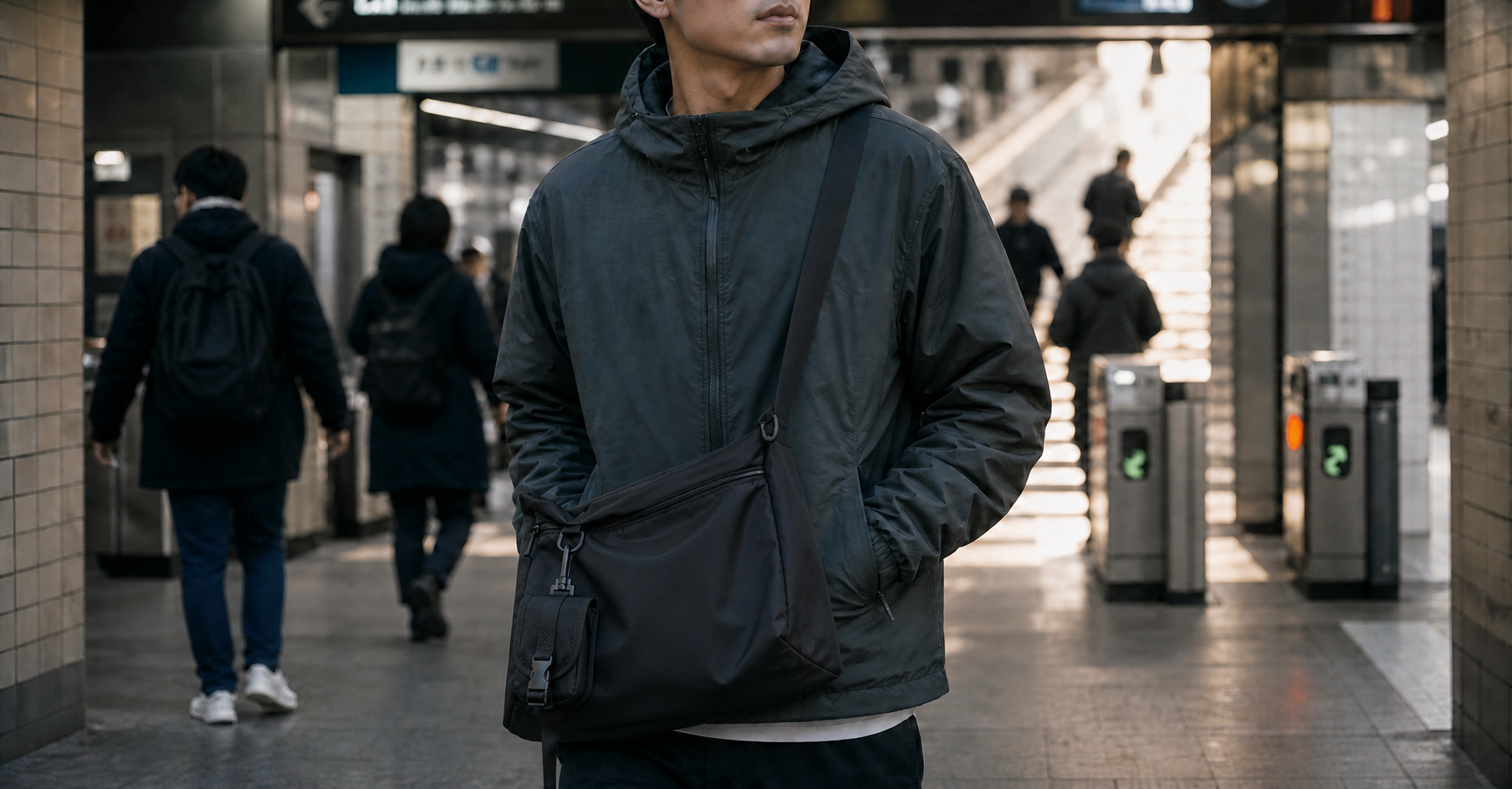
Priority one is access speed — you'll be reaching into the bag in motion, in tight spaces, in a hurry. Priority two is anti-theft design. Transit environments are where opportunistic theft is most common, and a bag that sits flat against your body with a back security pocket removes most of the risk.
Volume isn't the priority here. Most transit commuters carry a laptop, earbuds, a charger, and a notebook — a 10–15 liter bag is usually sufficient and won't take up space others need on a crowded train.
Walking Commuters
For commuters covering significant distance on foot, weight and carrying comfort become the primary considerations. A lighter bag carried closer to the body — a crossbody or a well-fitting backpack — is less fatiguing over thirty minutes of walking than a heavier bag worn poorly.
Weatherproofing matters more for walkers than for transit users, who get rained on only between stops. If your walk is long enough that getting caught in rain is a real possibility, make sure the bag's weather protection is genuine.
Cycling Commuters
Cycling demands specific bag behaviour: the bag needs to stay stable on the back or body without swaying, and it needs to keep contents dry in sustained rain. Backpacks work well for cycling because the two-strap design keeps the load from shifting. A crossbody bag works with a chest clip or a cinch strap to prevent movement.
High-visibility features — a reflective strip, a light attachment point — are worth considering for early-morning or evening cycling routes.
Driving Commuters
The bag goes in the car and comes out at the destination. Weather protection is still relevant (from car to building), but transit-specific features like anti-theft design and one-motion access matter less. This is the use case where a larger backpack or laptop brief makes the most sense — you're not carrying it far, so comfort-in-motion is less critical than organization.
How to Think About Size and Capacity
The most common mistake in commuter bag buying is choosing too large a bag. Volume is useful marketing copy — a 25-liter bag sounds more capable than a 12-liter bag. But for a daily commute, extra capacity doesn't mean extra utility. It means extra weight and extra temptation to fill the bag with things that don't belong in it.
A practical size framework:
Under 10 liters: Light days only. Phone, wallet, keys, a notebook. Works for commutes where the laptop stays at the office. Not a laptop bag.
10–15 liters: The right range for most commuters carrying a 14" laptop, a charger, earbuds, and a notebook. Enough capacity for daily essentials, compact enough to avoid bulk. This is the commuter bag sweet spot.
15–25 liters: Useful if your commute doubles as a gym visit, you regularly carry a change of clothes, or you frequently travel with the bag. The tradeoff is weight and profile — a full 20-liter bag on a crowded train is harder to manage than a 12-liter one.
Over 25 liters: This is a travel bag or a hiking bag. A 30-liter bag that's described as a "commuter backpack" can hold a commuter load, but most of its capacity goes unused five days a week. Unless you have a specific daily reason for the volume, it's the wrong size.
The Haven Messenger: Built for the Urban Commute
Most of what's covered in this guide reflects the design decisions behind the Haven Messenger — a 600D Oxford commuter crossbody built specifically for laptop-centric daily carry.
The structural brief was precise: a padded 14" laptop sleeve isolated from the rest of the bag, a dedicated front organizer pocket for daily-use items, a discreet anti-theft back security pocket, and a top-zip closure that opens in one motion. The wide seatbelt-style webbing strap holds the bag flat against the body on a crowded train without digging in over a long walk.
At $89, it's designed to be the last commuter bag you think about. Waterproof Oxford shell, all-matte-black hardware, and a detachable front accessory pouch for the days when you need to break the kit down further.
For an in-depth look at how to pack the Haven for different commute scenarios, the coffee shop carry guide covers the work-from-anywhere configuration. For a broader framework on what to carry day to day, the everyday carry guide is worth reading alongside this one. For a side-by-side comparison of the best commuter bags of 2026, matched by commute type, that guide covers every option. And for the professional carry system that pairs with this bag, the office EDC guide covers every layer.

The right bag disappears into the commute. You stop thinking about it and start thinking about where you're going.

Frequently Asked Questions
What should I look for in a commuter bag?
Start with these five things: a dedicated laptop sleeve (not a shared padded compartment), genuine weatherproofing (600D Oxford or better), a closure that opens in one motion, a carrying style that fits your commute type, and the right size (10–15 liters for most daily loads). Everything else is secondary. For a side-by-side comparison of the leading laptop commuter bags, the best laptop bags for commuting covers each option in detail.
What size commuter bag do I need?
For most commuters carrying a laptop, charger, earbuds, and a notebook, 10–15 liters is the right range. It's enough capacity for a full daily kit without excess volume that adds weight and invites overpacking. If you regularly carry gym gear, a change of clothes, or travel with the bag, 15–20 liters gives you room without going oversized.
Is a crossbody bag or a backpack better for commuting?
It depends on your commute. For transit-heavy commutes — subway, bus, train — a crossbody commuter bag offers better access speed and easier use in crowded spaces. For commutes that involve significant time on foot or a bicycle, a well-fitting backpack distributes weight better over distance. For driving commutes, the difference is minimal.
What does "waterproof" actually mean for a commuter bag?
For most commuter bags, "waterproof" or "water-resistant" means the fabric and zippers handle rain and surface water without saturating. 600D Oxford is a reliable standard — it repels daily rain without being a fully sealed dry bag. The practical question is whether the bag keeps your laptop dry on a rainy commute. A well-constructed Oxford bag does.
Is a commuter bag the same as a laptop bag?
Not exactly. A laptop bag is designed specifically to carry a laptop — it may be a sleeve, a brief, or a tote. A commuter bag is designed to carry a full daily kit including a laptop, with features optimized for commuting: weatherproofing, anti-theft design, organized pockets, and a carrying style suited to transit or urban environments.
What's the best commuter bag for the subway?
For subway commuters, the priority is access speed and anti-theft design. A crossbody or modern messenger-style bag with a top-zip closure and a back security pocket handles both. It opens in one motion without removing the bag, and the back pocket sits against your body on the train. The Haven Messenger was built around exactly this use case.
The Field & Ash Journal covers carry, craft, and the things worth keeping. For the full daily carry framework, start with What Is Everyday Carry? and The Working Minimalist Guide.