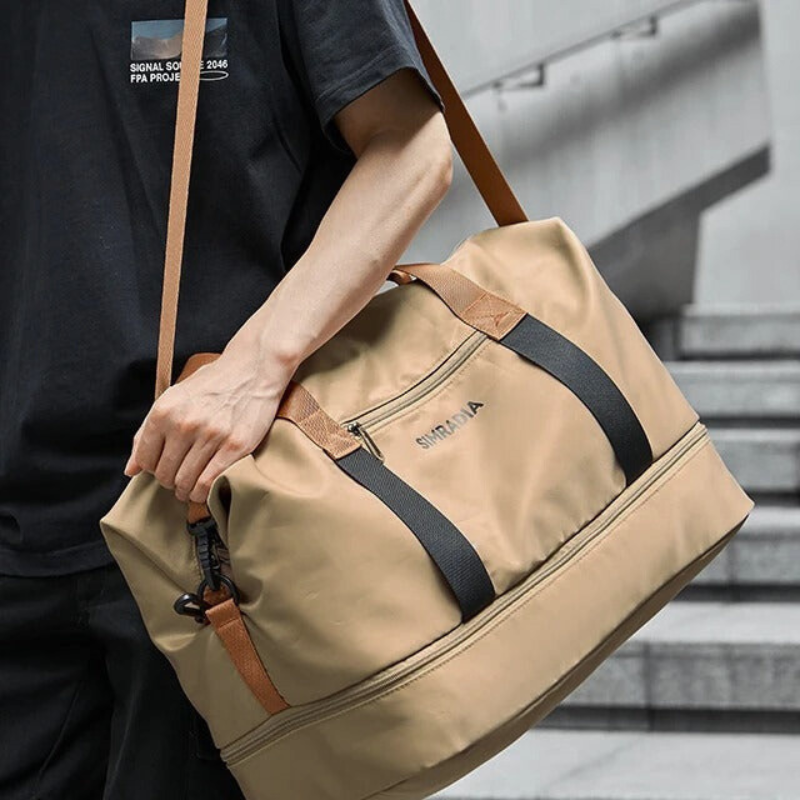



The Best Laptop Bags for Commuting

Most laptop bag guides are organised by brand or price. This one is organised by commute type, because the best laptop bag for a subway commuter and the best laptop bag for a cyclist are different bags for structural reasons — not preference reasons.
Before looking at options, the commute type is the first question to answer.
What Your Commute Type Actually Determines
Your commute type determines three things about the bag you need:
Weight distribution. A walking commuter carrying a bag for 20 minutes needs either bilateral weight distribution (backpack) or a well-designed diagonal crossbody. A transit commuter standing on a subway car needs a bag that stays in one position and does not shift or swing. A cyclist needs a bag secured tightly to the back with no lateral movement.
Access speed. A transit commuter needs fast access to a phone and transit card multiple times per commute. A driving commuter does not.
Weather exposure. A cycling commuter in rain needs a fully waterproof bag. A transit commuter who walks 90 seconds from a parking garage to an office elevator has different requirements.
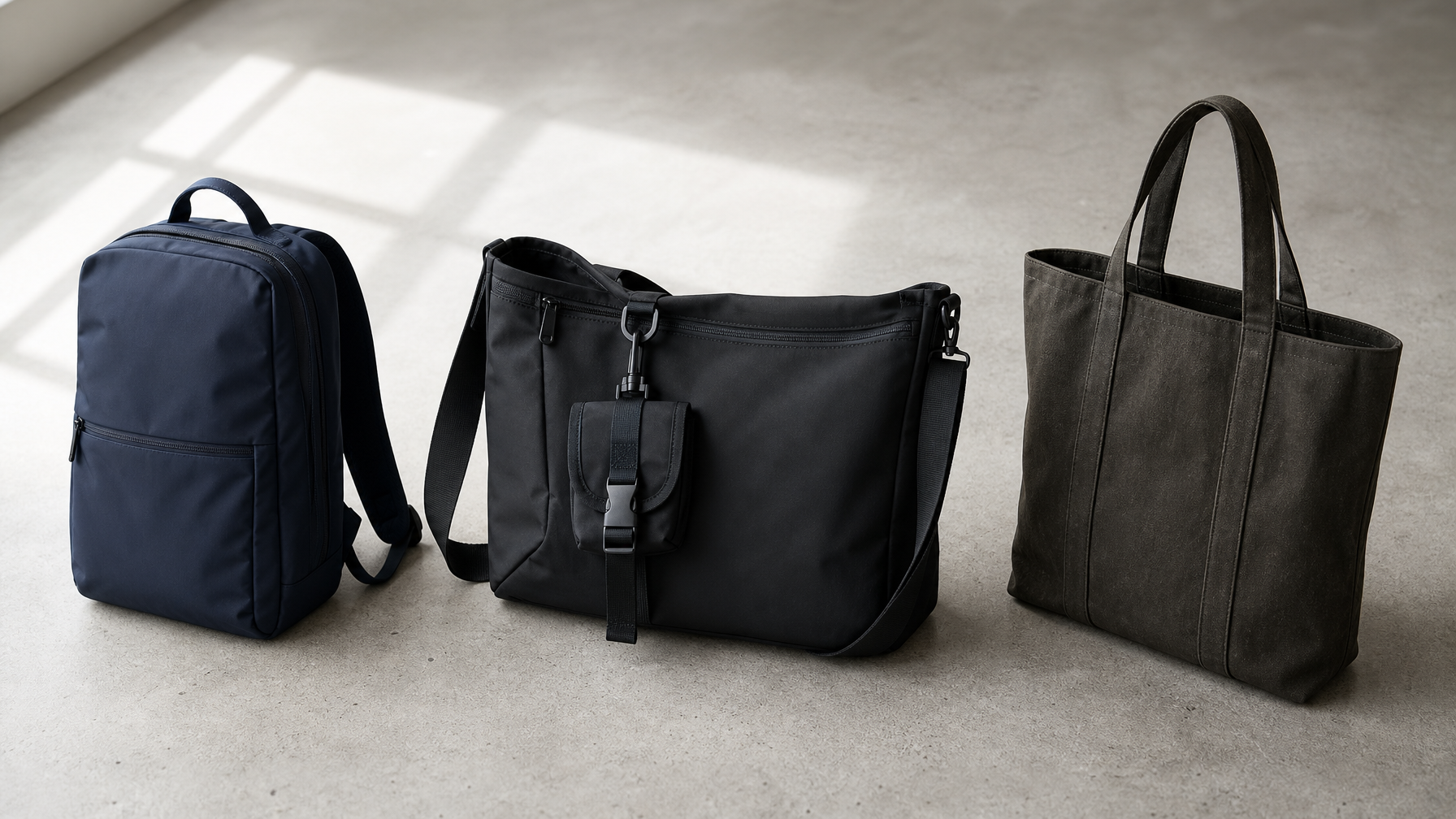
Get the commute type right and the bag selection becomes considerably more straightforward. For a full selection framework across every variable, the complete commuter bag guide covers the decision in detail.
The Best Laptop Bag for Transit Commuters
Commute type: Subway, bus, light rail — any commute involving crowds, turnstiles, and items accessed on the move.
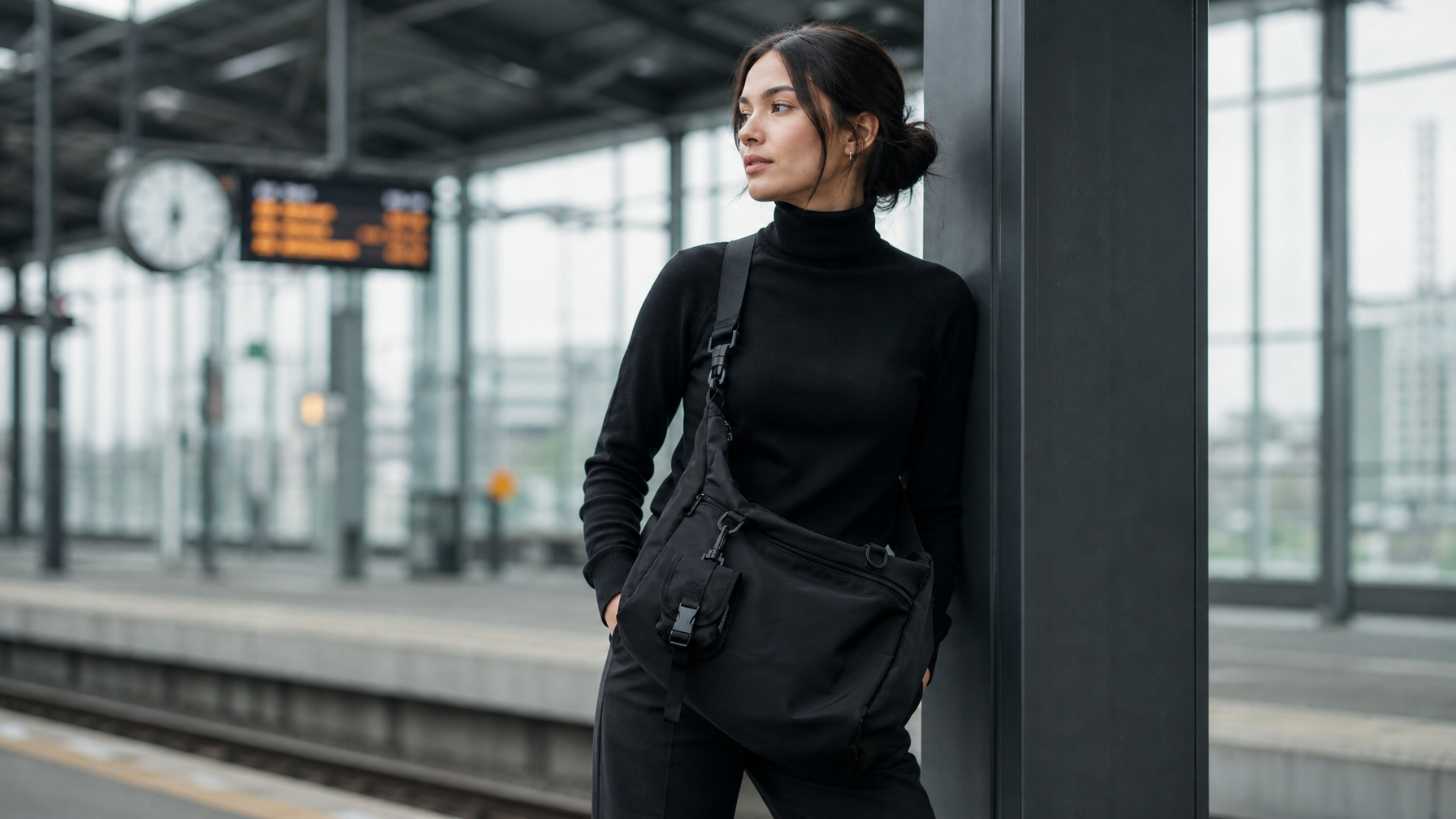
What you need: Hands-free carry, fast exterior pocket access, a bag that sits against the body and does not swing, a waterproof shell for the walk between transit and destination.
Why backpacks underperform here: A backpack worn on a crowded subway removes two passengers' worth of space behind you, cannot be accessed without removing it, and the outer pockets are accessible from behind. A crossbody sits flat against the body and keeps both hands free without any of those problems.
Why traditional messengers underperform here: A single-strap messenger without a chest stabiliser swings during movement, shifts when sitting, and a flap closure slows access compared to a top-zip or front-zip configuration.
The pick: A modern crossbody messenger hybrid. Top-zip closure, wide webbing strap, fast-access front exterior pocket, body-contoured carry at hip level.
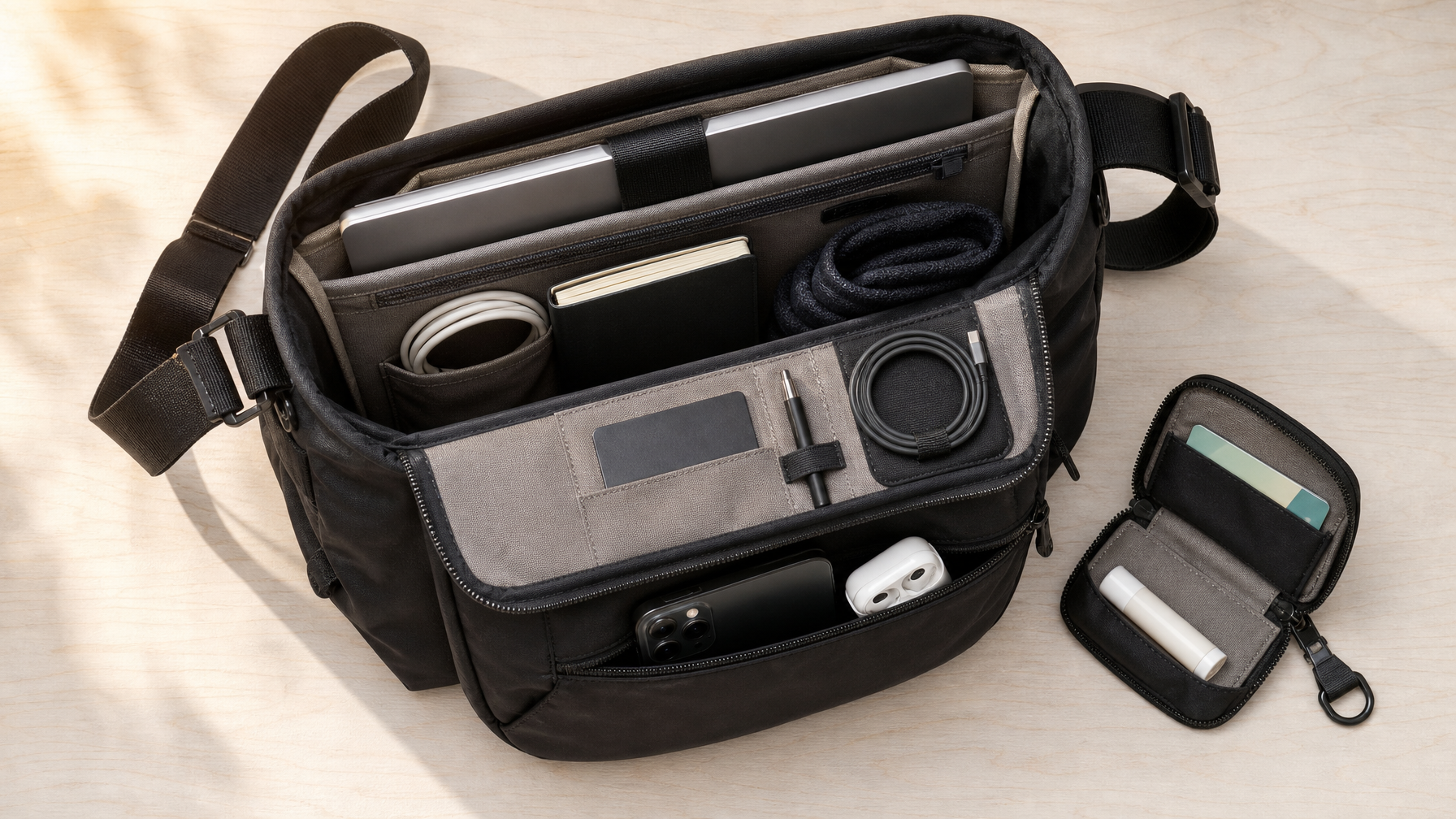
The Haven Messenger is the pick for transit commuters. A padded 14" laptop sleeve, a full-width front exterior zip pocket reachable at every gate and counter, a waterproof 600D Oxford shell, and a wide seatbelt-style webbing strap that keeps the bag stable through a standing commute. The rear security pocket sits flat against the body and is inaccessible from behind.
The Best Laptop Bag for Walking Commuters
Commute type: Any commute where the majority of the trip is on foot — 10 to 30 or more minutes of walking each way.
What you need: Weight distribution that does not fatigue one shoulder, a bag that moves with the body without swinging, adequate capacity for a full workday.
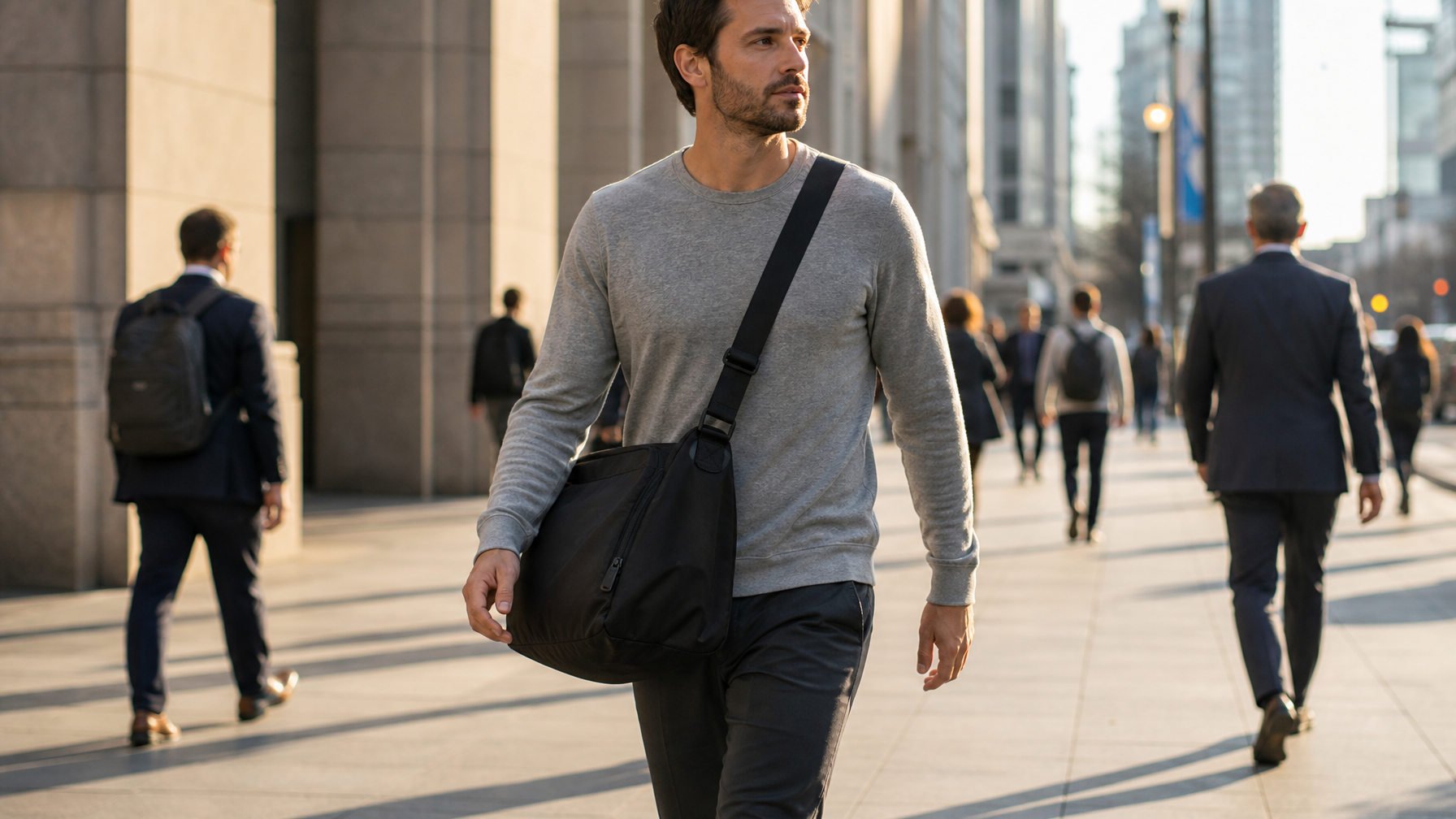
For light to medium loads (under 6 pounds loaded): A well-designed crossbody with a wide webbing strap handles walking commutes comfortably. The diagonal carry is not as symmetrically balanced as a backpack, but it is stable, keeps both hands free, and places the load across the chest rather than behind. At loads below 6 pounds, most commuters do not notice the asymmetry over a 20-minute walk.
For medium to heavy loads (6 pounds and above): A backpack is the stronger choice. Bilateral shoulder straps distribute a heavier load more evenly, and a structured back panel helps posture over longer distances. A slim 20 to 25L technical backpack — minimal external pockets, dedicated laptop sleeve, single main compartment — keeps weight centred and the profile clean.
The Haven Messenger covers walking commutes under 6 pounds loaded without fatigue becoming an issue. For heavier loads or longer distances, a slim technical backpack is the honest recommendation.
The Best Laptop Bag for Cycling Commuters
Commute type: Any commute where the majority of the trip involves cycling — fixed gear, e-bike, or road commuter.
What you need: A bag that does not move laterally during pedalling, fully waterproof construction, bilateral shoulder support, a low profile against the back.
Why crossbody and messenger bags underperform here: A single-strap bag swings and shifts during cycling, affecting balance and creating chafe at the contact point. A chest stabiliser strap helps a traditional messenger, but the design still has limitations at speed and over longer distances.
Why backpacks win for cycling: A structured backpack with a sternum strap sits close to the back, does not shift during pedalling, and distributes weight symmetrically. A 16 to 20L technical cycling backpack with waterproof construction is the correct tool for cycling commuters, regardless of aesthetic preference.
The Haven Messenger is not the right bag for a cycling commute. If you cycle and commute with a laptop, a dedicated cycling backpack in the 16 to 20L range is the appropriate choice.
For commuters who alternate between cycling days and transit days, a second bag is worth the investment. The Haven handles transit and walking days. The cycling backpack handles the rest.
The Best Laptop Bag for Driving Commuters
Commute type: Door-to-door by car, with minimal walking or transit exposure.
What you need: Laptop protection, enough organisation to stay tidy over time, a carry style that works from car to desk without friction.
What you can trade: Weather resistance beyond basic splash protection. Fast-access transit pockets. Anti-theft rear panel features. Weight distribution engineering for long carries.
For driving commuters, the bag style is the least constrained of any commute type. A structured laptop briefcase, a slim tote, or a crossbody all work. The decision comes down to how the bag functions at the destination rather than how it performs in transit.
The Haven works for driving commuters who also occasionally walk or transit. For a commuter who drives exclusively and wants a cleaner desk-presence aesthetic, a slim structured laptop briefcase is also a legitimate option.
What to Look for in Any Laptop Commute Bag
Regardless of commute type, four features apply to every laptop bag worth considering:
A dedicated padded laptop sleeve. Not a laptop-sized section of the main compartment — a sleeve with padding on both sides and a protective backing. This is the non-negotiable starting point. A laptop floating in a bag is not protected.
A material you can name. 600D Oxford, Cordura, ballistic nylon, Dyneema. If the product listing says "durable nylon" or "premium fabric" without a spec, the material is not the selling point.
A strap that holds its position. A tri-glide slider adjuster on a wide webbing strap holds under load. A simple ring buckle or quick-release clip loosens over repeated adjustment and daily use.
A capacity that closes cleanly. The bag should close with your full standard load inside. A bag that bulges at the zipper is the wrong size for your carry.
For crossbody bags specifically, the complete guide to crossbody bags for work covers each feature in detail. For messenger-style options across work use cases, the best messenger bags for work covers the leading picks.
Frequently Asked Questions
What size laptop bag is best for commuting?
For crossbody and messenger-style carry: 10 to 15 litres. This range fits a 14" laptop, charger, notebook, and personal items without the bag becoming bulky on transit. For backpacks: 20 to 25 litres covers a 15" to 16" laptop with room for extras. Anything above 30 litres is travel territory, not a commute bag.
Can I use the same bag for commuting and travel?
Yes, if the bag was designed for both contexts. The Haven Messenger handles day travel, transit commutes, and light overnight packing alongside a small compression cube. For longer trips requiring checked luggage, the commute bag stays as the personal item. See the best commuter bags of 2026 for options that cover both use cases.
Is a backpack or crossbody better for commuting with a laptop?
Backpack for cycling commuters and heavy loads. Crossbody for transit commuters and light-to-medium walking commutes. The full framework for this decision — commute length, load weight, and bag capacity — is in the complete commuter bag guide.