


The Sunday Bag Reset: How to Start Every Week Organized Without Thinking About It

By Thursday, it's already happening. The receipt from Monday's coffee is somewhere in the main compartment. The charger you borrowed from the desk at home is still in the front pocket. There's a granola bar wrapper that you're pretty sure arrived Wednesday. The earbuds aren't in the spot you left them, because at some point you just dropped them in rather than putting them back.
You don't have an organization problem. You have a maintenance gap — the space between how a well-organized bag starts the week and how it ends it, without any intervention in between.
The Sunday bag reset closes that gap. It takes five minutes. And it makes Monday morning something it probably hasn't been in a while: automatic.
Why Every Bag Accumulates Chaos By Thursday
The accumulation is predictable. Over a working week, the average everyday bag collects a specific kind of debris:
- Receipts from coffee shops, lunch runs, and transit
- Cables and chargers borrowed from home that never made it back to their drawer
- Items added for a specific appointment or errand that were never removed afterward
- Snack wrappers, loose coins, or the packaging from something you bought mid-week
- A second charger or cable because you couldn't find the first one
- A random item from your pockets that got dumped into the bag on a busy day
None of this is intentional. It's the byproduct of an active week — the carry doing its job while entropy, quietly and predictably, does its job on the carry. The bag isn't failing you. You just haven't given it a weekly reset.
And the compounding effect is real. A bag left unchecked for two weeks doesn't have two times the chaos — it has four times, because the accumulated debris starts interfering with the original organization. Items shift. The wallet ends up in the wrong pocket. The dedicated cable spot now holds three cables. The system degrades, slowly and then all at once.

What a Bag Reset Actually Is
The Sunday bag reset isn't a deep clean. It's a maintenance pass — a short, repeatable weekly habit that resets the bag to a working state before the next week starts.
It's a practice that's been quietly documented across EDC and carry communities for years. People who do it consistently report the same thing: the carry stops being something they think about, and starts being something they trust. The bag is ready when they pick it up. The morning is quieter. The decision overhead disappears.
The reset has four steps. Together, they take about five minutes on a Sunday evening.
Step One: The Empty-Out
Take everything out. Not sort, not organize — out. Every item, on a flat surface in front of you.
This step matters more than it sounds. You can't accurately audit what you have while it's still inside the bag. Interior pockets obscure what's accumulated. Layers form. Items migrate. Getting everything onto a surface gives you the only honest view of what the bag has actually been carrying this week.
Expect to find things that surprise you. Most people pull out at least two items they forgot were in there, and at least one item that has no clear reason to be there at all. That surprise is the whole point of the empty-out.
Step Two: The Trash Pass
Before anything goes back in, run a ruthless trash pass. Receipts, wrappers, tags, expired transit cards, torn packaging, the pen that ran out on Tuesday — gone. Five seconds of decisiveness here saves five minutes of digging on Wednesday morning.
The trash pass is also the moment to return borrowed items. The charger from the home desk goes back to the desk. The book that was going to be read on the commute gets shelved. The item added for a one-time errand gets put away. The rule is simple: if it doesn't belong in next week's carry, it doesn't go back in the bag.
This is harder than it sounds for one specific category of item — the things you're keeping "just in case." An extra charger you carry because you've run out of battery before. A backup cable because the primary one sometimes doesn't work. The multi-tool you haven't used in four months. The Sunday reset is the moment to be honest about these. If a backup item has never been used, it's weight, not insurance. The capsule carry system gives every item a specific, earned reason for being in the bag — the trash pass is where you enforce that standard weekly.
Step Three: The Tech Charge
Before anything goes back in the bag, put every piece of tech on charge. All of it, at the same time.
- Laptop plugged in
- Phone topped up if it's below 80%
- Earbuds case on the charging pad
- Power bank plugged in and charging
- Anything else with a battery that can be charged, charged

This step is the one most people skip and regret most on Monday morning. Starting the week at 100% on every device means you don't spend the first hour of the week hunting for outlets, borrowing cables from colleagues, or sitting in a meeting watching your battery count down from 22%.
The Sunday tech charge isn't about paranoia. It's about removing a class of small friction that compounds over the week. One Monday at 60% battery becomes Tuesday at 40% by lunch. The charge pass is how you stop that cascade before it starts.
Step Four: The Repack
Now — and only now — repack. But only what earns its place in next week's carry.
If you've built a working capsule carry, this step is confirmation rather than decision. You're verifying that the right items are going back to their designated spots, not rebuilding the entire system from scratch. Laptop in the sleeve. Cables in the mesh. Daily-access items in the front zip. The bag closes the same way it opened on Monday morning last week, because the system didn't change — the debris did.
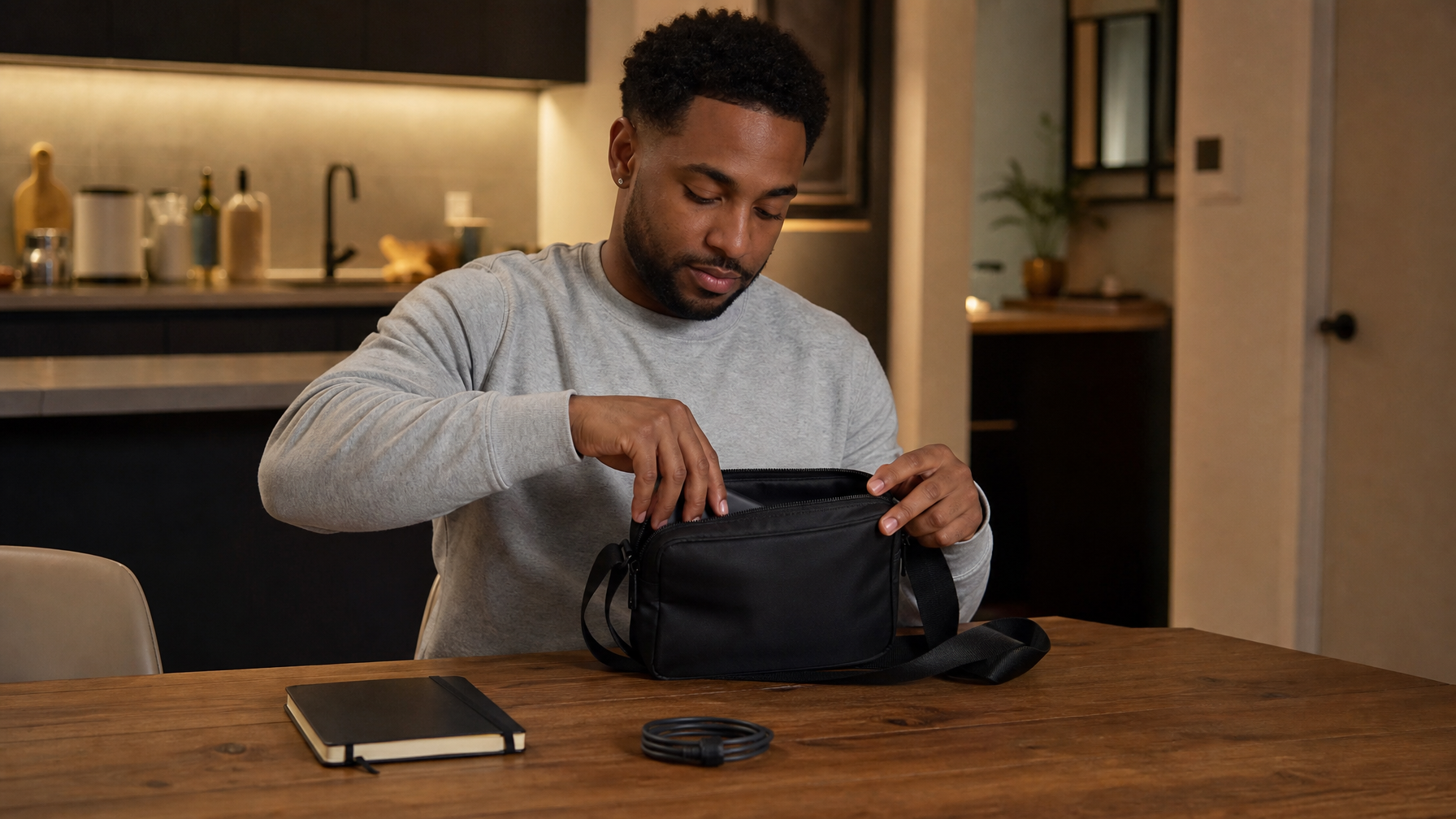
For anyone who doesn't yet have a fixed carry system, the repack is the step that builds it. Look at the items on the table after the trash pass. Ask, for each one: does this genuinely need to come with me next week, or am I packing it by default? The answer to that question, repeated every Sunday, gradually tightens the carry into something intentional.
Why Sunday Works Better Than Any Other Day
The reset can happen on any day. But Sunday has a structural advantage: it's adjacent to Monday. The bag you reset on Sunday evening is the bag you pick up Monday morning, with no intervening opportunity for chaos to return.
Friday evening works for some people — the week is fresh, the bag is freshly heavy with accumulated debris, and clearing it out creates a clean psychological divide between work and weekend. The trade-off is that the reset then needs to survive the weekend without any items migrating back in.
Saturday works if the week's routines are consistent enough that nothing from the weekend ends up in the work bag by accident.
Sunday evening — specifically after dinner, not before — tends to be the moment that sticks for most people. The week is close enough to feel relevant without feeling urgent. You're in a settling mode rather than a reactive one. The bag doesn't feel like a task to check off. It feels like a quiet, five-minute close to the weekend.
What matters more than the day is the anchor. The reset needs a fixed, recurring place in the week, or it doesn't happen. Pick the moment that already has the right energy and protect it.
The Bag That Makes the Reset Faster
The reset is faster when the bag's organization is pre-defined. A bag with designated zones — where each item has a specific home — turns the Sunday repack into a sequence rather than a decision tree. You're not choosing where things go. You're confirming they're in the right place.
The Haven Messenger is built around this principle. The interior is organized into distinct, purposeful zones: a padded 14" laptop sleeve along the back panel for the main device, a main compartment with a mesh pocket for cables and small items, a front zip pocket for daily-access essentials (wallet, transit card, earbuds), and a detachable front accessory pouch on a D-ring for overflow or trip-specific items. The anti-theft back zip pocket handles anything sensitive that shouldn't be buried.
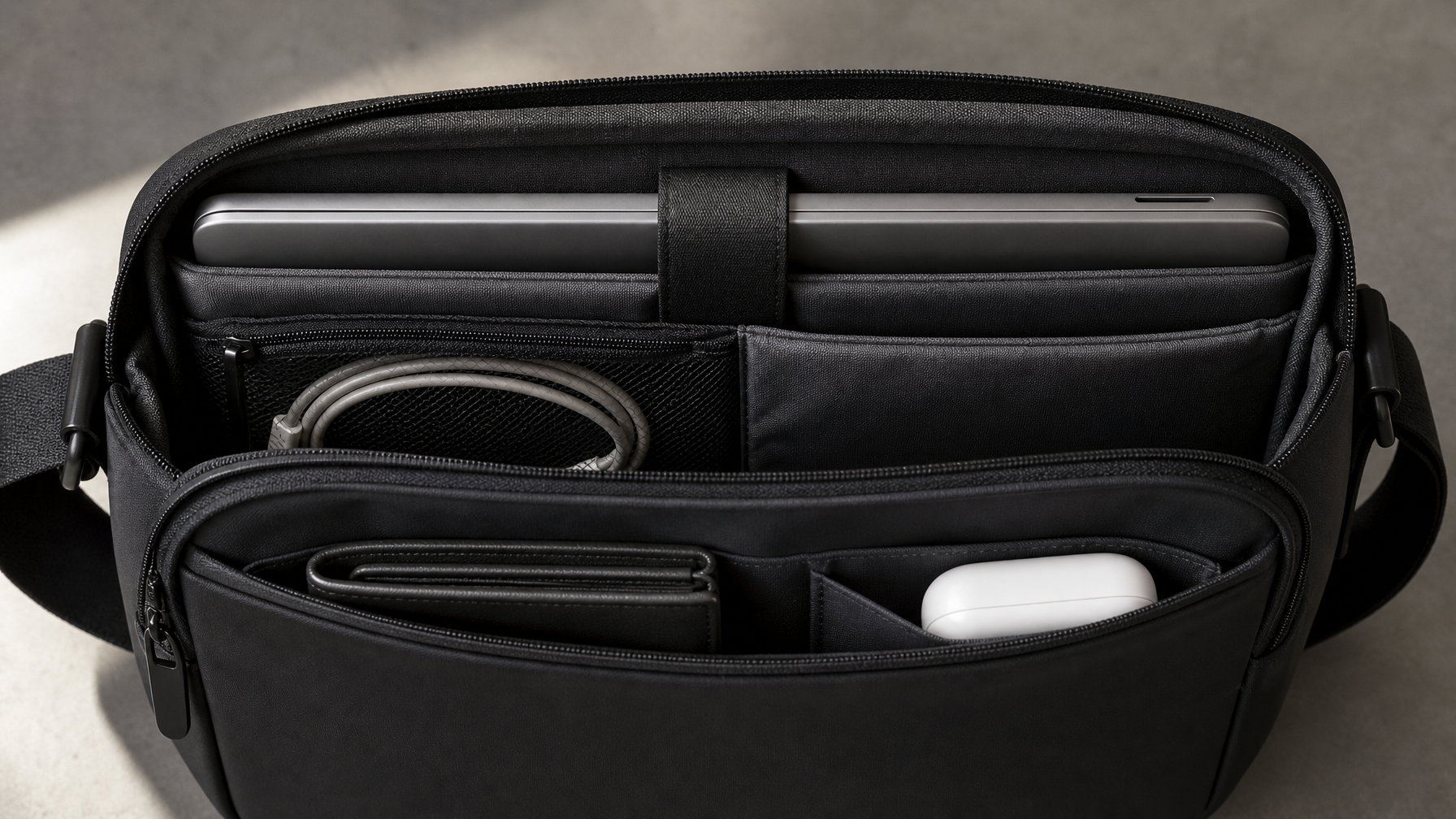
Because every zone is predefined, the Sunday repack is a sequence, not a judgment call. The tech goes in the sleeve. The cables go in the mesh. The daily items go in the front zip. Done. A bag without defined zones turns the Sunday reset into a daily decisions exercise, and the friction accumulates until the reset stops happening altogether.
If the bag you currently carry doesn't have this kind of interior structure, the Sunday reset is harder than it needs to be — not because you're doing it wrong, but because the bag is making you work against it. A well-organized bag makes the reset almost automatic.
The Daily 30-Second Check
The Sunday reset is the anchor. But it works best alongside a daily check — not a second reset, just a brief confirmation.
Each morning, before you zip the bag: one pass. Is everything in its zone? Did anything get added yesterday that doesn't belong? Is the tech charged from last night's use?
Thirty seconds, if that. The kind of check that catches a single receipt before it becomes five receipts by Thursday. The kind that notices the borrowed charger before it migrates permanently into the bag's ecosystem.
The daily check doesn't maintain the system — the Sunday reset does that. The daily check just keeps the reset from having to undo a week's worth of drift all at once. Together, they're what professional everyday carry actually looks like in practice: not a perfectly curated flat lay, but a repeatable habit that makes the carry reliable enough to stop thinking about.
What Changes When the Reset Becomes a Habit
The first Sunday reset takes maybe fifteen minutes — longer than five, because you're finding things you forgot were in there and making decisions you haven't made before. The second takes ten. By the third or fourth, it's five minutes, maybe less.
And somewhere around week three or four, something quieter happens: Monday morning stops requiring a decision about the bag. You pick it up. It's ready. You go.
The rummaging stops. The dead-battery starts stop. The borrowed charger finds its way back. You stop carrying last Tuesday's receipts into next Thursday. The carry becomes something you trust rather than something you manage.
That's what the reset is actually building, one Sunday at a time: a carry that has earned the right to disappear into the background. Not minimal for its own sake. Not maximally organized. Just right — and maintained that way, so you can stop thinking about it and start moving.
That's the full idea behind carrying deliberately: not carrying less as an aesthetic choice, but carrying the right things in the right way, with enough maintenance that the system takes care of itself.
Frequently Asked Questions
How long does the Sunday bag reset actually take?
The first time: ten to fifteen minutes, because you're making decisions you haven't made before. By the third or fourth week: five minutes or less. Once you have a consistent capsule carry and defined bag zones, the repack is a sequence rather than a decision tree — it gets faster as the system becomes familiar.
Does the reset have to happen on Sunday?
No. The day matters less than the anchor — a fixed, recurring moment in the week that you protect. Sunday evening works for most people because it's adjacent to Monday, minimizing the window for the bag to accumulate chaos before the week starts. But Friday, Saturday, or any consistent moment works. The key is the regularity, not the day.
What if I carry different bags on different days?
The reset applies to whichever bag you're using that week. If you rotate regularly, consider a small organizational pouch or inner bag insert that moves with you between bags — your core daily items stay in the pouch, which moves rather than the items themselves. This makes the Sunday reset a pouch audit rather than a full bag audit, regardless of which outer bag you're carrying.
Do I need a specific bag for the reset to work?
The reset works with any bag, but it's faster and more durable with a bag that has defined interior zones. A bag without structure requires ongoing decisions about where things go — which adds friction to every repack. A bag with designated pockets for each category of item makes the repack a confirmation rather than a judgment call. The reset is the habit; the right bag is the infrastructure that makes the habit sustainable.