


The Case for Carrying Less: How Minimalist Thinking Changes What You Carry Every Day

Your bag is heavy before the day starts. Not because you need everything in it — because you never got around to taking things out. The charger for a device you don't own anymore. The umbrella from that one rainy Tuesday in April. The notebook you've been carrying for six months without writing a single word in it. All of it is "just in case." All of it has been wrong about the day ahead, every day, for months.
This is how most people carry. Not intentionally — by default. The bag accumulates. The load grows. The friction becomes so familiar you stop noticing it. Until one day you pick up someone else's bag and realize how light a bag is supposed to feel.
Minimalist carry isn't about carrying almost nothing. It's about carrying exactly what you need — and nothing that isn't. That's a small conceptual shift, but it changes the experience of every day you walk out the door.
Why We Overpack (and Why It's So Hard to Stop)
The "just in case" habit is a psychological one, not a practical one. The imagined cost of not having something you need feels larger than the very real cost of carrying something you don't. So we hedge. We pack for the unlikely scenario rather than the likely one.
The result is a bag packed for a version of your day that rarely happens. Your laptop charger goes on every trip to a coffee shop where you'll be there for two hours on a full charge. The portable umbrella lives in your bag for the three days a year it actually rains unexpectedly. The extra notebook, the backup cable, the things-I-might-need layer — they weigh the bag down every single day to solve a problem that almost never occurs.
This matters more than it sounds. The weight on your shoulder is real. The time spent digging through a full bag for what you actually need is real. The mental overhead of managing a full carry — always aware of what's in there, where things are, what you packed this morning — is real. Carrying too much doesn't just affect your shoulders. It fragments your attention in small, constant ways.
What Minimalism Actually Means for Your Carry
The word "minimalism" carries some cultural weight it doesn't always deserve. In its popular usage, it can mean stark white rooms, capsule wardrobes, and a studied indifference to possessions. That's not what minimalist carry is about.
Minimalist carry is deliberate carry. The question isn't "how little can I take?" — it's "what do I actually use?" The goal is a bag where every item earns its place, which means the bag becomes more functional, not less capable. You can find anything in it immediately. It doesn't tire you out before you get where you're going. You don't spend three minutes at a turnstile trying to locate your transit card.
The minimalist insight applied to everyday carry is simply this: the excess is friction. Every item beyond what you genuinely use is weight, bulk, time, and mental load you're paying every day for a theoretical future benefit you'll almost never collect.
When you get the carry right, you stop thinking about it. The bag disappears into the background of your day. That's the goal — not the aesthetic of less, but the function of less.
The Carry Audit: Starting With What You Actually Use
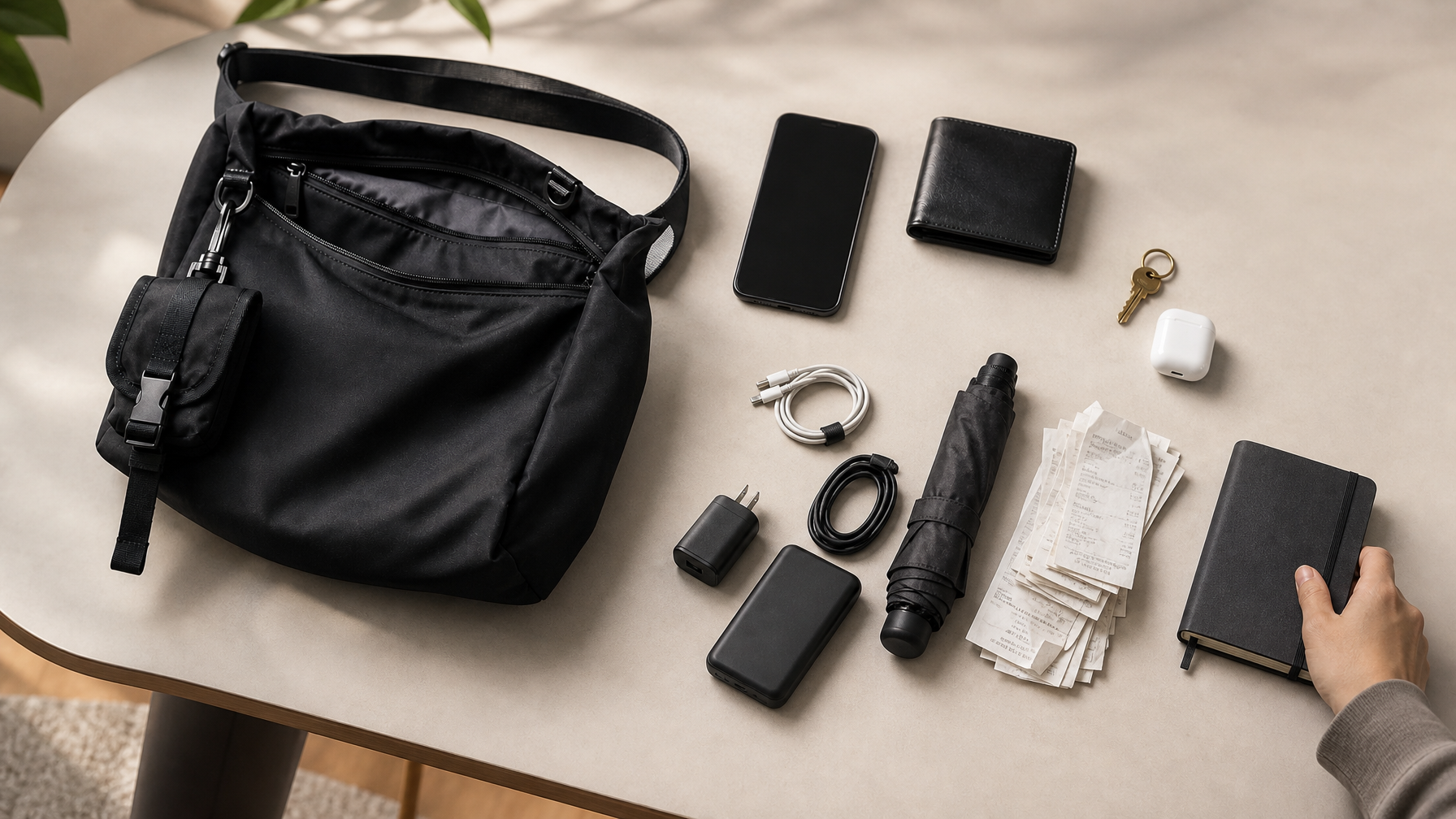
The most useful thing you can do before thinking about a new bag or a new system is audit the one you already have. Empty it. Everything out.
Then sort into two columns: things you used in the last seven days, and things you carried but didn't use in the last seven days. Be honest. Not "I might have needed it" — did you actually open it, reach for it, use it?
Most people who do this find the second column is longer than the first. Sometimes significantly. A charger that hasn't left the bag in a week. A sunscreen bottle from a trip three weeks ago. Cards in a wallet slot that haven't been touched in months. Items that were placed in the bag for a specific trip or specific day and never came out.
The items in the first column — the things you actually touched — are your real carry. Everything else is overhead.
This audit is useful even if you don't act on it immediately, because it makes the cost of the second column visible. You've been carrying that weight every day. You've been adding to the dig-and-find time every morning. The audit doesn't tell you to get rid of things — it tells you what you've been doing for free, and what it's been costing you.
Once you have your real carry, you can start asking a better question: what's the lightest, most functional way to carry these specific things — not a general version of your life, but the actual version?
What a Minimal Carry Actually Looks Like in Practice
There's no universal minimal carry, because what you actually use depends entirely on how your day is structured. A person who commutes to an office every day and needs a laptop has different real requirements than someone who works primarily from home and carries mainly when running errands or meeting people. Both can carry minimally — they're just calibrating to different sets of genuinely-used items.
The common thread is that a minimal carry has no filler. It has no "maybe I'll need this" layer. Some things that turn out to be nearly universal in this process:
- Most people carry too many charging cables. The cable for the device you didn't bring. The adapter from two phones ago. Audit ruthlessly — carry only the cable for the device you're actually bringing that day.
- Most wallets hold too many cards. The gym membership card for a gym you haven't visited in months. Three loyalty cards for coffee shops you rarely use. Minimizing your wallet is often the single easiest carry reduction — and it makes your life measurably better in the process.
- Most bags carry a "just in case" charger that's never used. If you're leaving a charged phone, working at a café for two hours, or commuting without a laptop, the charger often isn't needed. Carry it once, confirm your day. Leave it on the days it isn't.
- Notebooks are often aspirational, not functional. If you haven't opened it in a week, it's not a tool — it's an idea of who you might be.
None of this means stripping out everything. It means being accurate about what you actually do, versus what you imagine you might do. The working minimalist approach is about finding that line and holding it, not about crossing some purity threshold.
Choosing a Bag That Matches the Intent
One of the underappreciated facts about minimalist carry is that your bag size shapes your carry behavior — not the other way around. Carry a large backpack and you'll fill it. Carry a small sling and you'll edit. The container creates the constraint. The constraint is a feature, not a bug.
This is why the right bag for minimalist carry isn't simply "the smallest bag you can find" — it's the bag that's exactly sized for your actual carry, with no room for accumulation. Too small and the bag fails the real load. Exactly right and the bag enforces the discipline passively.
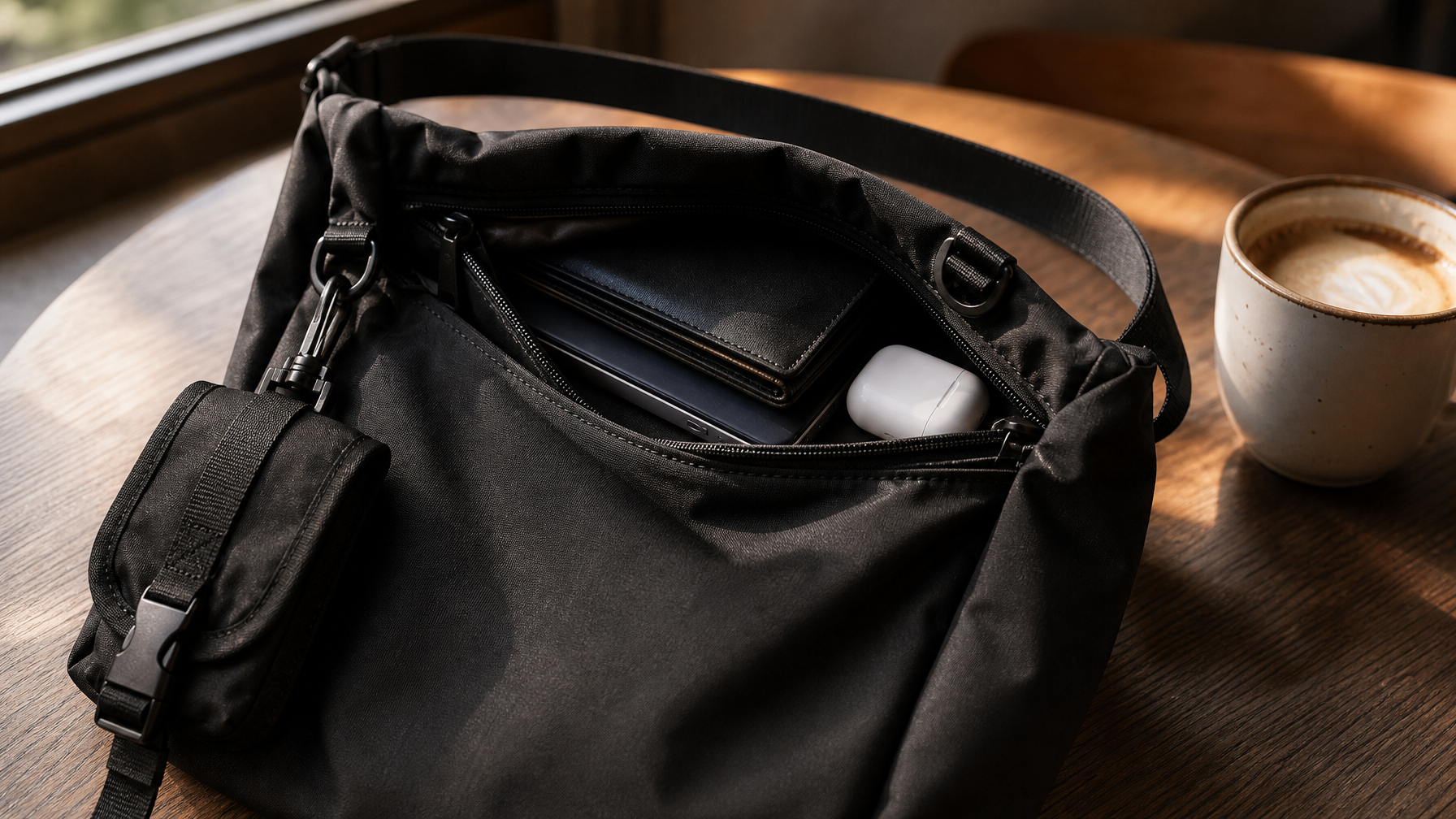
For people who've done the audit and found their real carry is phone, wallet, keys, and earbuds — with no laptop — the Commuter Sling is built for exactly that load. At 0.66 lb empty, it's the lightest bag in the Field & Ash catalog. Breathable back panel, adjustable strap that works chest or back, room for up to a 9.7-inch tablet if you occasionally carry one. It has no excess space for accumulation. That's the point.
If your real carry includes a laptop — you use it every day, it's genuinely part of your work — then the question isn't whether to carry it, it's whether the rest of the load is streamlined around it. The Haven Messenger sits at the same price point ($89) with a padded 14-inch laptop sleeve and a multi-pocket interior that keeps the rest of the carry organized and accessible. When your load is genuinely minimal but your laptop is part of it, the Haven disappears into the commute the way a good bag should.
The principle: choose the bag after you know what you're carrying. Not the bag that accommodates everything you might ever carry — the bag built for what you actually carry.

The Real Payoff: When the Bag Stops Being the Story
The case for carrying less isn't really about the bag. It's about what happens to your day when the carry works.
The bag stops being a recurring source of friction. You stop arriving at a meeting and spending thirty seconds digging for a pen that's been under everything since Monday. You stop pulling your shoulder on the same platform you commute through every week. You stop dreading the checkout counter because your wallet is a puzzle. You stop noticing the bag — which is the goal.
There's something more subtle, too. When you've been deliberate about what you carry, the carry tends to stay deliberate. The bag doesn't accumulate again as quickly. You start to notice when something earns its place and when it doesn't. The habit of asking "do I actually use this?" extends a little beyond the bag.
Minimalism as a philosophy can spiral into something prescriptive — how few possessions you have, how empty your apartment looks, how pure the practice is. Minimalist carry doesn't need to go there. It's just a question, asked once, applied honestly to the thing on your shoulder every morning: does everything in here earn its place?
If the answer is yes, you're done. If it isn't, you know exactly what to do.

Where to Go From Here
The audit is the first step. Empty the bag, sort what you actually use, and start from there. If the result is a carry that no longer fits well in your current bag — either because it's too large for what you now carry, or because the organization doesn't match the load — that's useful information, not a problem to ignore.
For a closer look at the items themselves — what belongs in a minimal carry and how to think about each category — the working minimalist guide covers the item layer in detail. If you're still working out which bag style matches your actual load, the minimalist shoulder bag guide walks through the options by size and use case.
The goal isn't a perfect system. It's a bag you pick up each morning that's right for the day in front of you — and nothing more.
Frequently Asked Questions
How do I start carrying less without feeling unprepared?
Start with the audit: empty your bag and separate what you actually used in the last seven days from what you just carried. The "unprepared" feeling almost always comes from imagined scenarios, not actual experience of needing something. Most people find their real carry is significantly smaller than their habitual carry once they look at actual usage rather than imagined futures.
Does minimalist carry mean not bringing a laptop?
No. Minimalist carry means carrying what you actually use — and if your laptop is genuinely part of your daily work, it belongs in the carry. The minimalist principle applies to everything else in the bag: the cables, chargers, accessories, and backup items that accumulate around the laptop. A carry that includes a laptop can still be minimal if everything else is earning its place.
What's the smallest useful bag for everyday carry?
It depends entirely on what you actually carry. For phone, wallet, keys, and earbuds with no laptop, a sling-style bag is often the right fit. For anyone carrying a laptop, the bag should be sized to the laptop sleeve plus the minimal accessories that genuinely belong there. The right bag size is determined by your carry inventory — not the other way around.
Won't I forget things if I carry less?
Only during the calibration period. Most people find that once they've identified their real carry, a smaller bag covers it reliably. The "I might need this" items that get left out turn out to be unnecessary almost every time — which reinforces the smaller carry rather than undermining it. The calibration period is short. The payoff lasts.