


The Capsule Carry System: How to Always Have What You Need and Nothing You Don't

You know the feeling: you're halfway out the door and you stop, because something is missing. Not something big. A charger. Your keys, buried under three other things. The little card wallet that always seems to migrate to whichever bag you weren't carrying yesterday. So you go back in, dig through the bag, and leave four minutes later than you meant to — a little irritated before the day has even started.
This isn't a bag problem in the way most people think about bag problems. It's not that you need a bigger bag, or a fancier one, or one with more pockets. It's that what's inside the bag was never actually decided. It accumulated. And an accumulated bag is a bag you can't trust, because you never know what's actually in it until you check.
A capsule carry system fixes this by borrowing an idea from capsule wardrobes: a small, fixed, deliberately chosen set of items that covers what you actually need, arranged the same way every time, so the bag becomes something you stop thinking about entirely. Not because you own less — although you probably will — but because what you own has a job, a place, and a reason for being there.
What a Capsule Carry System Actually Is
A capsule carry system is the everyday-carry version of a capsule wardrobe: a fixed core of essentials, chosen deliberately, that covers the vast majority of your normal day without needing to be re-thought each morning. It's the opposite of the bag that slowly fills up with things you added "just in case" six months ago and never took back out.
The test isn't how few items you carry. It's whether every item in the bag has a specific, recurring reason to be there. A phone charger you use daily earns its spot. A phone charger you packed once for a trip and never removed does not — even if it weighs almost nothing, because the real cost isn't weight. It's the two extra seconds every time your hand goes into that pocket looking for something else and finds the wrong thing instead.
If you want the foundational thinking behind this — what everyday carry means and where the idea came from — our guide to what everyday carry actually is covers the background. This article is about the system you build once you've decided to take it seriously.
Why Most People's Bags Never Actually Get "Organized"
Most attempts at organizing a bag fail for the same reason most attempts at organizing a closet fail: they start with the container, not the contents. You buy a new pouch, a new set of packing cubes, a new insert — and for about a week, everything has a place. Then life happens. A new charger cable gets added. A receipt goes in and never comes out. Three weeks later, the pouch is just as chaotic as the bag was before, except now it's chaotic in a slightly smaller space.
The actual fix isn't a better container. It's deciding, once, what belongs — and then being honest every time something new gets added about whether it's a permanent resident or a guest that needs to leave by tomorrow.
That distinction — permanent resident versus guest — is the entire system. Most bags fail because nobody ever makes that call. Everything just stays, by default, forever.

Building Your Capsule: The Four Categories
A working capsule carry system splits into four categories. Not every item you carry needs to fit neatly into one, but almost everything will.
1. Identity and access
Wallet, keys, transit card or badge, phone. These are non-negotiable — you need them every single day, and they should live in the exact same pocket every single time, so your hand finds them without your eyes needing to check.
2. Power and connection
Charging cable, a compact battery pack if your day runs long, earbuds. This category is where accumulation happens fastest — old cables, a backup charger you don't need because your primary one works fine, a second pair of earbuds you forgot you owned. Audit this category the hardest.
3. Capture and focus
A small notebook and pen, or whatever your equivalent is for capturing a thought before it disappears. This category is small but easy to skip entirely, and skipping it is usually a mistake — the friction of "I'll remember it" is higher than the friction of writing it down.
4. Comfort and contingency
One item, maybe two, for the thing that occasionally goes wrong — a small first-aid item, a spare mask, a stain pen. The rule here is strict: one item per contingency, and if you haven't needed it in three months, it's a candidate for removal.
Notice what's not on this list: the things you carry "in case." A capsule system isn't built around worst-case scenarios. It's built around your actual, typical day — the one you have five days out of seven, not the one you have once a year.
The Pouch Rule
Once you know your categories, the next decision is how they're physically organized inside the bag — and this is where most people either succeed or quietly give up.
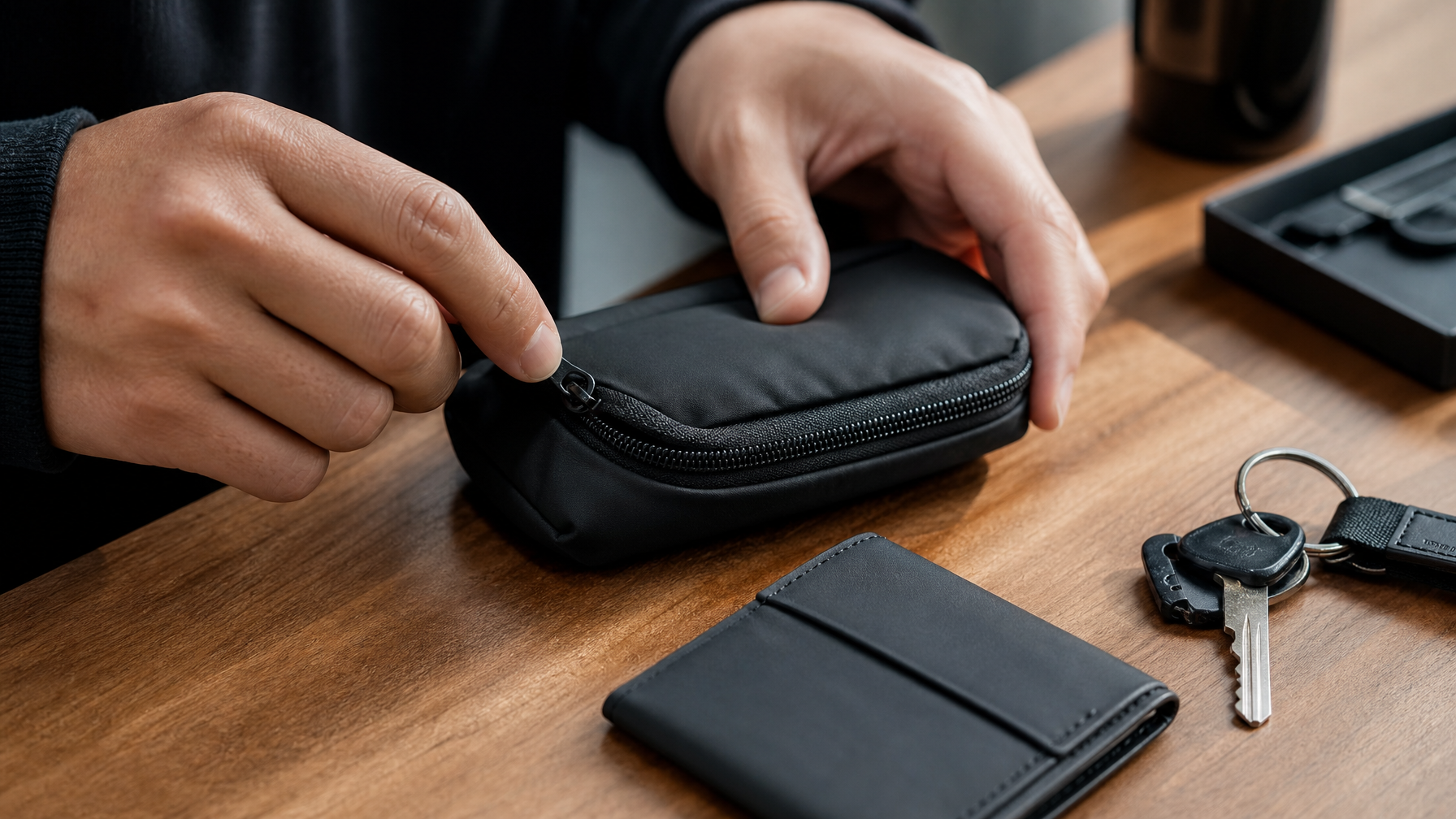
Loose items in a single main compartment will always drift back toward chaos, no matter how disciplined you are, because there's no structural barrier stopping a charger cable from tangling with your earbuds case. The fix is small, dedicated pouches — one per category, ideally in a color or shape you can identify by feel, so you're not unzipping three pouches to find the one you need.
This is also where the bag itself matters more than people expect. A bag with genuine internal structure — dedicated slots, a separate zip pocket, a mesh compartment — does half the organizing work for you before you even add pouches. A bag that's just one large open compartment puts the entire burden on you, every single day, indefinitely. Most people who feel like they're "bad at staying organized" are actually just carrying a bag that was never built to help.
The Weekly Reset
A capsule system isn't a one-time setup. It needs a recurring checkpoint, or it slowly turns back into the bag you were trying to escape.
The reset takes five minutes and works best at the same point every week — Sunday evening is common, because it sets you up for the week rather than reacting to it. Empty the bag completely. Every item goes back in deliberately, not automatically. Anything that's been sitting unused for more than a week gets pulled and asked the honest question: permanent resident, or guest that overstayed?
This is also the moment to catch scope creep — the receipt that's been living in the front pocket for two weeks, the extra cable that snuck in during a trip and never left, the notebook that's actually full and needs replacing rather than continuing to be carried, full, as dead weight.
If you already have a Sunday-night routine for planning your week, this adds about five minutes to it. If you don't, it's worth starting one — not as a productivity system, but as the maintenance layer that keeps the capsule from drifting back into accumulation.
Where the Bag Fits
The system works in almost any bag, but it works meaningfully better in a bag built with actual internal structure — separate compartments instead of one large space, a dedicated pocket for cables and small electronics, an anti-theft or interior pocket for anything you'd rather not lose.
For a genuinely minimal capsule — identity items, a phone, maybe a tablet, no laptop — the Commuter Sling is built for exactly this. At 0.66 lb it's the lightest bag in the catalog, with a main compartment plus interior slot and zip pockets that naturally separate categories instead of pooling everything into one space. It's not sized for a laptop, which is the point: it forces the discipline of a genuinely small capsule rather than quietly expanding to fill whatever room is available.
For readers whose capsule includes a laptop most days, the Haven Messenger gives you the same category-based organization — a padded laptop sleeve, dedicated organizer pockets, a mesh pocket, and a detachable front accessory pouch that works well as a standalone home for your power and connection category, so it's never mixed in with everything else.
Either way, the bag should be doing organizational work for you, not the other way around. If you're still deciding what your daily carry actually needs to include before you build the system around it, our guide to building a minimalist everyday carry is the right starting point.

What Changes Once the System Is Built
The payoff isn't really about owning less, even though most people who build a capsule system do end up owning less. The real payoff is that the bag stops being something you think about. You stop patting your pockets at the door, unsure. You stop the mid-commute search for a charger you're pretty sure you packed. You stop discovering, three stops into your train ride, that today is the day you forgot the one thing you actually needed.
That's the actual goal — not a minimalist aesthetic, not a smaller bag for its own sake, but a bag you trust completely, because you built it on purpose and you maintain it on a schedule. Once that's in place, the bag genuinely disappears into the day. You reach for it without checking. It's just there, doing its job, the way it's supposed to.
If your daily setup involves working from more than one location during the week, our guide to what professional commuters actually carry every day extends this same category thinking into a full office EDC setup.

Frequently Asked Questions
How many items should be in a capsule carry system?
There's no fixed number — the point isn't minimizing count, it's that every item has a recurring, specific reason to be there. Most people land somewhere between 10 and 15 core items once contingency extras are stripped out, but a working system with 20 deliberate items beats a "minimal" one with 8 items nobody actually uses.
What's the difference between a capsule carry system and just packing light?
Packing light is usually about a single trip. A capsule carry system is a permanent, repeatable setup for your everyday bag — the same categories, the same pouches, the same weekly reset, every week, indefinitely.
Do I need special pouches, or can I use what I already have?
Any small pouch that creates a physical barrier between categories works. The goal is separation, not a specific product — though a bag with built-in compartments reduces how much separate pouch organization you need to do yourself.
How often should I actually do the reset?
Weekly is the sweet spot for most people. Daily is more maintenance than most schedules can sustain, and monthly is often too infrequent to catch small accumulation before it becomes a real problem.