


The Digital Nomad Carry Setup: What You Actually Need (and What You'll Wish You Left Behind)

The first time you pack for an extended working trip, you bring too much. Almost everyone does. The second time, you bring half as much and realize you still brought too much. By the third trip, you know.
The problem is not the gear — it's the mental model. Most digital nomad packing lists are written as exhaustive catalogs of what might be useful. They cover every contingency, every edge case, every scenario the author has faced in three years on the road. Reading one before your first trip is like trying to prepare for a job by memorizing the employee handbook. The information is technically accurate. It doesn't tell you what you actually need to know.
What you need is a framework. A way to make the same call your future self — four trips in — would make. Not a longer list.
Start Here: The One Question That Cuts Your List
Before anything else, write down what you actually used every single day on your last trip. Not what you brought. What you reached for every day.
For most remote workers, that list is short. A laptop. A charger. Earbuds. A notebook. Maybe one adapter. A small number of clothing items. Whatever your personal health or hygiene essentials are.
Everything else is conditional — items you use some days, or items you brought just in case, or items you needed once and carried for three weeks afterward.
The framework that follows is built around that distinction. The things on your "every day" list go in the bag without negotiation. Everything else gets evaluated individually, and most of it gets left behind.

One Bag or Two? The Decision That Shapes Everything
Before you think about what to pack, decide how many bags you're carrying. It's the most important structural decision in your setup, and it affects everything downstream.
One-bag travel means a single backpack handles everything — clothes, tech, and daily carry — all in one place. No checked luggage, no second bag. You move faster through airports. You never wait at baggage claim. You can't overpack because the limit is what fits. The constraint is the point.
Two-bag travel means a larger primary bag for clothes and gear plus a smaller day bag for daily carry. You stow the primary overnight; the day bag comes with you everywhere — to the café, the coworking space, the evening plans. The benefit is more total capacity and cleaner separation between what you're living out of and what you're working out of.
Neither approach is universally better. One-bag is right for faster movers, shorter trips, and anyone who finds simplicity motivating. Two-bag works better for longer stays, climates that require more clothing variety, or anyone moving from work mode to evening plans in a single day.
Most people start with two bags and migrate toward one over time, as they discover how little they actually need. Either way, pick your system before you pack a single item. The bag choice determines everything else.
The Tech Layer: What Actually Makes the Cut
Tech is where the packing list always inflates first. External monitors, portable keyboards, ring lights, backup hard drives — all reasonable in isolation, all weight and volume that compounds quickly. Start with your laptop. Build everything else around it.
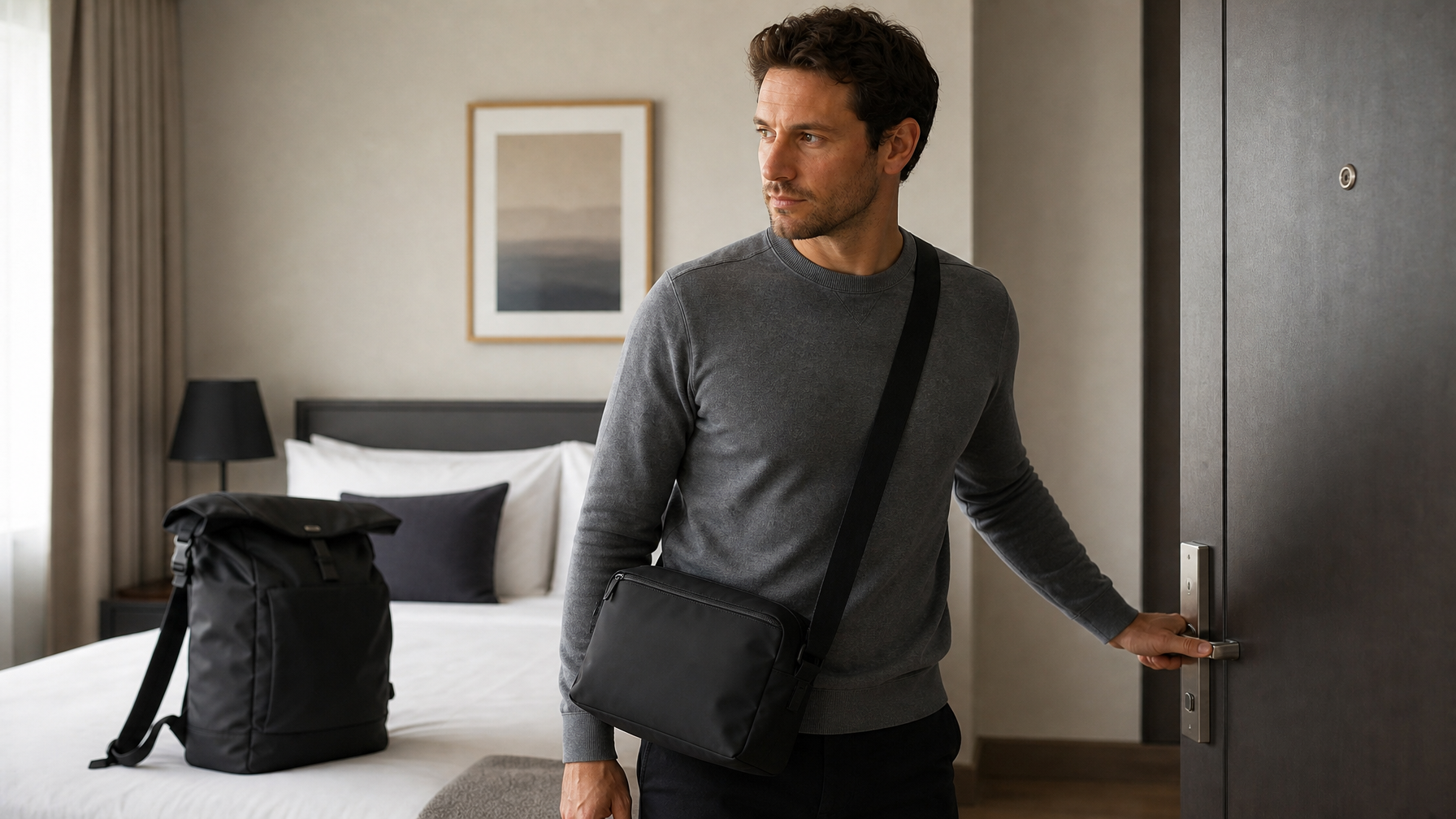
The core tech list for most working travelers is genuinely short:
- Laptop charger (the original — resist the urge to buy a "compact" replacement you haven't fully tested)
- A single USB-C hub covering HDMI, USB-A, and USB-C pass-through
- One universal travel adapter
- Earbuds or headphones — whichever you actually use every day
- Phone charging cable
- A compact power bank if you work from cafés without reliable outlets
Notice what's not on that list: external keyboard, portable monitor, tablet, camera, secondary charger, recording gear. All of these are legitimately useful in the right context. Most people find they stop reaching for them within the first week and carry them for the rest of the trip anyway.
The rule for any tech addition: if you wouldn't reach for it every day on a normal workday at home, it doesn't earn a slot in the bag.
Keep everything in a single dedicated pouch or organizer — one fixed home for your cables means you're not unpacking the entire bag every time you need a charger. That friction compounds across weeks of working from different locations. The full coffee shop carry guide goes deeper on building a daily work setup that travels cleanly.
The Bag That Makes the System Work
The bag is not the last decision — it's the container that makes every other decision possible. Get it wrong and even a perfectly curated packing list won't save you.
For one-bag travel, the right bag sits in the 20–35L range with a dedicated laptop sleeve, enough internal organization to avoid unpacking everything to find one thing, and shoulder straps built for real carry weight rather than display.
The Transit Pack covers this well: 20–35L expandable via roll-top closure, Oxford shell, padded 15.6" laptop sleeve, and enough internal organization to stop the bag from becoming a search operation. At $199, it handles the full trip without requiring a separate system on top of it. Tighten the roll-top down for a lighter day, open it up when you've added a week's worth of gear. The expandable design is the point — you're not locked into a fixed volume as the trip evolves.
If you want more raw capacity and a dedicated device compartment, the Apex Backpack gives you 20–35L with separate laptop and tablet compartments, S-curve shoulder straps for heavy-load carry, and waterproof nylon construction. At $139–$159, it's the pick for anyone regularly carrying a large laptop alongside gear for an extended stay.
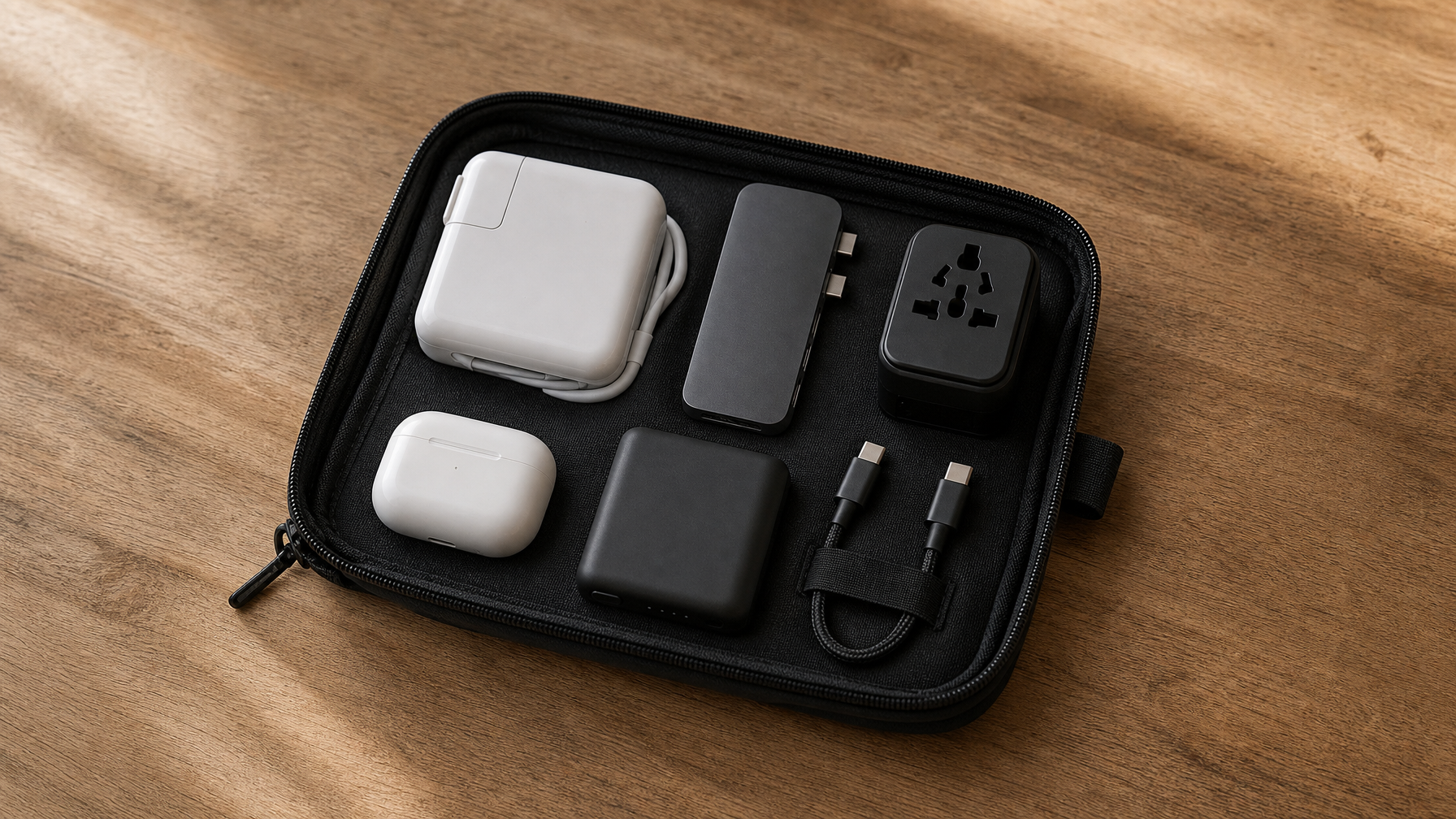
For two-bag setups, pair either backpack with a dedicated day bag — something compact that you're comfortable carrying from 8am through dinner without thinking about it. The Haven Messenger works well here: 33×18×30 cm, 1.21 lb, padded 14" laptop sleeve, anti-theft back pocket, and a detachable front pouch for quick-access items. It carries a full work setup but wears flat and light when the laptop stays back at the accommodation.
The Clothing Layer
Clothing is the most personal part of the equation and the area where context matters most — hot climates versus cold, frequent meetings versus fully async, a culture where what you wear is noticed versus one where it isn't.
Three principles hold across almost all contexts.
Build around neutral, versatile pieces. Items that pair with anything and function in multiple situations mean fewer total items for the same number of outfit options. Dark, solid colors that don't show wear extend the interval between laundry runs.
Figure out your laundry cadence before you pack. If you have access to laundry every three or four days, you need three or four days of clothes — not two weeks' worth. The number of days between laundry is the variable that determines your clothing count. The length of the trip is not the variable.
Pack for your actual plans, not your optimistic ones. Don't build your entire clothing list around the one formal dinner you might attend, the hike you'll maybe do, or the event that's tentatively scheduled. Bring what you'd wear 95% of the time and problem-solve the edge cases locally.
Most experienced one-bag travelers settle on five to seven days of clothing as the practical range — enough to go a week between laundry, light enough to keep the bag manageable. That number tends to come down, not up, over time.
What You'll Wish You Left Behind
This is the section most packing guides skip, because most packing guides are written to include rather than exclude. It's also the section that saves the most weight.
The items that end up at the bottom of the bag by week two, carried but never used:
A backup laptop charger. The "just in case" charger that adds half a pound to every single carry. A single reliable charger is almost always enough. If it fails, buying a local replacement takes an afternoon and costs far less than the frustration of carrying a second one for months.
Physical books. One for the flight, one for the trip. The flight book is finished by arrival. The trip book is open for two days before work gets busy and you switch back to reading on your phone. Both still weigh nearly a pound. Download everything.
Specialist tech you haven't committed to. The portable monitor that will definitely improve your productivity. The folding keyboard that's more comfortable than the laptop's. The camera you'll use this time. In practice, most remote workers have their work setup dialed before they leave and find that changing it mid-trip creates more friction than it removes.
Three pairs of shoes when two cover everything. Most experienced travelers converge on two pairs: one you can walk all day in, one you can wear to dinner. Three pairs have been attempted by many. Two pairs remain.
Clothing packed for scenarios, not reality. The hiking gear for the hike that might happen. The formal outfit for the event you'll maybe attend. The cold-weather layer for the three cold days at the end of a warm trip. Pack for your actual plans. The edge cases are rarely as edge-case as they seem in advance.
The same logic behind a good digital nomad kit applies to everyday carry generally — the best setup is the one you stop thinking about. The minimalist EDC guide covers how that principle works in a daily commute context.
How You'll Know Your System Is Working
You'll know it's right when you stop thinking about it.
Not on the first trip — the first trip is still calibration. But at some point, packing for two weeks away becomes a 20-minute task you do while thinking about something else. You know what goes in which compartment. You know exactly what you're leaving behind and why. The bag comes off at a café and goes on the chair without deliberation. The laptop is out before the security guard asks.
That state — where the carry is no longer taking up mental bandwidth — is what the whole exercise is building toward. Every unnecessary item is something that has to be managed, tracked, charged, or worried about. Removing it isn't a sacrifice. It's simplification.
Start light. Note what you actually miss. Add back only what the evidence demands. If you end a trip wishing you'd brought something, it earns a spot next time. If you end a trip having never needed something, it stays home.
That's the whole system.
Frequently Asked Questions
How many liters does a digital nomad bag actually need to be?
For most remote workers doing one-bag travel, 20–35L is the practical range. 20–25L works if you pack very light and do laundry every three to four days. 30–35L gives you room for climates or longer stays requiring more clothing variety. Bags with expandable capacity — like a roll-top closure — give you the flexibility to compress down or open up depending on the trip without committing to a fixed volume.