


How to Work from a Coffee Shop Without Losing the Whole Morning

You showed up early. Found a good table. Ordered the coffee. Opened the laptop. And then — somehow — two hours passed and you don't quite know where they went.
Working from a coffee shop is one of those things that sounds like it should be obvious. You go, you sit, you work. But anyone who does it regularly knows there's a real skill gap between showing up at a café with good intentions and actually walking out with something done. The environment can sharpen your focus or scatter it completely, and usually the difference isn't the café — it's the approach you bring through the door.
This isn't a guide about finding the best third place in your city, or which coffee shop has the fastest Wi-Fi. It's about the specific habits that separate a coffee shop session that produces something from one that just feels productive while it's happening.
Why Some Sessions Work and Others Don't
The research on this is actually useful. A 2012 study from the University of Illinois found that moderate ambient noise — around 70 decibels, roughly the level of a mid-busy café — improves creative cognition compared to both silence and louder environments. The low-grade background hum triggers what researchers call "diffuse attention," a mental state that's better suited for abstract thinking and creative problem-solving than the highly focused, narrow attention that silence encourages.
Put plainly: the café noise helps certain kinds of work. Not all of it — focused analytical tasks often suffer — but the kind of writing, brainstorming, and thinking-through that people often go to cafés specifically to do.
The other thing working in your favor is the novelty effect. A new environment interrupts habitual thinking patterns and forces a mild cognitive reset. The home office pulls you back toward the same grooves. The café puts you slightly outside your usual mental territory, which can loosen up ideas that were stuck.
What works against you: the same environment that's stimulating in small doses becomes overwhelming in large ones. The noise level that sharpens focus at 70dB becomes fatiguing at 80dB. The interesting people-watching that helps you think for the first twenty minutes becomes a distraction after an hour. There's a window, and the sessions that succeed are usually the ones that stay inside it.

Choose Your Spot Before You Order
Most people order first, then find a seat. Do the opposite. Walk the room for sixty seconds before you commit to anything. The seat you end up in shapes the entire session.
What you're looking for: a power outlet nearby (or a fully charged device), a sightline that doesn't put high foot-traffic in your peripheral vision, a surface that fits your laptop without your elbows hanging off the edge, and a seat that doesn't face a window where the backlight will wash your screen.
Window counter seating works well for solo focus sessions — you're looking out, the traffic behind you is out of your eyeline, and the natural light is usually good. Communal tables look good on paper but put you in the middle of conversations you didn't choose, which fragments attention whether you notice it or not.
Corner seats and booths are optimal when available: controlled sightlines, backs to a wall, less passing traffic, usually better acoustics. They fill up fast — which is one of the best arguments for arriving early.
Also pay attention to sound. A café with a kitchen pass-through near your seat will have unpredictable noise bursts. A café playing music at high volume shifts the ambient noise above the useful range. If a location consistently doesn't work for you, find one that does — the difference in output is real.
Arrive with One Task, Not a List
The productivity trap most people fall into at cafés is arriving with an open-ended list of intentions: answer emails, work on the proposal, maybe look at those slides, possibly deal with the invoices. None of it is concrete enough to pull you in, so you move between tasks without completing any of them and feel vaguely busy for two hours.
Before you leave for the café, define a single deliverable. Not a category of work — a specific, completable output. "Write the first two sections of the client brief" is a deliverable. "Work on the brief" is not. "Finish the budget estimate and send it" is a deliverable. "Look at finances" is not.
The question that clarifies this: What will I have done by the time I pack up? If you can't answer that in one sentence before you walk out the door, sharpen it first. The session will be better for it.
This doesn't mean you can't do other things if you finish early. It means you have a single anchor to return to when the background hum of the café or the pull of your phone starts to drift your attention. The deliverable is the thread you pull back to.
Build a Setup Ritual That Signals Focus
People underestimate how much a consistent physical ritual helps the brain shift into a working state. Office workers have this built in — the commute, the desk setup, the first cup of coffee in the same mug at the same chair — all of it cues the brain that it's time to work. When you work from a café, you have to build that cue yourself.
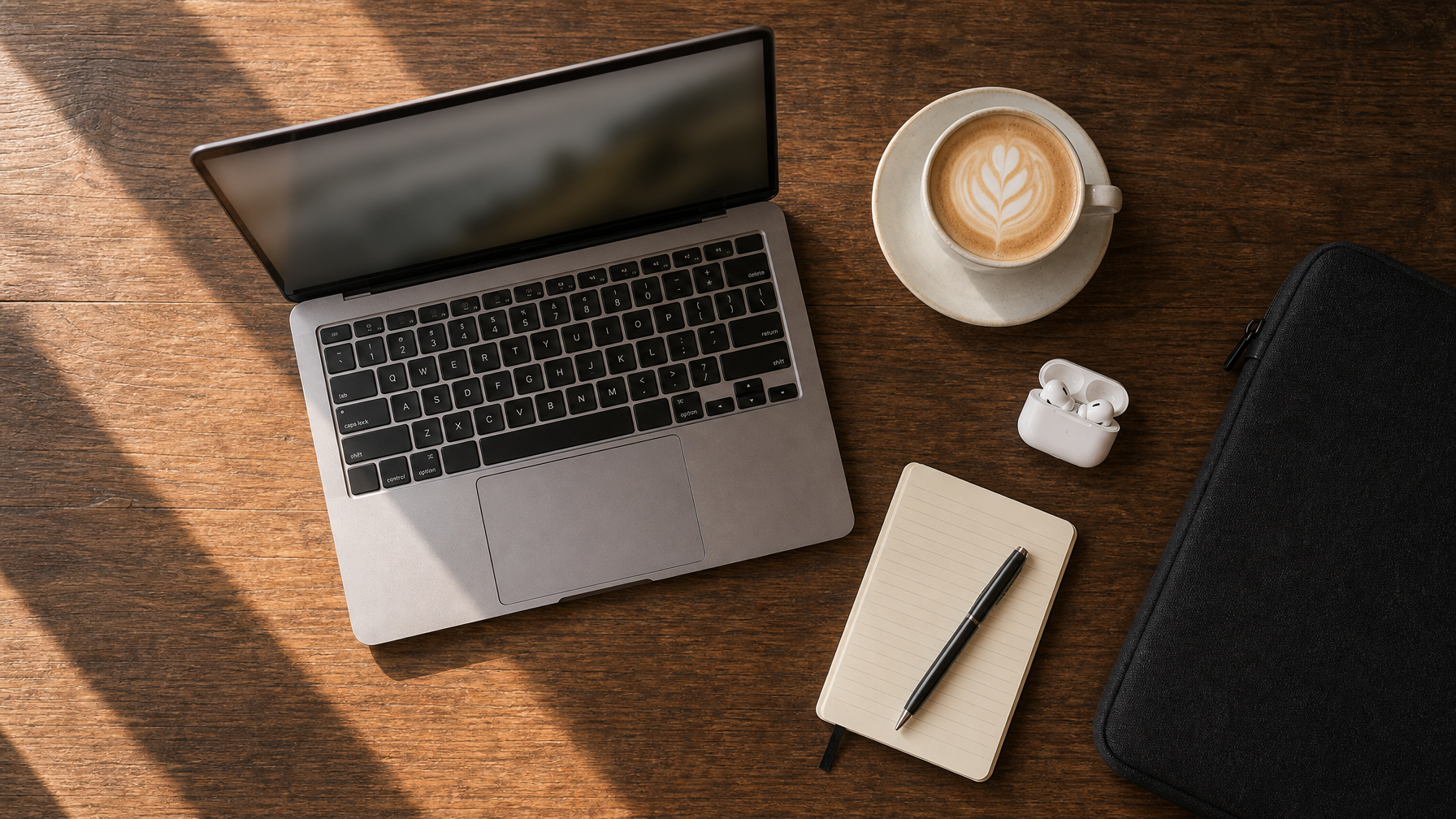
It doesn't need to be elaborate. Something as simple as: sit down, take out the laptop, open your notebook to a fresh page, write the date and today's single deliverable, then put your phone in your bag. Do it the same way every session. Over time, the sequence itself becomes the trigger — by the time you write the deliverable in the notebook, your attention has already started to narrow.
The phone-in-the-bag piece isn't optional if you're serious about this. Not face-down on the table — in the bag. Notifications you can see are interruptions you didn't choose. The table is for the work. The bag is for everything else.
For a read on what to actually bring to a café to build this kind of setup, that's covered separately — the short version is that what you carry shapes what's physically available to pull your attention, which makes your bag decisions more consequential than they look.
Managing the Distractions That Are Actually Solvable
Some café distractions are environmental and outside your control — a loud conversation at the next table, a door that opens and closes on a cold day, music that shifts from background to foreground. These you adapt to or move away from.
But most of the distractions people experience at cafés are solvable with a small number of tools and decisions.
Noise: A pair of noise-isolating earbuds makes a significant difference for most people. You don't need active noise cancellation — the passive isolation from in-ear earbuds reduces unpredictable noise spikes enough to stabilize focus. Music matters too: instrumental or ambient music (lofi, classical, film scores) is consistently better for focus than music with lyrics, which competes with language-processing when you're reading or writing.
Wi-Fi: If your work involves writing, designing, or anything local, turn off Wi-Fi. Not the café's Wi-Fi — your own. Set your task to not require connectivity, then remove the option. If you need the internet, define when you'll check it: between Pomodoro sessions, not continuously.
Table anxiety: The discomfort of wondering whether you've overstayed your welcome is real and low-grade distracting. The simple fix is to order something reasonable for the duration you're staying. A coffee for an hour, a second coffee or a snack for two. You're not exploiting anyone. You're also not obligated to churn through purchases every 20 minutes. The places that genuinely don't want laptop workers make it obvious — they limit outlets, play loud music, or remove the seating. If the café you're in hasn't done any of that, you're fine.

The Two-Hour Window
The café productivity window is real and has a ceiling. Most people who work from cafés regularly find that sessions longer than two hours produce diminishing returns — attention softens, the ambient noise that was background starts to register as foreground, and the novelty effect that was useful early in the session fades.
Planning around this makes sessions sharper. A focused 90-minute session with a clear deliverable typically produces more than a 3-hour session with a vague list. When you know you have two hours, you're more likely to use them well. When you have an open-ended block, you're more likely to pace yourself in ways that don't work out.
Mornings tend to work better for most people for a few overlapping reasons: cafés are quieter before 9am, tables are easier to get, your cognitive resources are typically fresher, and there's a natural session-end when the café fills with the mid-morning crowd. Arriving at 7:30 or 8:00 and working until 9:30 or 10:00 — before the first interruption of the day — is often when people have their most productive café sessions.
Some people work better in the mid-morning lull after the commuter rush clears around 10:30. Both windows work. The ones that usually don't: after 1pm on weekdays (loud, crowded, difficult table availability), and weekend afternoons (brunch energy is different from work energy, and the room knows it).
What to Carry So the Setup Disappears
The relationship between what you carry and how well you work is more direct than most people think. A bag you have to dig through to find your charger, or one that spills when you set it down, or one where everything lands in one undivided compartment — these add friction to the start of a session and low-grade annoyance throughout it.
The goal is a setup that goes from bag to table in under a minute, with nothing left over that you don't need. Laptop, notebook, earbuds, charging cable. Maybe a water bottle. That's the functional ceiling for a focused café session. Everything beyond that either doesn't leave the bag or doesn't come at all.
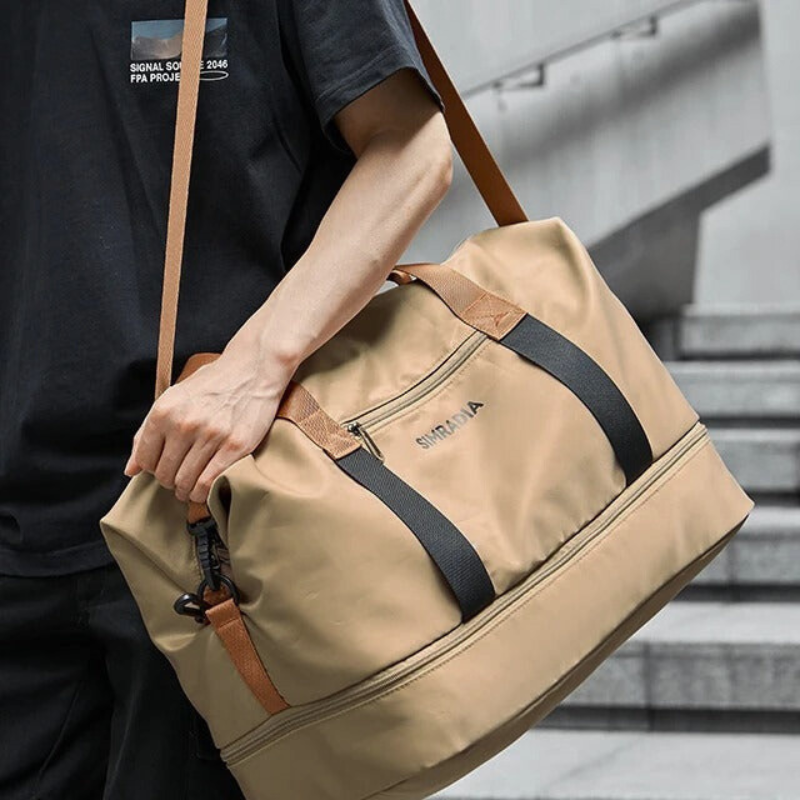
The bag itself matters more than it sounds. The Metro Laptop Brief was built for exactly this kind of session — a slim Oxford exterior that doesn't look out of place on any café table, a dedicated padded sleeve for the laptop, a front zip for charger and earbuds, and an interior organizer for everything else. It's the bag you reach into once and close before you sit down. Nothing rattling. Nothing hunting.
For days when you're commuting to work after a café session — or carrying more gear between locations — the Haven Messenger handles a fuller load while staying compact enough that it doesn't overwhelm a café table. The anti-theft back pocket is genuinely useful in a busy café where your attention is on your screen and your bag is on the chair behind you.
Whatever bag you use, carrying less on purpose is part of what makes café work feel clean. Every extra item is a potential distraction sitting in front of you. Edit before you leave, not when you arrive.

The Full Picture
Working from a coffee shop isn't inherently productive or unproductive — it's a tool, and like any tool, the results depend on how deliberately you use it. The sessions that work follow a recognizable pattern: you arrive with one specific thing to accomplish, you set up the same way every time, you manage the environment proactively rather than reactively, and you leave before the session loses its edge.
Do all of that, and you'll find that two hours in a good café can produce more than a full morning at your desk ever did. Not because the café is magic — because you finally stopped treating it like a place to sit down and hoping something happened.
Frequently Asked Questions
Is it rude to work at a café for a long time?
If you're ordering something appropriate for the time you're there — a coffee per hour is a reasonable guideline — you're not exploiting the space. Most cafés that actively want you to stay longer have power outlets and solid Wi-Fi. Most that don't want long-stay laptop workers have deliberately removed them. Read the room and act accordingly.
Does background noise actually help you concentrate?
For certain kinds of work, yes. Research consistently shows that moderate ambient noise — around 70 decibels, roughly the volume of a mid-busy café — improves creative and divergent thinking compared to silence. It's less effective for focused analytical work or reading comprehension. Match the session type to the environment.
What's the best time of day to work from a coffee shop?
Early morning (before 9am) and mid-morning (after the commuter rush clears, roughly 10:30am) are the most consistently productive windows. Pre-noon café environments tend to have better acoustics, easier table access, and calmer energy than afternoon or weekend sessions.
How do I avoid getting distracted at a coffee shop?
Three things cover the majority of it: arrive with a single defined deliverable (not a list), put your phone in your bag instead of on the table, and use in-ear earbuds with instrumental music during the session. These aren't restrictions — they're the conditions that make focus the path of least resistance.