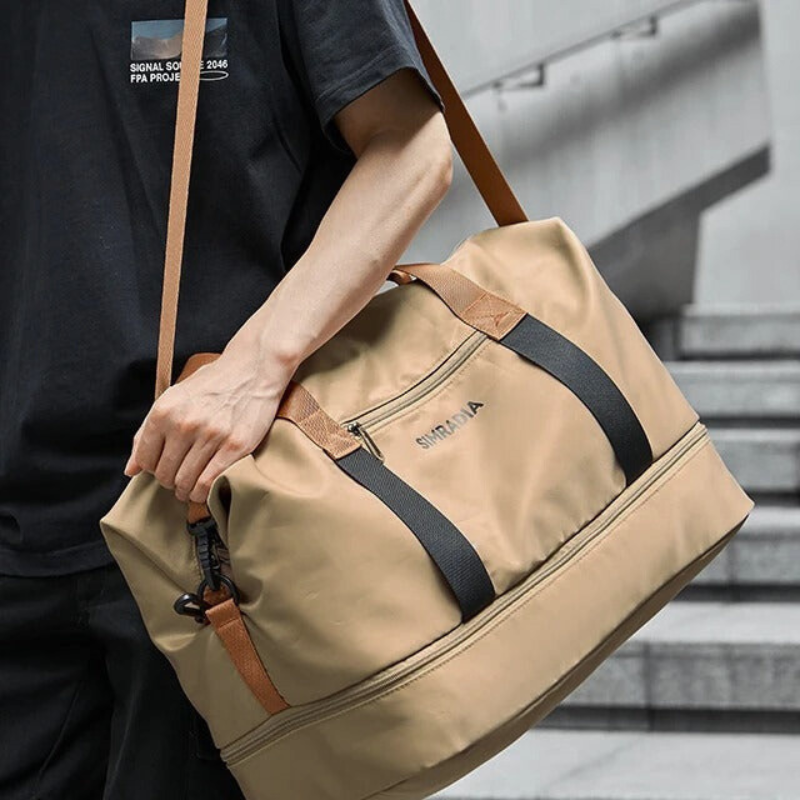



Messenger Bag Shoulder Pain: Fix the Setup Before You Replace the Bag

Shoulder pain from a messenger bag is usually a setup problem before it is a bag problem. Most people feel the pinch after weeks of the same commute: strap too long, load too heavy, bag hanging too low, and no habit of switching sides. Replacing the bag can help. Fixing the setup often helps first.
This guide is for people who like a single-strap bag for access and city movement, but do not want a daily ache at the base of the neck or along one trapezius. It pairs with how heavy your everyday bag should be and messenger bag vs backpack when you need a format decision. It is not medical advice. If pain is sharp, radiating, or lasting after you stop carrying, talk to a clinician.
Why messengers load one side of the body
A backpack spreads weight across two straps and the back panel. A messenger or crossbody puts most of the load on one shoulder contact point and a diagonal strap. That is useful when you want the bag at your side on a train, in a booth, or walking between meetings. It is less forgiving when the bag is overloaded or worn like a low sling that pulls away from the body.
Three forces usually stack:
- Vertical load through the strap into one shoulder
- Lateral pull if the bag hangs away from the hip instead of close to the torso
- Static posture if you hike the shoulder up all day to keep the strap from sliding
You do not need a heavy bag to feel this. A medium bag worn wrong for forty minutes each way is enough.

Fix the setup before you replace the bag
Work these in order. Each one is free.
1. Shorten the strap until the bag sits high on the hip
If the bag bounces on the thigh or swings in front of your knees, it is too long. A long strap increases leverage. The bag pulls away from your center of mass and your shoulder works harder to stabilize it.
Aim for:
- Bag body against the side of the hip or slightly behind the hip when you walk
- Strap firm across the torso, not loose and sliding
- No need to constantly hitch the shoulder
Crossbody wear (strap across the chest to the opposite hip) usually stabilizes better than pure single-shoulder hang for longer walks. Try both. Keep the shorter, closer position.
2. Cut weight before you cut the format
Shoulder pain tracks load. Run a one-week audit:
- Weigh the bag as you actually leave the house (kitchen scale is fine)
- Empty everything onto a table
- Return only what you used in the last five workdays
Common weight that does not need to ride every day: spare shoes, full gym kit on non-gym days, multiple chargers, hardcover books, "just in case" layers. For a structured weight framework, use the everyday bag weight guide. For a weekly reset habit, use the Sunday bag reset.
A practical target for many city commuters is a lean daily kit: laptop if required, one short cable, wallet and keys, phone, water only if you will drink it, one light layer. Organization systems in how to organize your bag help because loose bulk becomes dead weight.
3. Widen the contact patch and stop pinching
Thin, round cords dig. A wider, flatter strap spreads pressure. If your current bag has a narrow strap with no pad, that alone can explain hot spots even at moderate weight.
Also check:
- Hardware that sits directly on the collarbone
- Twisted straps that create a rope edge
- Jacket seams under the strap that create a ridge
Smooth the path of the strap. Wear a mid-layer with a clean shoulder line when you can.
4. Alternate sides and take micro-breaks
If your commute is long, switch the bag to the opposite shoulder at a natural midpoint (transfer station, coffee stop, building lobby). On trains and buses, set the bag on your lap or between your feet when seated instead of staying loaded the entire ride. Standing still with a loaded single strap is still load.
5. Watch posture you invent to "help"
Hiking one shoulder, leaning away from the bag, or gripping the strap with a raised elbow are common compensations. They feel like control. They often increase neck and upper-back fatigue. Prefer a shorter strap and closer bag so you can stand neutrally.

When the format is the problem
Setup fixes fail when the job of the bag exceeds what one shoulder should do every day. Signals:
- Your true daily load stays high after a ruthless purge (large laptop, multiple devices, gym block, long walk)
- Pain returns within minutes even with a short strap and wide pad
- You need both hands free and still carry a heavy kit for long distances
- You already tried crossbody and side-switch habits for two weeks with little change
Then a two-strap bag is a legitimate answer, not a style defeat. Compare formats honestly in messenger vs backpack. For size framing, see what size bag you actually need for commuting.
What to look for if you stay with a messenger
- Wide, adjustable strap with enough range to wear high on the hip
- Stable crossbody geometry so the bag does not swing wide
- Enough structure that the load does not collapse into a soft lump pulling on one point
- A main cavity you can keep lean so you are not rewarded for overpacking
- Quick outer access for phone and wallet so you are not opening the full bag on every small errand (which often leads to looser packing)
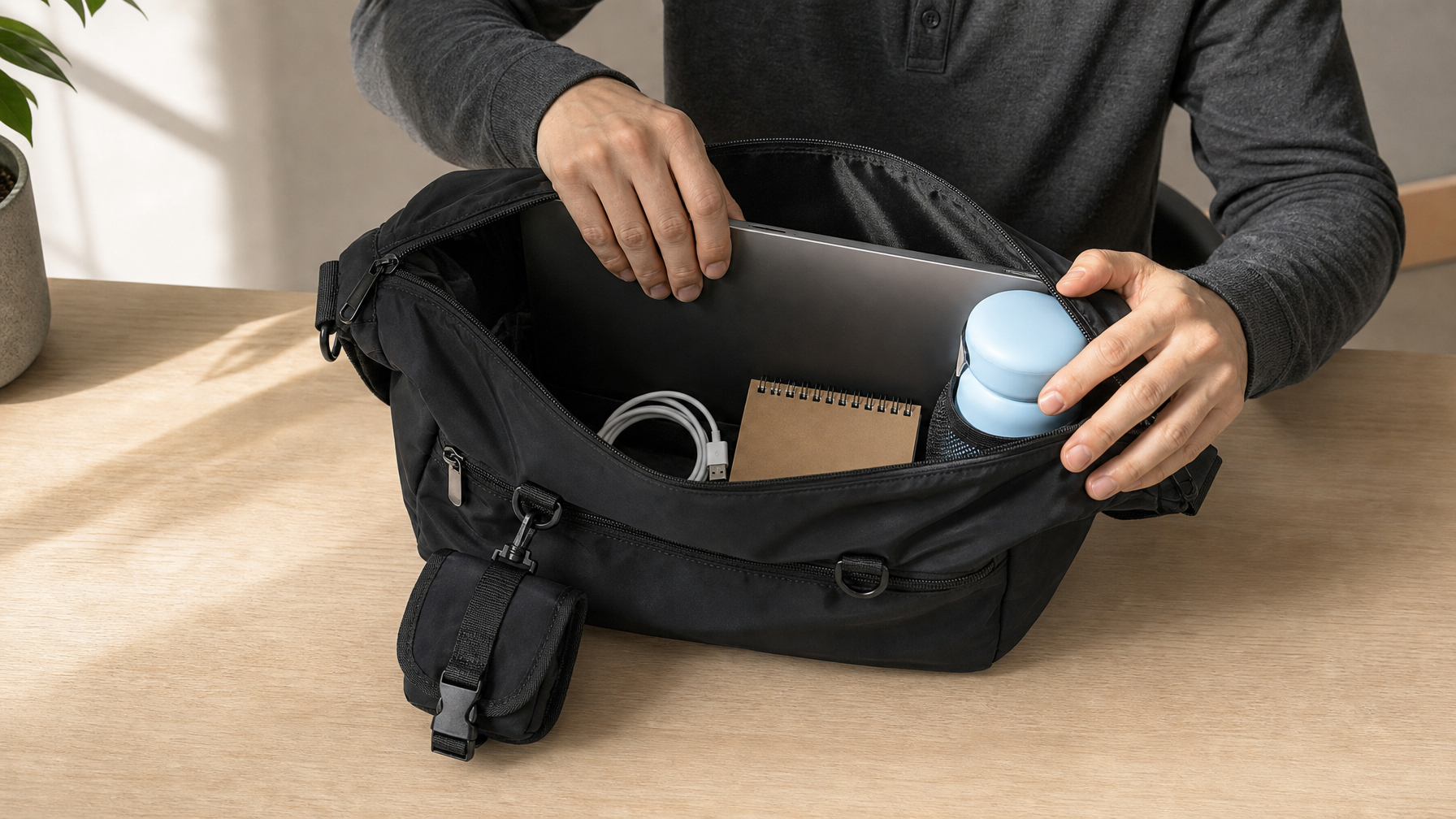
For Field & Ash, the Haven Messenger is a modern top-zip crossbody messenger hybrid at $89. It is built for daily city carry with a wide seatbelt-style strap, a main compartment that fits a laptop up to 14 inches (no dedicated padded sleeve; the laptop sits in the open main cavity), and external organization that supports a lean kit. The front pocket fits your phone, wallet, and card together. Access the front pocket while Haven stays at your side. A separate back pocket fits a phone and wallet together. The detachable pouch holds one small essential, such as AirPods. The shell is water-resistant 600D Oxford, not a fully waterproof dry bag.
If you want a more structured, office-forward single-strap option, the Metro Laptop Brief ($79 for the 11 inch variant, $99 for the 14 inch) stays slim and includes a padded device sleeve. For heavier multi-modal days, the Summit Messenger ($129–$149) is a larger flap messenger with a padded strap and more volume. Larger volume only helps if you refuse to fill it by default.
What to look for if you move to two straps
- Even load across both shoulders
- A laptop compartment that matches the device you actually carry
- Enough capacity for your real week without turning into a hiking pack
- A silhouette you will still wear on client days
In the active catalog, the Lite Backpack ($89) is a lighter two-strap option when you want to keep weight down. The Apex Backpack ($139–$159) and Venture Backpack ($139) suit more organized everyday laptop carry. Expandable travel-scale loads belong in something like the Transit Pack ($199), not in a messenger you force to behave like a suitcase.

A two-week test that settles the argument
Do not buy three bags in one weekend. Run a short experiment.
Week 1, messenger optimized
- Shorten the strap
- Purge the load
- Wear crossbody if possible
- Alternate sides mid-commute
- Note pain at start, midpoint, and end of each day (0-10 scale is enough)
Week 2, two-strap comparison on the same route
- Same contents
- Same commute
- Same shoes and outerwear when you can
- Compare the same notes
If Week 1 drops pain to a mild background level you forget about by mid-morning, keep the messenger and lock the setup habits. If Week 2 is clearly better and Week 1 never settles, change format without guilt. Many people land on a hybrid calendar: messenger on light meeting days, backpack on heavy device or long walk days. That is the same spirit as splitting laptop days and light days in hybrid work, covered more broadly in best bags for hybrid work.
Common mistakes that keep the pain around
Buying a "better" messenger and packing it the same way. New fabric does not cancel old weight.
Wearing the bag low because it looks casual. Low often means more swing and more shoulder work.
Using a messenger as a gym-plus-office trunk every day. Transition days need a deliberate pack plan; see gym to office without switching bags if that is your pattern.
Ignoring recovery. Even a good setup benefits from not loading the same tissue every waking hour. Put the bag down at your desk. Do not wear it while sitting through long calls.
Chasing one-handed myths. Access matters. So does not overstuffing the bag so every pocket becomes a junk drawer. Keep the daily surface area small.
FAQ
Is shoulder pain normal with messenger bags?
Mild fatigue on a long first week with a new strap can happen. Ongoing pain that builds through the week is a signal to change load, length, or format. It is common. It is not something you have to accept as the price of looking put together.
Should I switch to a backpack permanently?
Only if your real load and distance stay high after setup fixes. Plenty of people keep a messenger for city access and add a backpack for heavy days. Format is a tool, not an identity.
Does a wider strap solve everything?
It helps pressure distribution. It does not fix a bag that is too heavy or hanging too far from the body.
Can a lighter bag still hurt?
Yes, if the strap is thin, the bag hangs low, or you hike the shoulder all day. Weight and geometry both matter.
What if I only hurt on one specific commute?
Map that route: stairs, long standing segments, one-shoulder habits on transit. Fix those segments first. Sometimes the bag is fine for a short walk and wrong for a forty-minute stand.
The point
Messenger bag shoulder pain is usually the sum of length, load, and time on one contact point. Shorten the strap, cut the dead weight, stabilize the bag against your body, and give the other side of your body a turn. If the pain remains after an honest two-week setup test, move the heavy days to two straps. Keep the single-strap bag for the days when access and a lean kit are the real job.
Carry deliberately. Your shoulder is part of the system.