


How Heavy Should Your Everyday Bag Be? A Simple Weight Check

The moment usually happens when you borrow someone else's bag.
You pick it up and carry it for half a day, and you don't think about it once. Then you go back to yours and the difference is immediately obvious. The pull on your shoulder, the slight lean, the small adjustments you make every few blocks that you stopped noticing because you started doing them automatically.
Most people find out their bag is too heavy the same way: by comparison. Not through pain, not through measuring anything, but through the contrast of carrying something lighter and realizing how much friction they'd been absorbing.
This guide is for the moment after that comparison. If you've started wondering whether your current carry is heavier than it needs to be. And what to do about it. Here's the framework that actually helps.
Why Bag Weight Adds Up More Than You Think
A 3-pound bag doesn't feel like much sitting on a table. Over a 45-minute commute with walking, stairs, and transit, it's a different experience.
The problem isn't peak weight. Your shoulder can handle a heavy bag for a minute. The problem is accumulated load. The same muscles contracting against the same resistance for the same repetitive motion across an entire commute, then the entire walk to a café, then the subway home.
Orthopedic research consistently points to asymmetric shoulder loading as the root of most commuter bag discomfort. A bag that sits on one side. Even a light one. Asks the same muscles to compensate for every step. The heavier the bag, the larger the compensation, and the faster fatigue and strain accumulate.
There's also a postural dimension. A heavy one-shoulder bag creates a lateral pull that the spine resists by curving slightly to compensate. Over time, that compensation becomes habit. Most people who switch to a lighter bag notice a change in how they stand within a week or two. Not because the bag is magic, but because the muscles stop working against anything.
The short version: your body is paying for your bag weight all day, whether you notice it or not.
What's Actually a Reasonable Weight?
Physical therapists working with commuters and athletes typically use a guideline of 10. 15% of body weight as the upper limit for any bag carried daily. For most adults, that translates to somewhere between 15 and 25 pounds for a fully loaded bag.
That number sounds generous. And it is. Most commuters are nowhere near it. But the real question isn't about the maximum. It's about the minimum.
The bag itself. Most carry bags fall somewhere between 0.5 pounds (a light sling or compact crossbody) and 4 pounds (a structured leather briefcase or hiking-style backpack). The bag's empty weight is the one weight you can't reduce through better packing. It's fixed. It follows you whether you're carrying a lot or a little.
The contents. A laptop, charger, headphones, water bottle, wallet, and phone typically weigh between 5 and 8 pounds depending on what you carry. Add a change of clothes or a larger adapter and you're at 10 or more.
The working target for a daily commuter bag: aim for a total loaded weight you can carry for 45 minutes without noticing you're carrying it. That feels vague until you test it. And once you find that threshold, you know it. It's the weight at which the bag stops registering.
For most people doing a mixed commute (transit and walking), that number tends to fall between 5 and 9 pounds loaded. Which means your empty bag should ideally come in under 2 pounds. And closer to 1 pound if you want meaningful headroom.
The Weight Audit
The single most useful exercise for figuring out if your bag is too heavy is also the most tedious: empty it completely and weigh everything.
Not to count calories or optimize obsessively. To identify the things you carry without ever thinking about why.
Step 1. Put the bag on a scale empty. Note the number. That's your baseline. It comes with you everywhere, whether you like it or not.
Step 2. Go through what you were carrying and divide it into two piles: things you used in the last week, and things you haven't touched in the last week.
The second pile is the problem. It's almost always larger than expected.
Common permanent residents in commuter bags that most people have never consciously added: a power adapter they stopped needing when they switched laptops, duplicate cables kept as backups, a notebook they carry in case they want to write something down (they don't), two pairs of earbuds, and three pens.
Step 3. Weigh just the first pile. The things you actually use. Add back the bag. That's your real carry weight.
Compare it to what you were carrying before. The gap is usually 0.5 to 1.5 pounds. On a foot commute, that's the difference between noticing the bag and not.

When Capacity Matters More Than Weight
Not everyone should optimize for the lightest possible bag. Two things determine how much weight matters for your specific commute.
How far you carry it. A 10-minute walk to a car is different from a 25-minute walk through a transit station and three neighborhoods. Distance is the multiplier for everything else. The longer you carry, the more every pound matters.
What you're carrying in it. If your daily load is a laptop, a thin wallet, a phone, and earbuds, a light bag with minimal pockets serves you well. If you're adding a gym kit, a change of clothes, or regular trips to client sites with presentation materials, a larger bag becomes unavoidable. And the question shifts from weight to how intelligently that weight is distributed.
The worst outcome is carrying a heavy bag with heavy contents because you feel like you should have the capacity even on days you don't use it. A bag that's too big for your actual carry ends up holding extra weight through volume alone.
What the Lightest Options Actually Look Like
If your weight audit points to a change, here's where the Field & Ash catalog sits at the lightweight end of the range.
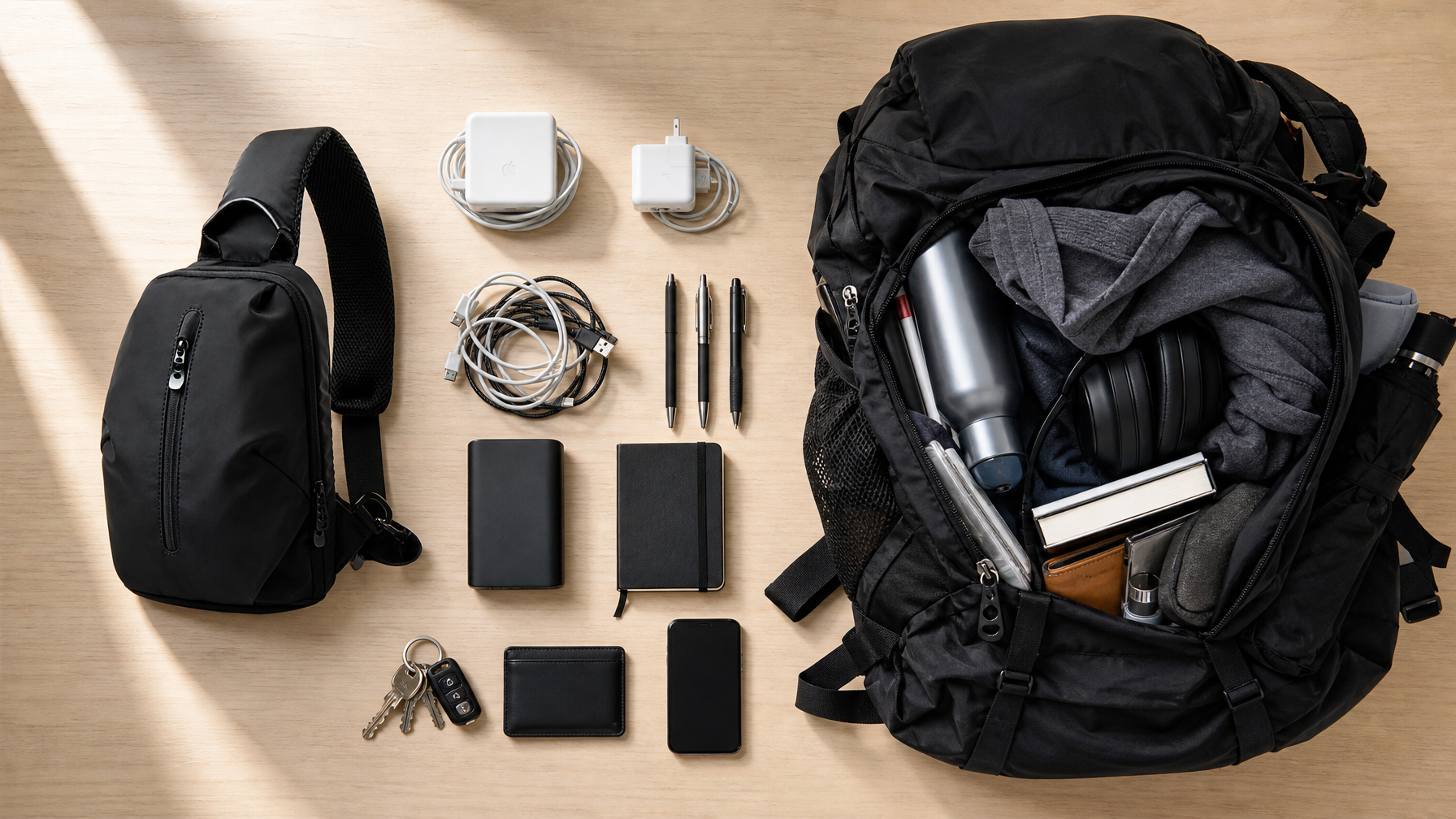
Commuter Sling ($89). 0.66 lb empty
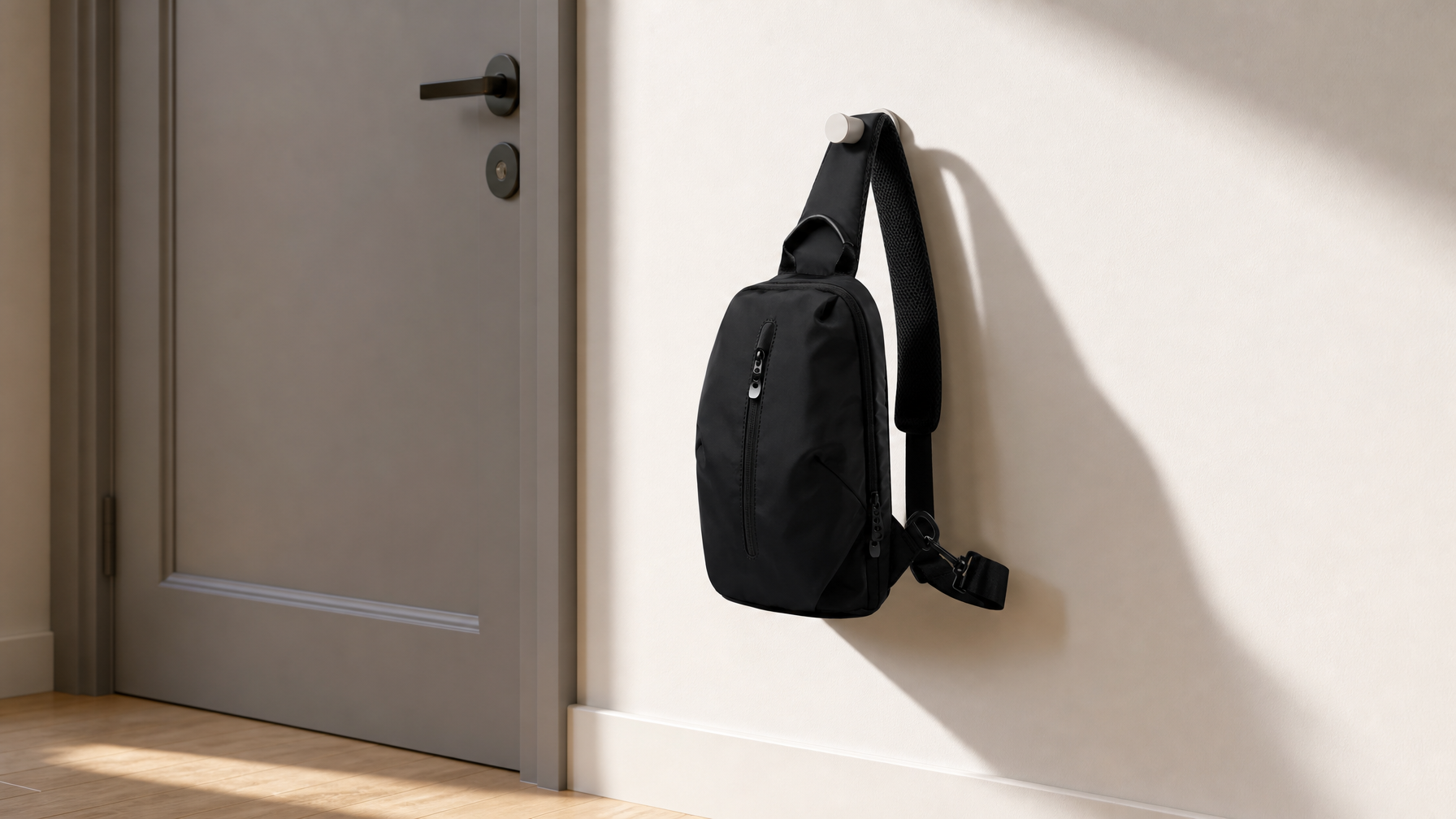
The Commuter Sling is the lightest bag in the catalog at 0.66 lbs empty. It's built for days when you're carrying less. A phone, wallet, keys, earbuds, and a portable charger. And want those things accessible without reaching into a pocket.
The sling format carries crossbody at the chest or hip and swings around to the front for fast access. There's no laptop compartment, which is the reason it weighs less than a pound: it's built for a defined, lighter load, not a full daily kit.
For short city commutes, weekend carry, and situations where a messenger or backpack would be overkill, this is the lightest carry that still holds what you need organized.
Lite Backpack ($89). 1.0 lb empty
At 1.0 lb empty, the Lite Backpack is the lightest backpack in the catalog. It carries a laptop, and it does so without the structural overhead of a heavier organized pack.
The tradeoff is intentional: fewer internal pockets means less bag weight. If you're packing deliberately. Laptop, charger, one or two other items. The Lite Backpack distributes that load across both shoulders and disappears from your awareness faster than any one-shoulder carry of equivalent weight.
For longer commutes where symmetric load distribution matters, this is the backpack that stops the shoulder conversation entirely.
Haven Messenger ($89). 1.21 lb empty
The Haven Messenger sits at 1.21 lbs empty. Heavier than both options above, but within the range of not-noticing for most commutes. It carries a 14-inch laptop in the main compartment along with full daily organization: two adjacent interior slip pockets, a separate interior zip pocket, and a mesh bottle pocket on the interior side wall. A hidden back zip pocket sits against your body when the bag is worn crossbody.
The front exterior zip pocket fits your phone, wallet, and card together. Access the front pocket while Haven stays at your side.
Haven is the carry for people who want a complete daily kit. Laptop, organized accessories, quick phone access. In a crossbody format that stays at hip level and doesn't swing. The extra weight compared to the sling or Lite Backpack is the cost of that capability.

The Weight You Stop Noticing
The right bag weight isn't a number. It's the point where the bag stops registering mid-commute. Where you arrive somewhere and realize you haven't adjusted the strap or shifted the load once since you left.
That experience varies by person, commute, and how much you're carrying. But the audit process gets you to an honest baseline: this is what I actually carry, this is what it weighs, and this is what I notice.
Most people who go through it find their current carry is heavier than they thought, and their actual required carry is lighter than they assumed. The gap between those two numbers is where the right bag lives.
A note on the bag's empty weight: it matters more than most people account for when bag shopping. A 3-pound bag that looks organized and capable will always weigh at least 3 pounds, regardless of what you put in it. A 1-pound bag starts there and adds only what you choose to carry. That difference follows you every day you use either one.
If you're not sure where you fall, start with the audit. The number it produces tends to answer the question more clearly than any comparison review or feature list.
Frequently Asked Questions
How heavy is too heavy for a daily bag?
There's no universal cutoff, but a useful working test is whether you adjust, shift, or think about the bag during a normal 30-minute carry. If you're compensating regularly, the bag is too heavy for the load and carry style it's being asked to handle. Most commuters find the threshold sits somewhere between 7 and 10 pounds loaded, depending on commute distance.
Does the bag's empty weight really matter?
Yes. The empty weight is the weight you can't reduce through smarter packing. A bag that weighs 3 pounds empty weighs at least 3 pounds every day you use it. For daily commuters, the empty weight compounds over weeks and months in a way that matters for shoulder and posture health.
Should I weigh my bag?
Doing the audit once is useful. Not as an obsessive measurement exercise but as a practical test of whether your carry matches your actual needs. Most people who do it find out they're carrying 1 to 2 pounds they don't need. That's the only data point worth having.
Which Field & Ash bag is lightest?
The Commuter Sling at 0.66 lb, followed by the Lite Backpack at 1.0 lb and the Haven Messenger at 1.21 lb. Each serves a different carry capacity, so the right choice depends on what you're actually carrying day to day.