


The 1.5-Bag Travel Setup: How to Pack a Main Bag and a Day Bag Without Overpacking

One-bag travel sounds simple until the day bag problem shows up. You check into the hotel, leave the main pack behind, and still need something for the city: phone, wallet, water, a layer, maybe a camera. Without a plan, that second bag becomes a second packing project, or you drag the full travel backpack through museums and dinner.
A 1.5-bag setup solves that with a clear split. The main bag holds the trip. The half bag is a compact day bag that leaves the room empty of bulk and stays useful from the first morning walk to the last night out.
This is not a third suitcase. It is a deliberate two-piece system: one bag that travels, one bag that explores.
If you are still deciding whether a single expandable pack is enough on its own, start with the best one-bag travel backpacks guide. For longer multi-city trips, pair this with international travel bag systems. For how the personal-item slot works on flights, see airport carry setup and related personal-item guidance in the Journal travel cluster.
What 1.5-bag travel actually means
Main bag (the 1): Clothing, shoes, toiletries, bulk tech, anything you only need at the lodging. It can be a travel backpack or expandable pack that stays carry-on friendly when packed with discipline.
Day bag (the 0.5): Identity, phone, payment, keys or room card, small power, water if needed, one layer, and whatever you will actually touch between leaving the room and returning. It should feel light enough that you forget you are wearing it.
The ratio is intentional. The day bag is not half the volume of the main bag. It is the half of the system that does daily work while the main bag rests.
People fail 1.5-bag setups in two ways:
- They pack the day bag like a second weekend bag (too much clothing, shoes, "just in case" bulk).
- They pack the main bag so tightly that the day bag becomes a dumping ground for overflow at the airport.
Both mistakes erase the point of the system.
When 1.5 bags beat pure one-bag
Pure one-bag is excellent when every day looks like a transit day: you leave lodging with everything, or you never separate lodging gear from city gear.
Choose 1.5 bags when:
- You will leave a base (hotel, Airbnb, train lodging) and explore for hours
- You do not want your full clothing load on your back in heat or crowds
- You need a bag that can pass as everyday carry in restaurants and museums
- You want a personal-item candidate for flights while the main bag is the carry-on
Skip 1.5 bags when:
- Every night is a new city with no secure place to leave a main bag
- Your trip is mostly moving, not settling
- You refuse to manage two pieces at security and boarding (valid preference)
There is no moral win in either camp. Fitness for the itinerary wins.
Build the main bag first
The main bag only has one job: hold the trip without forcing you to live out of it every hour.
Capacity that stays honest
Aim for a pack that fits your clothing formula for the trip length, not a volume number you saw online. Expandable designs help when the outbound flight is tighter than the return (souvenirs, laundry lag). An example in the active catalog is the Transit Pack ($199), built as an expandable laptop backpack for travel loads rather than a fashion daypack.
For travelers who want a simpler non-expandable laptop backpack shape, the Apex Backpack ($139–$159) covers a full work-and-travel clothing block when you pack dense and leave the "maybe" items at home.
What stays in the main bag
- Clothing cubes or rolled layers
- Spare shoes if you bring them
- Full toiletry kit
- Charging bricks you only need overnight
- Documents you will not need mid-day
- Anything you are willing to leave behind a locked door
What never lives only in the main bag on travel days
- Passport and boarding credentials (on your person or day bag during airport moves)
- Medication you cannot replace
- The phone you navigate with
Build the day bag second
The day bag is where 1.5-bag systems succeed or fail. Treat it as everyday carry with a travel overlay, not as a mini suitcase.
Size and structure
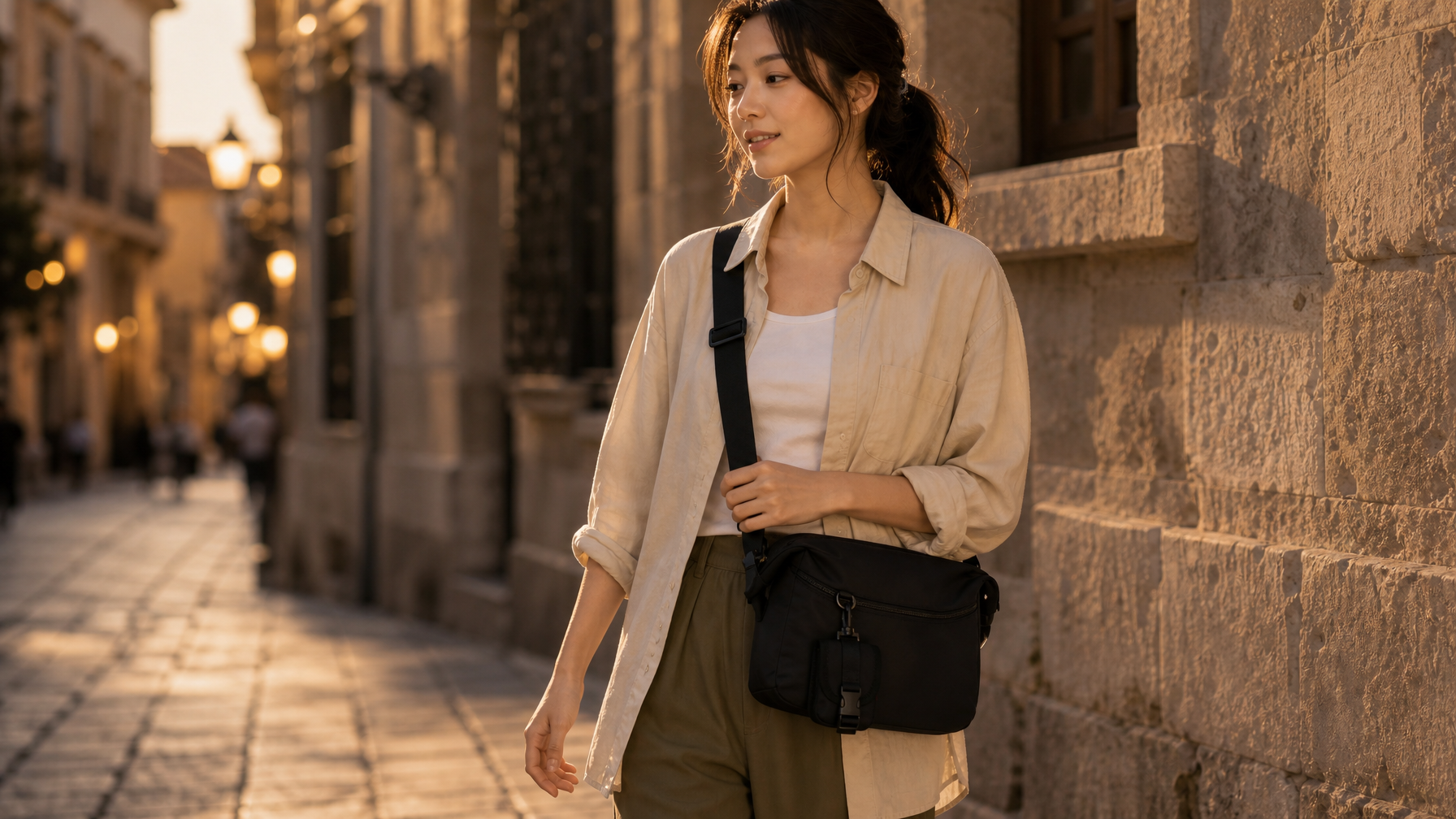
Soft structure usually beats rigid mini luggage for city days. You want something that sits against the body, opens without a full dump, and does not look like airport gear at dinner.
Strong day-bag shapes:
- Compact messenger or crossbody for laptop-light city days
- Sling for phone-wallet-layer days
- Slim waist pack only when the city load is truly minimal
Catalog options that match the day-bag job
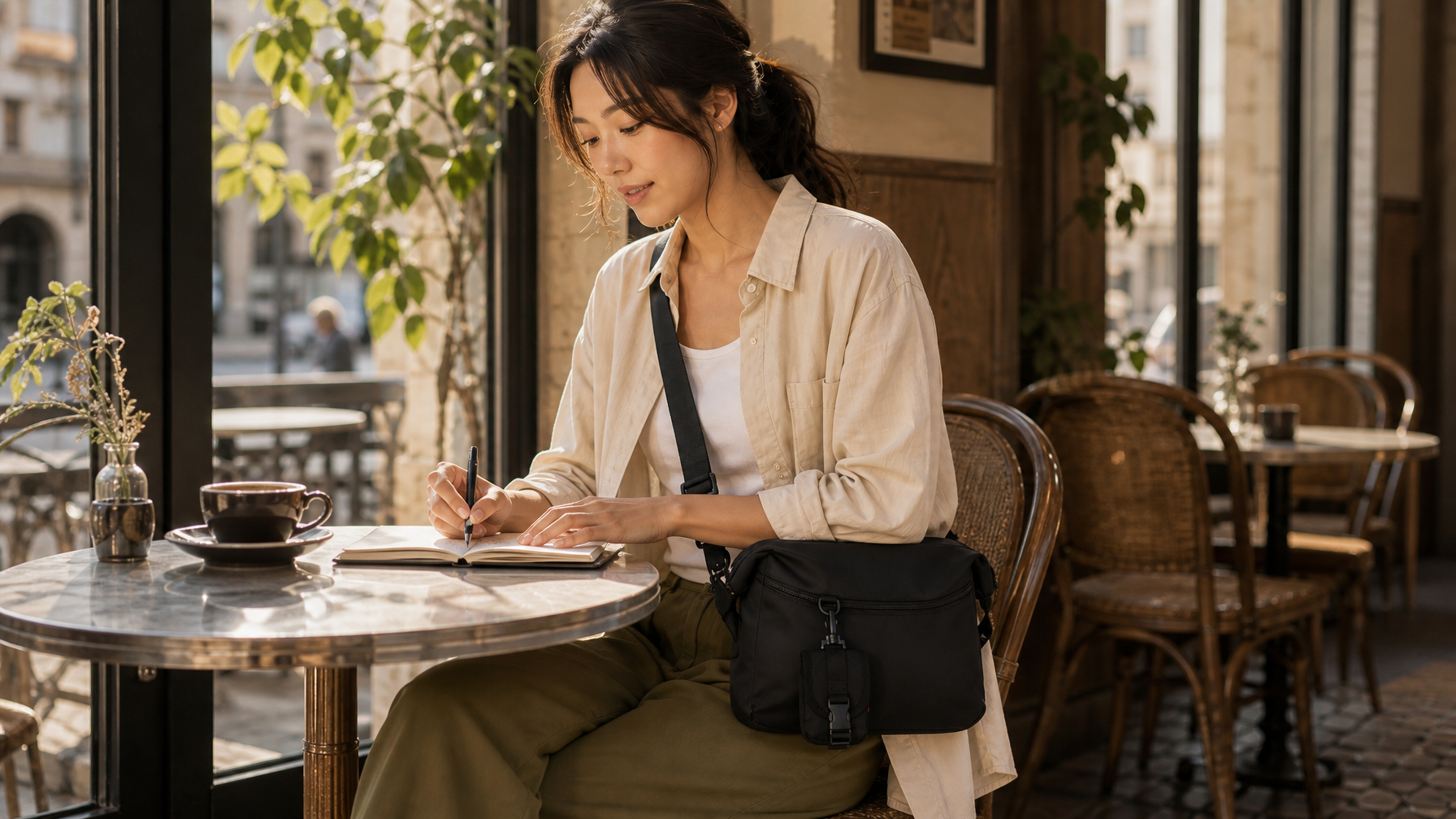
Haven Messenger ($89). Modern messenger hybrid for days when you still want a laptop up to 14 inches in the main compartment (no dedicated padded sleeve; the laptop sits in the open main compartment), plus organized access for phone, wallet, and card in the front pocket. A separate back pocket fits a phone and wallet together. The detachable pouch holds one small essential, such as AirPods. Water-resistant 600D Oxford shell. Good default when the day includes café work or longer walks with a thin layer.
Commuter Sling ($89). Lightest full sling option in the lineup (about 0.66 lb). Best when the day bag should disappear and the laptop stays in the room or in the main pack.
Transit Crossbody ($69). Slim entry crossbody when the day load is wallet, phone, and a few small items and you want less bulk than a messenger.
Horizon Waist Pack ($59–$69). Minimal hands-free option for short hops and true light days. Not a substitute for a messenger when you need a laptop or water bottle capacity.
Match the day bag to the heaviest normal city day on the trip, not the lightest. If one afternoon needs a tablet and a jacket, design for that, then under-pack on lighter days.
The packing split (copy this)
Use this as a ceiling, then cut.
Main bag
- Clothing for the trip length using a simple formula (for example: bottoms × days/2, tops × days, one warmer layer, sleep kit)
- Toiletries in a single kit
- Laundry bag or packing cube for worn clothes
- Night charging kit
- Optional spare shoes in a bag
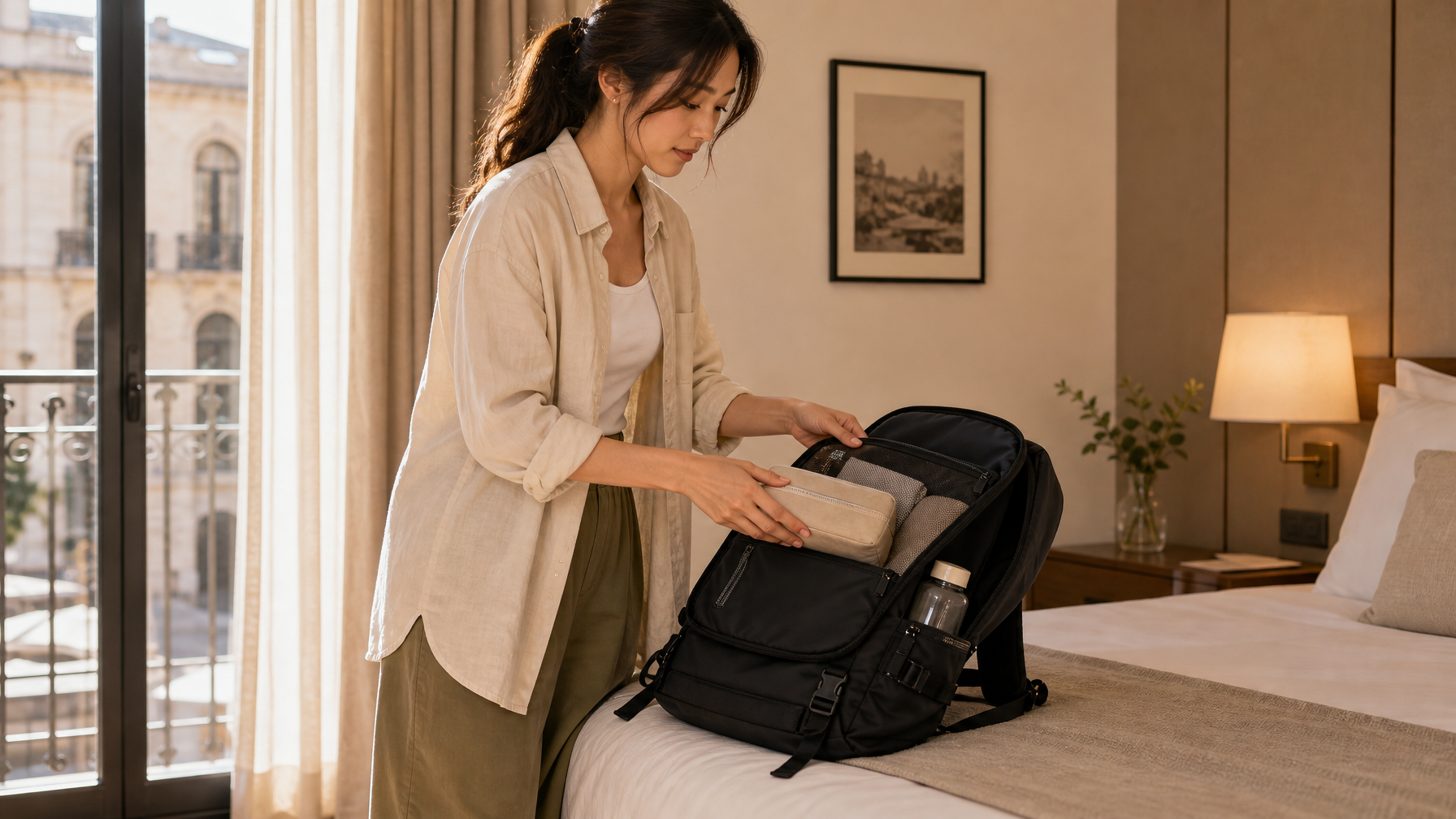
Day bag
- Passport or ID when you are away from the room in unfamiliar cities
- Phone, wallet or slim card holder, room key
- Compact cable and small power bank if you use one
- Medication for the day
- Thin layer only if weather demands it
- Water bottle only if the bag and your route support it
- Camera only if it is a primary reason for the day
If the day bag needs a second clothing cube, the split failed. Move clothing back to the main bag or leave it home.
Airport day: how the two bags behave
On flight days, roles can flip temporarily:
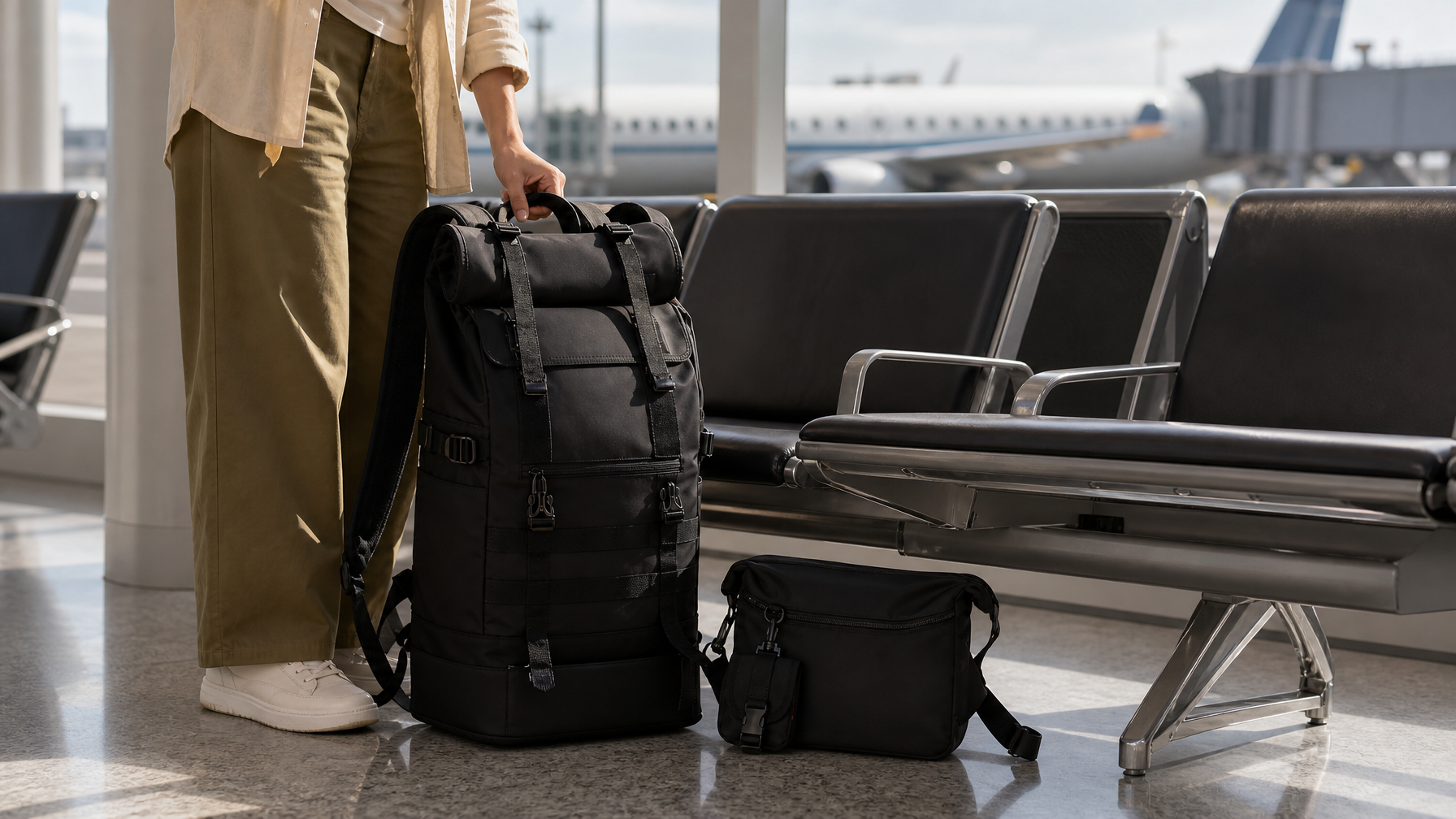
- Main bag = carry-on that may go overhead
- Day bag = personal item candidate under the seat when airline limits and seat geometry allow
Do not assume every airline or every seat will accept the same day bag under the seat. Published personal-item limits and physical under-seat space vary by carrier, aircraft, fare, and seat. Pack the day bag so it can compress, and keep credentials accessible without unpacking the main bag in the aisle.
Security tip: keep liquids and laptop staging simple. The day bag should open to the items you actually need at the tray; the main bag should not become a second puzzle mid-line.
City days: leave the main bag behind on purpose
Once lodging is secure, the 1.5-bag payoff is psychological as much as physical. You walk with a day load. You sit down without a full travel pack beside the chair. You stop treating every errand like a relocation.
Rules that keep the system clean:
- Reset the day bag every night. Empty trash receipts, recharge what lives there, restock water only if needed.
- Do not use the day bag as dirty-laundry overflow. That belongs in the main bag.
- One home for each category. Keys always the same pocket. Phone always the same access path.
- Rehearse the leave-the-room checklist once. After that, it should be automatic.
For a weekly organization habit that transfers well to travel nights, see the Sunday bag reset. For building a permanent everyday system at home that travels with you, see the capsule carry system.
Choosing your pair (decision framework)
Ask four questions:
- Will I leave a secure base most days? If no, lean pure one-bag.
- Do city days need a laptop or only phone-scale tech? Laptop-capable day bag vs sling/waist pack.
- Is the main bag already at its comfortable carry-on limit? If yes, the day bag cannot absorb clothing overflow.
- Do I want the day bag to double as my everyday bag after the trip? Prefer a bag you would actually commute with.
Example pairings from the active catalog:
| Trip type | Main bag | Day bag |
|---|---|---|
| Multi-city, base hotel, café work days | Transit Pack | Haven Messenger |
| One city, light days, heat | Apex Backpack or Transit Pack | Commuter Sling |
| Budget-minded, minimal city load | Lite Backpack or Nomad Backpack | Transit Crossbody |
| Ultra-light sightseeing only | Any disciplined main pack | Horizon Waist Pack |
Common mistakes
Buying a huge "day" tote. If it holds a change of clothes and shoes by default, it is a second main bag.
Matching colors and calling it a system. Visual matching does not create role clarity. Pocket layout and load limits do.
Skipping a night reset. A day bag that accumulates tickets, cables, and snacks becomes the chaos you left home to avoid.
Forcing a laptop into a bag that cannot protect or carry it comfortably. If the day needs a laptop, choose a day bag built for that load. Otherwise leave the laptop secured at lodging.
Ignoring weight. Two light bags beat one heavy bag plus a sloppy tote. For how empty-bag weight shapes comfort, see how heavy your everyday bag should be.
A simple 1.5-bag checklist before you book
- Main bag packed to a real carry-on discipline (not "it closed somehow")
- Day bag packed for the heaviest normal city day only
- Credentials and medication paths tested without opening the main bag
- Secure place to leave the main bag on city days
- Flight plan for which bag is personal item vs overhead when relevant
- Nightly reset habit you will actually do
Bottom line
A 1.5-bag setup is a role split, not a loophole for packing more. The main bag holds the trip. The day bag holds the day. When those roles stay clean, you move through cities lighter, keep lodging calmer, and stop dragging a full travel load through every café, museum, and metro car.
Build the main bag for the itinerary. Build the day bag for the hours between leaving the room and coming back. Carry deliberately in both.