


The One-Bag Rule for Every Kind of Day: How to Find a Bag That Never Feels Wrong

Most people do not need five bags. They need one bag that does not feel wrong on a light day and does not collapse on a heavy day.
The variable day problem is simple. Monday is phone, keys, wallet, and a short walk. Tuesday is laptop, charger, water, lunch, and a full commute. Wednesday sits in between. If the bag only works when stuffed, light days feel ridiculous. If it only works empty, office days turn into loose cables and a second tote.
This is a decision rule for one carry that holds its shape across those loads. Pair it with the capsule carry system for what goes inside, and with two bags for hybrid work only if you already want two distinct bags. Here the goal is one bag that stays honest on both ends of the week.
Name the three loads you actually live
Write three short lists before you shop or retire a bag you already own.
- Light day: what you carry when nothing is scheduled except living.
- Full day: what you carry when work is real, laptop or not.
- Transition day: mostly light until one meeting or transit leg adds weight.
If you cannot name those three loads, you will keep buying for imaginary days. A bag that looks right for a single use case fails when your week is not one use case.
Do not confuse this with a gym-plus-office day. That load lives in gym to office without switching bags. Variable-day carry is ordinary weekdays that swing between almost nothing and a full desk kit.
The one-bag rule
A bag earns the one-bag label only if all four are true:
- It still looks intentional when half empty.
- It accepts a full work load without becoming a soft brick.
- Pocket jobs stay the same whether the main compartment is light or full.
- You can leave without rearranging the whole interior every morning.
If any one fails, you do not have a versatile everyday bag. You have a bag that works on some days and negotiates on others.
Structure matters more than maximum volume. Soft sacks collapse when light and balloon when full. Overbuilt packs that only feel right when packed make light days feel like a suitcase on a coffee run. You want enough structure to hold a silhouette, and enough open volume for a laptop day without a second bag.
What never feels wrong actually means
Never feels wrong is a practical test:
- On a light day, the bag does not look abandoned or deflated.
- On a full day, you are not fighting zippers or stacking loose items into a heap.
- In public, the bag does not announce that you are moving offices when you are walking to lunch.
- At the door, you can grab it without a rebuild.
If you need a different bag personality for errands, office, and weekend coffee, the problem is usually organization and structure, not a missing third SKU. See also the case for carrying less.

Build a core kit that never leaves the bag
The one-bag rule fails if the interior is a junk drawer. Keep a permanent core kit in the same pockets every day:
- Phone, wallet, keys or room card
- Earbuds
- One short charging cable or one multiport adapter
- Thin notebook if you take notes by hand
- One small essential in a fixed pouch, for example AirPods
Everything else is day-specific: laptop, water bottle, lunch, layer, documents.
When the core kit has fixed homes, light days and heavy days feel like the same bag with different add-ons. Habits from the night-before bag prep and the Sunday bag reset keep the core kit honest.
Capacity without bulk
A versatile everyday bag needs a main compartment that can take a laptop for real work without forcing a second bag, and pockets that still work when the main compartment is not full.
Field & Ash's Haven Messenger is built for that middle. The main compartment accommodates a laptop up to 14 inches. There is no dedicated padded laptop sleeve; the machine sits in the open main cavity. The front pocket fits your phone, wallet, and card together. Access the front pocket while Haven stays at your side. A separate back pocket fits a phone and wallet together when you want those items against the body. The detachable pouch holds one small essential, such as AirPods.
Haven is water-resistant, not waterproof. Treat rain as a reason to keep zippers closed and move indoors, not as permission to set the bag in standing water.
If most heavy days are sit-down laptop blocks with short walks, the Metro Laptop Brief is the quieter slim option with a padded device sleeve. If light days are truly minimal and you rarely need a laptop, the Transit Crossbody can be the everyday default, with a larger bag reserved for true laptop days. That is a deliberate two-bag system, not a failure of the one-bag rule.
Run the empty-bag test and the full-bag test
Before you keep a bag or buy a new one, run two five-minute tests at home.
Empty-bag test. Put only the core kit inside. Wear it on a short walk. If the bag looks collapsed or half-deflated, it will feel wrong on light days no matter what the product page says.
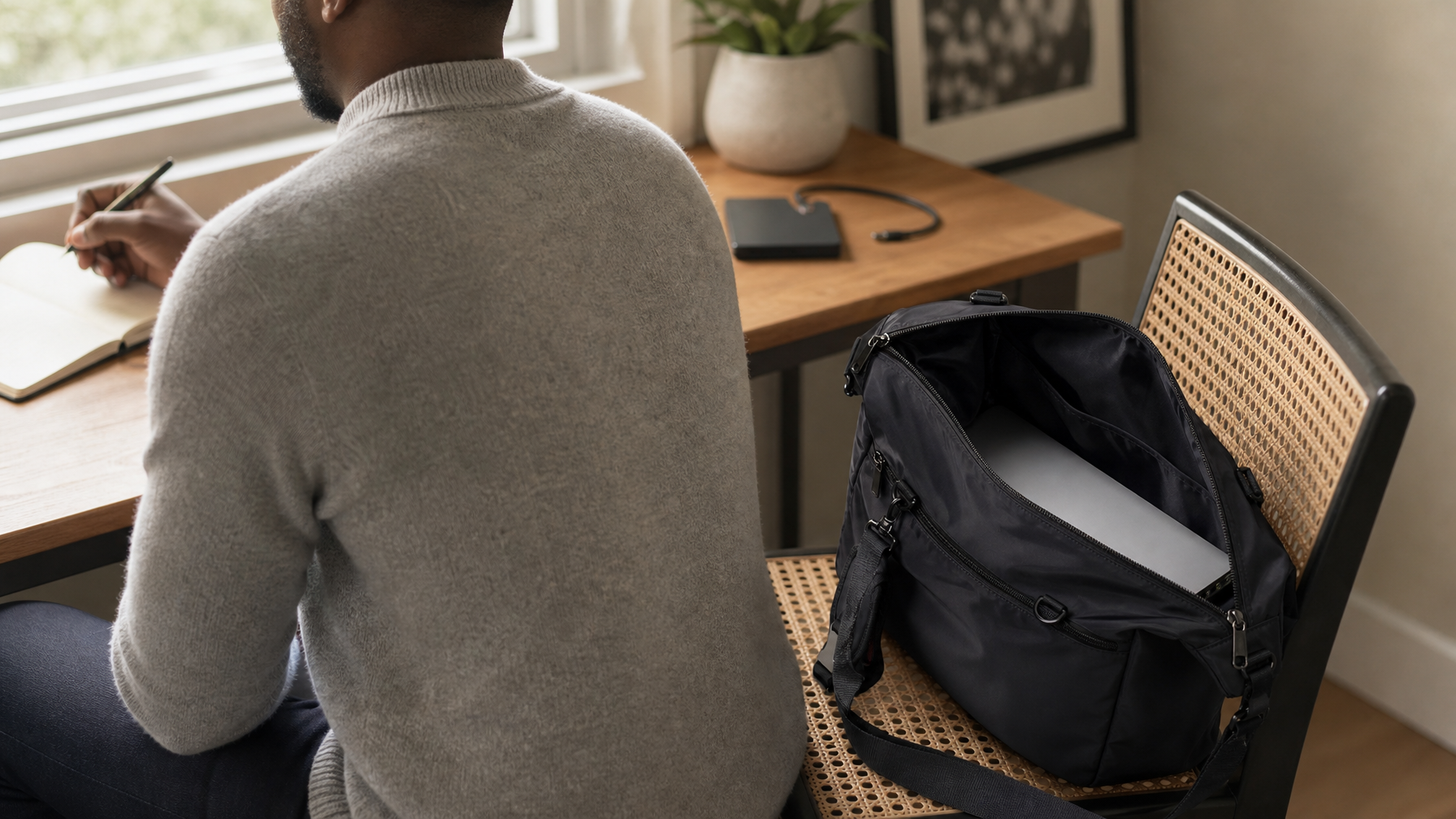
Full-bag test. Add the real full-day load: laptop if you use one, water, layer, lunch if that is normal for you. Walk stairs if you can. If the strap bites, the zipper fights, or items migrate into a heap, the bag fails the variable week.
Both tests must pass. A bag that only passes the full-bag test is an office bag. A bag that only passes the empty-bag test is an errand bag. The one-bag rule needs both.
Weight still matters. A commute already includes walking. Dead weight shows up faster than at a desk. Use the same discipline as how heavy your everyday bag should be: if an item has not been used in a week of real days, it does not belong in the permanent kit.
Pocket jobs stay fixed
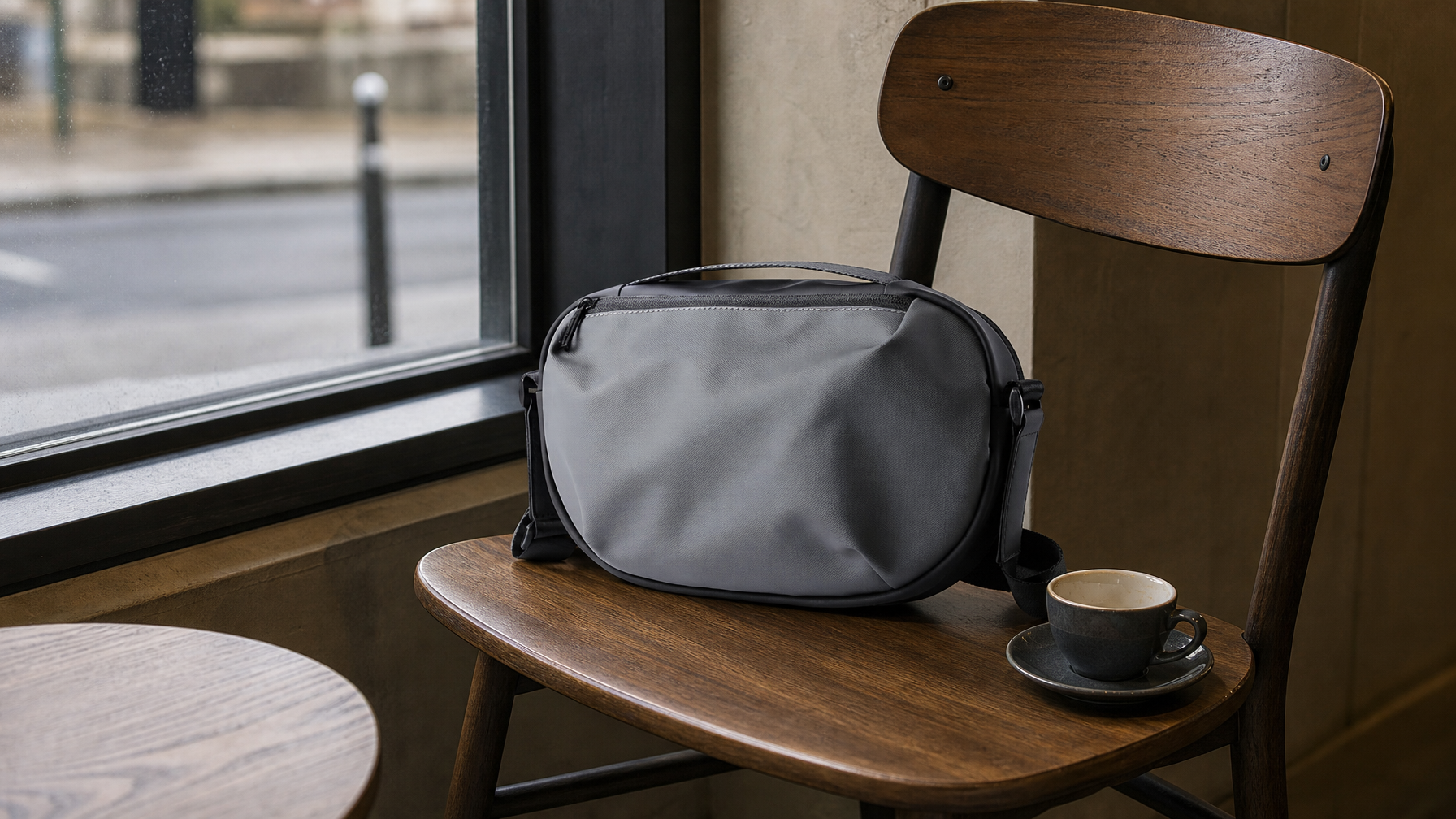
Phone always goes in the same pocket. Cable always goes in the same place. When the main compartment fills on a laptop day, those pocket jobs should not move. That is what makes the bag feel like the same tool on Monday and on Thursday.
If you invent a new layout every morning, the bag is not the only problem. The kit is unstable. Fix the kit first, then judge the bag.
When one bag is the wrong answer
Skip the one-bag rule when the jobs are truly different shapes:
- Gym clothes plus a full office load every day
- Camera kits or tools that need hard protection
- True travel weeks where a room bag and a day bag split cleanly, as in the work-while-traveling setup
- A job that requires a hard briefcase for client optics every day
In those cases, two bags with clear jobs beat one bag that fails half the week. The failure mode to avoid is three or four almost-right bags that all do most of the same job.
For hybrid office formats, start with the best bags for hybrid work. For coffee-first remote days, use coffee shop bag setup. Those articles solve scenario-specific days. This one solves the week that mixes them.
A simple weekly pattern
- Sunday night: empty trash, wipe the interior, put the core kit back in fixed pockets.
- Light days: add nothing except a layer if weather is real.
- Full days: add laptop and day-specific items in the morning; remove them when you get home.
- Transition days: leave the core kit alone; add only the one extra the afternoon needs.

Do not rebuild the bag from zero every morning. Rebuild only the temporary layer.
A short close
The one-bag rule is a filter, not a shopping spree. Choose structure that holds when empty, volume that works when full, and pockets that keep the same jobs every day. Then stop collecting near-duplicates for moods you already solved.
If your week is truly two different loads that never share a bag well, name that honestly and run a two-bag system. If your week is one life with different amounts of stuff, one well-chosen bag is enough.
Carry deliberately.