


Desk Stash vs Commute Bag: What Stays at Work and What Leaves With You

Most overloaded commute bags are not full of tools you need on the sidewalk. They are full of a second office that never leaves the building.
A spare charger brick, a wired mouse, a full cable drawer, a desk notebook, headphones you only use at a monitor, and a water bottle you refill at the same sink every day all travel with you because nothing at the desk owns them. The bag becomes the default storage unit for two jobs at once: the route and the workstation.
That mix is expensive in weight and attention. You feel it on stairs, in a crowded car, and when you dig for keys under gear that never left the building yesterday either.
This article splits the system. Build a small desk stash for stationary gear. Keep the commute bag for what must move with you. For the broader weight check, use how heavy your everyday bag should be. For the weekly habit that keeps both sides honest, use the Sunday bag reset.
Two jobs, two homes
Write the day as two jobs before you pack.
Job 1 is motion. Walking blocks, a platform wait, a bike lock-up, a lobby line. The bag should stay balanced, leave hands free when it matters, and open cleanly at a door.
Job 2 is arrival work. The same person needs a laptop path, power, and a few tools that live next to a chair for hours. Those tools do not need to ride the train twice a day if the desk can hold them.
When both jobs share one cavity, the bag always wins the wrong fight. You overpack "just in case" and underprotect the machine with wet umbrellas and gym layers. Split the jobs and the bag choice gets simpler.
A useful rule: if an item only works when you are sitting at a fixed surface, it is a desk candidate. If you need it between door and desk, it rides.
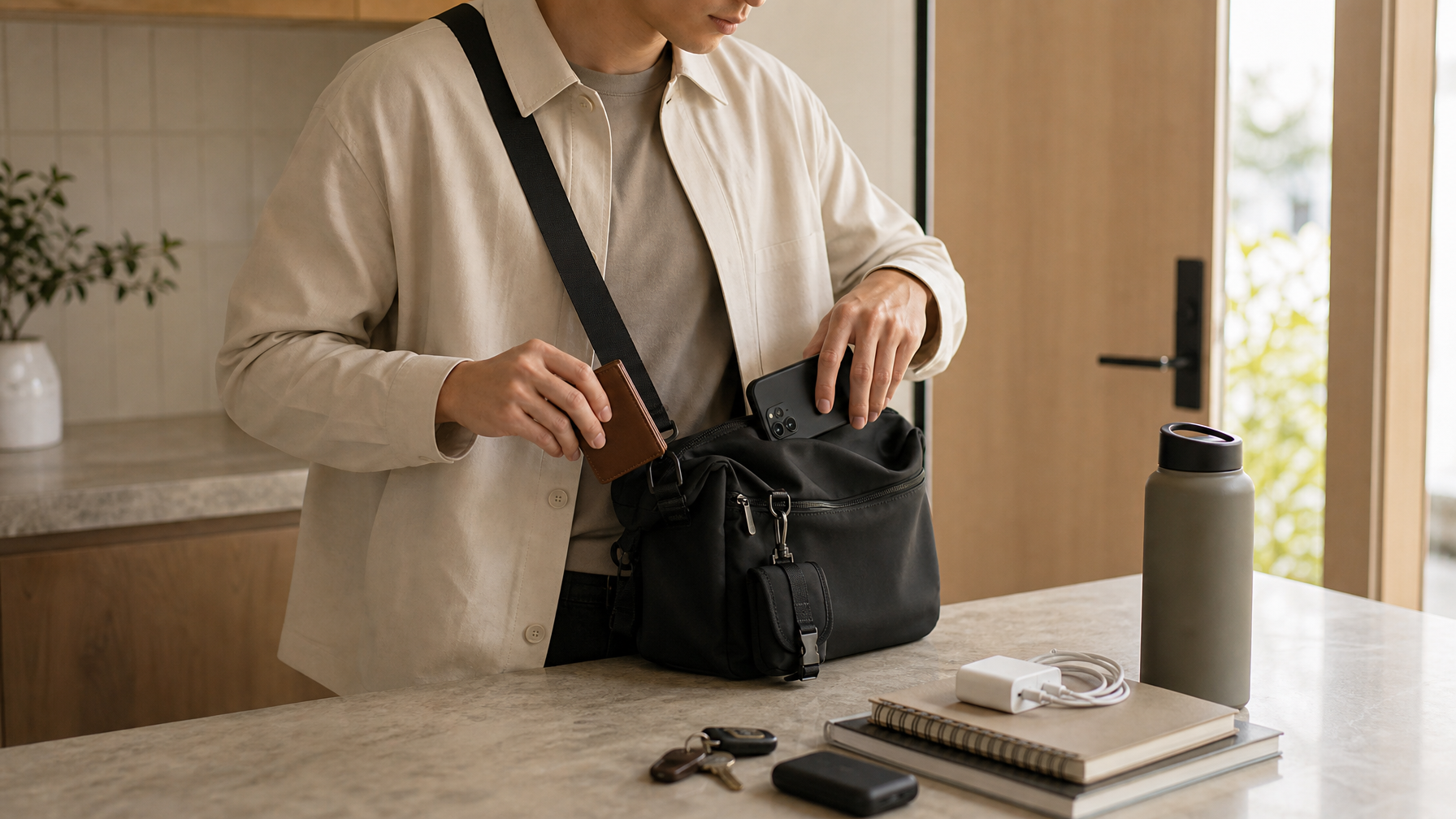 Pack the route at the door. Leave the second office where the chair is.
What belongs in a desk stash
A desk stash is not a second wardrobe. It is a short list of stationary gear with a fixed home: a drawer tray, a locker shelf, a file cube under a hot desk, or a labeled bin in a home office you return to three days a week.
Strong desk stash candidates
- Spare charger brick or dock you only use at that seat
- Wired mouse or full-size keyboard if you dock a laptop
- Headphones that stay on a stand at the monitor
- Desk notebook and pens you do not need on the sidewalk
- Badge spare, stapler, cable odds you never open mid-commute
- A water bottle that lives at the desk if you refill there every day
Keep these out of the stash
- The laptop you need on the route or in a café after work
- Wallet, keys, phone, transit card
- Medication, glasses case, or anything you cannot replace if you skip the office tomorrow
- Weather shell and umbrella on days you will walk exposed segments
If you hot desk or change floors, shrink the stash to what fits a single tray you can claim in two minutes. If you work from a coffee shop three days a week, the stash moves to a home drawer and the bag carries a thinner power kit on those days. The principle stays the same: stationary gear does not earn a permanent seat on your shoulder.
What leaves with the commute bag
The commute bag carries the moving day, not the furniture of work.
Core ride list (most laptop days)
- Laptop if the day needs it
- One slim charger or cable kit, not a drawer of bricks
- Phone, wallet, keys
- Badge or transit card
- One notebook or tablet, not both by default
- Compact umbrella only when the forecast earns it
Usually leave behind when a desk stash exists
- Second charger brick
- Full mouse and keyboard set
- Desk headphones
- "Maybe" snacks that expire in a side pocket
- A second pair of shoes unless the day truly needs them
On the Haven Messenger, the front pocket fits your phone, wallet, and card together. Access the front pocket while Haven stays at your side. The detachable pouch holds one small essential, such as AirPods. A separate back pocket fits a phone and wallet together. A laptop up to 14 inches sits in the open main compartment. There is no padded dedicated laptop sleeve. Keep wet gear out of that cavity.
For hybrid weeks where laptop days and light days already pull you toward two systems, pair this article with two bags for hybrid work. Desk stash is the third lever: even a one-bag week gets lighter when the chair owns its own tools.
 The brief leaves for the meeting. The tray stays with the chair.
How to set the system up in one evening
You do not need a new furniture order. You need a 20-minute sort.
- Empty the bag onto a table.
- Mark each item S (stays at desk), R (rides every day), or C (conditional weather or meeting).
- Put S items into one tray or drawer. Photograph the tray once so you remember the baseline.
- Rebuild the bag with R only. Walk a hallway loop. If the bag still changes your gait, cut one more R item or move another brick to S.
- Write a three-line card and tape it inside a desk drawer: "Stash: charger, mouse, desk phones. Bag: laptop, slim power, keys."
On Sunday, the bag reset should touch both sides. Confirm the stash is still only stationary gear. Confirm the bag did not quietly reabsorb a second brick. The reset habit in the Sunday bag reset keeps the split from drifting.
If organization inside the bag is still noisy after the split, use the zone method in how to organize your bag. Desk stash reduces volume. Zones reduce rummage.
Which bag when the load is honest
Once the stash exists, bag choice follows the route, not the fear of forgetting a mouse.
Haven Messenger ($89), daily laptop walk and transit
Soft-structured crossbody for days when a laptop up to 14 inches and a short core list are enough. Front pocket for phone, wallet, and card together. Detachable pouch for one small essential. Water-resistant Oxford shell for light rain, not a dry-bag claim. Best when you want hands free at crosswalks and a bag that still opens cleanly at a desk after the stash has taken the stationary weight out.
Shop the Haven Messenger →
[Metro Laptop Brief](https://www.fieldandash.com/products/metro-laptop-brief) ($79–$99), slim office and client paths
When the desk stash holds the bulk of power and desk tools, a slim brief can carry the machine and a thin day kit without looking like a full pack. Strong fit for client floors and meetings where you want a quiet professional silhouette. Pair with a real desk tray so you do not rebuild a cable drawer inside the brief.
Shop the Metro Laptop Brief →
[Lite Backpack](https://www.fieldandash.com/products/lite-backpack) ($89), two-strap days after the cut
If stairs, longer walks, or a slightly larger laptop day still need two straps, keep the pack light after the stash cut. The point is not a bigger pack. The point is a pack that no longer carries a second office.
Shop the Lite Backpack →
[Commuter Sling](https://www.fieldandash.com/products/commuter-sling) ($89), light days when the laptop stays docked
On days the machine stays at the desk or at home, a sling can cover phone, wallet, keys, and a thin kit. Desk stash makes those days honest instead of half-empty backpack days.
Shop the Commuter Sling →
 After the stash cut, the pack only has to do the route.
Edge cases without breaking the rule
No fixed desk. Use a locker, a locked drawer, or a single tote that lives under a shared bench. If nothing is secure, shrink S to zero and accept a slightly thicker R list, then cut ruthlessly every Friday.
Multiple sites in one day. Carry only what the farthest site cannot replace. Leave site-specific chargers at each site if you return weekly.
Home office plus two office days. Keep a home stash and an office stash. Do not merge them into the bag "so you never forget." Forgetting a desk mouse once is cheaper than carrying it two hundred times.
Walking and bike days. Those routes punish weight faster. See the walking commute bag setup and the bike commute bag setup after the stash split, not before. Fix the inventory first.
Weather and claims without theater
Field & Ash daily bags use water-resistant shells meant for daily use and light rain. That is not the same as a fully waterproof dry bag. Wipe the exterior if it picks up moisture. Do not park a wet umbrella against a laptop in the main compartment. Educational language is fine: waterproof means sealed against immersion-level water; water-resistant means the fabric sheds light rain for commuting. Shop Materials & Care on each product page before you claim more than the page supports.
A desk stash helps weather days too. When the bag is lighter, you are more willing to wear the shell and keep the bag under a coat flap at lights instead of stuffing another layer into an already full cavity.
 One tray stays. One bag leaves.
A simple weekly check
Once a week, ask three questions:
- Did anything in the bag never leave the bag at the desk?
- Did anything in the stash get carried "just in case" and never used on the route?
- Did my shoulder or gait complain before the second block?
If yes to any, move one item. The system is working when the bag feels slightly empty at first and then correct by the time you hit the door.
For the one-bag identity question across light and heavy days, see the one-bag rule for every kind of day. Desk stash is compatible with one bag. It often makes one bag possible.
FAQ
Is a desk stash only for people with private offices? No. A locker shelf, a claimed hot-desk tray, or a home drawer all count. The requirement is a fixed home for stationary gear, not square footage.
What if I forget the stash charger once? Borrow or buy a cheap spare for the desk and leave it there. Do not solve one miss by permanently loading two bricks into the bag.
Can the stash include clothes? Only if you truly change at that site every day and storage is secure. Most people do better with a thin transition kit on true gym-to-office days and a separate plan for that job. See gym to office without switching bags.
Does this replace a packing system for travel? No. Travel still needs its own formula. This article is for the repeat commute and hybrid week. For weekend loads, use the weekend trip packing formula when it is live, or the existing weekend packing guide already on the Journal.
Bottom line
Your commute bag should not be a mobile filing cabinet for a chair that already exists.
Give stationary gear a desk home. Give the bag the route. When those two homes stay separate, weight drops, morning rummage drops, and the bag you already own starts to feel like the right size again.
Carry deliberately. Leave the second office where it works.