


Luggage Strap Work Bag: How to Ride a Rolling Suitcase Without a Second Shoulder

TLDR: A luggage strap (trolley sleeve) lets a work bag ride the suitcase handle so your shoulder is free in the airport. It does not replace a personal-item size check. The Summit Messenger is the Field & Ash messenger built with a rear luggage strap, a padded sleeve up to 14 inches, and a fold-over flap for a defined laptop day on the move.
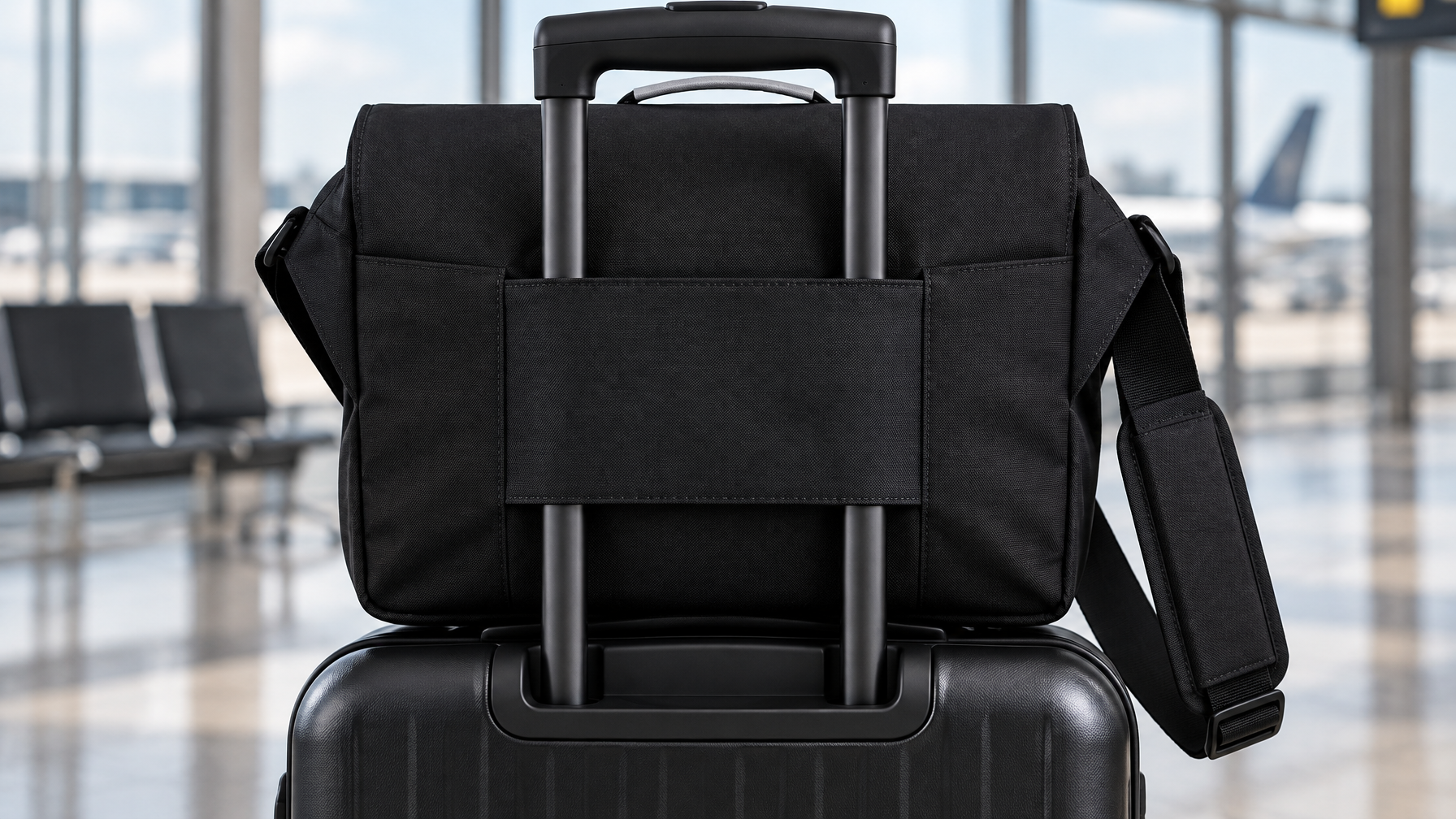
Most people treat the rolling bag as the trip and the work bag as extra punishment. You already packed the carry-on. Then you still hang a laptop bag on one shoulder through security, the jet bridge, and the hotel lobby. The luggage strap exists for that second bag. It is a sleeve or tunnel on the back of a briefcase or messenger that slides onto the telescoping handle. When the handle is up, the work bag sits on the suitcase. When you sit, you take it off and wear it.
This is not a personal-item shopping guide (The Best Personal Item Bag for Flying). It is not a 1.5-bag packing formula (The 1.5-Bag Travel Setup). It is not overnight packing with an expandable backpack (One Expandable Pack, One Day Bag). The job here is only this: when you already roll a suitcase, how should the laptop bag attach, and when should you still wear it.
What a luggage strap actually is
On product pages it shows up as “luggage strap,” “trolley sleeve,” or “pass-through.” Function is the same: a horizontal sleeve on the rear panel. You drop the sleeve over the raised handle, then the bag rests against the suitcase shell.
It is not a carabiner. It is not a shoulder-strap clip onto the handle. Those still leave the bag swinging. A true sleeve keeps the bag centered on the trolley and stops it from rotating when you walk.
Use it when:
- You have a rolling bag as the main luggage
- The second bag is a laptop messenger or brief, not a huge backpack
- You will walk long indoor distances (terminal, hotel, convention center)
Do not use it as a substitute for:
- Airline personal-item measurements
- A backpack that needs both straps on your body for a heavy load
- Outdoor walking where the suitcase is not with you
The three modes of a work-trip bag
Mode 1: On the trolley. Handle up, sleeve on, both hands free except for steering the case. Best for long terminal walks and hotel check-in.
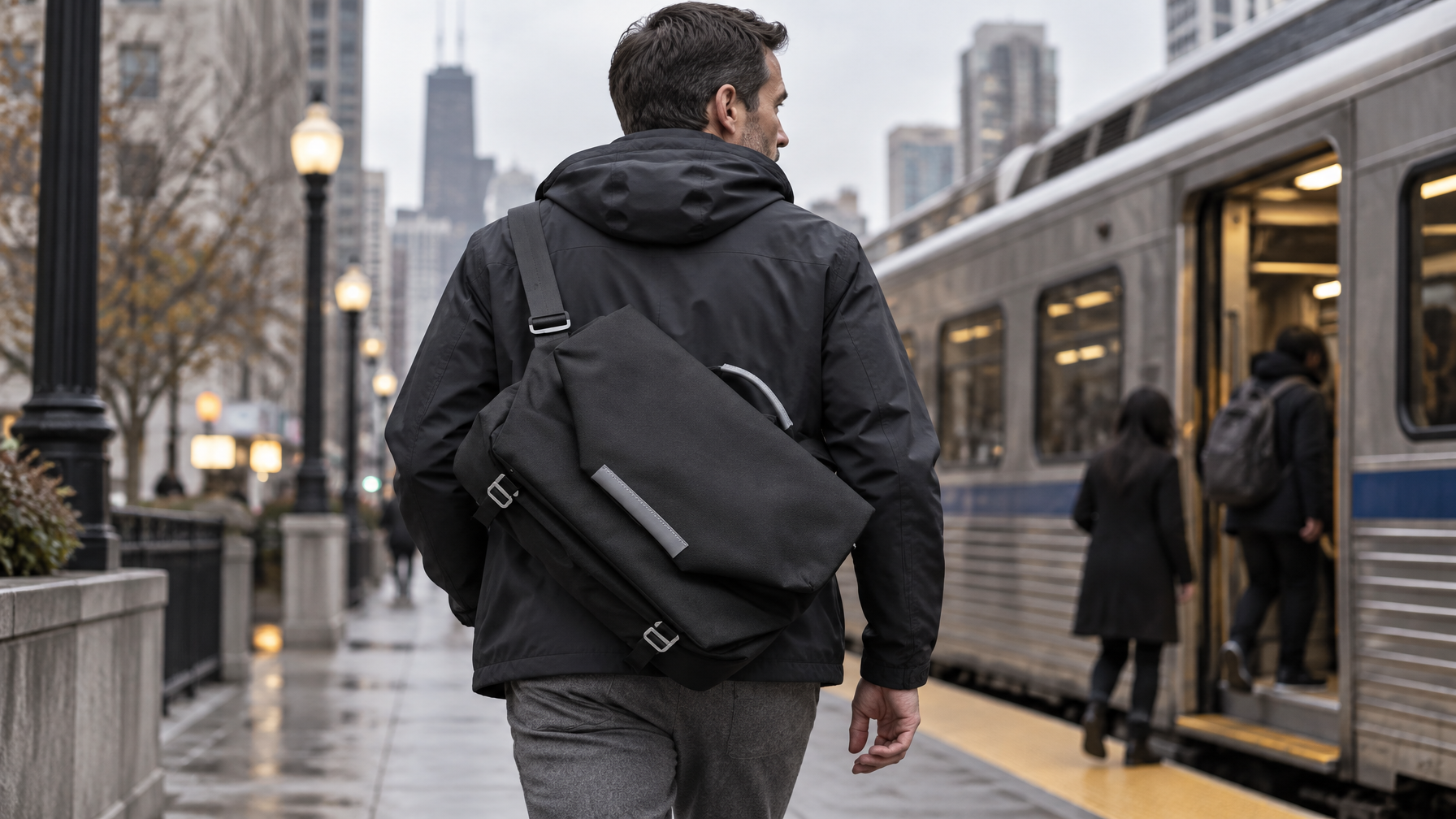
Mode 2: On the shoulder. Sleeve off, padded strap on. Best for security bins, stairs, rideshares, and any stretch where the suitcase is checked or out of reach.
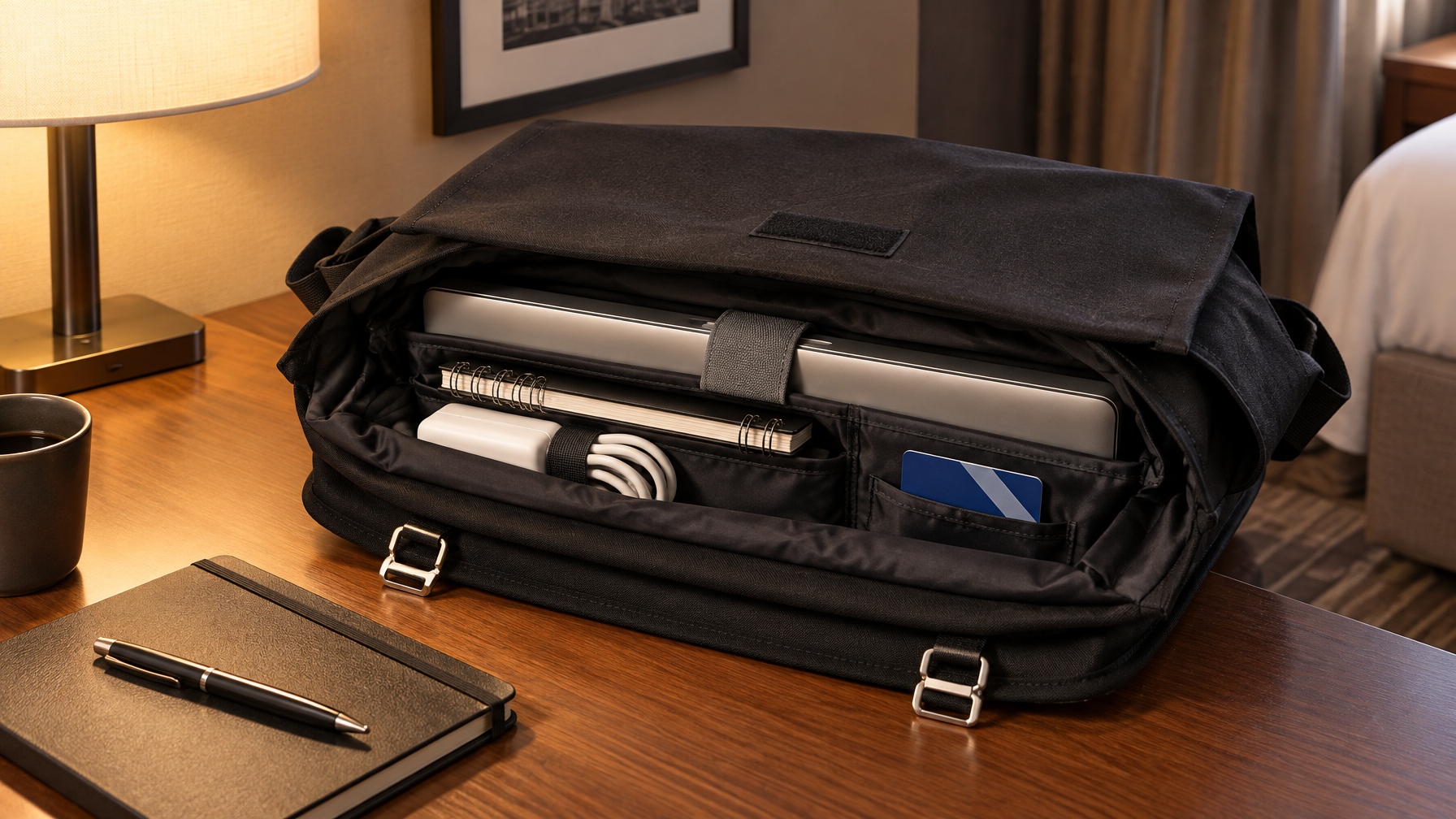
Mode 3: Open on a desk. Flap open, laptop in the sleeve, charger in an interior pocket. Best after you arrive. The bag should still work as a daily messenger once the suitcase is in the closet.
If a bag only does Mode 1, it is a luggage accessory. If it only does Mode 2, you still fight the shoulder on travel days. The useful work bag does all three without a packing rebuild.
Summit Messenger: the catalog bag with the strap
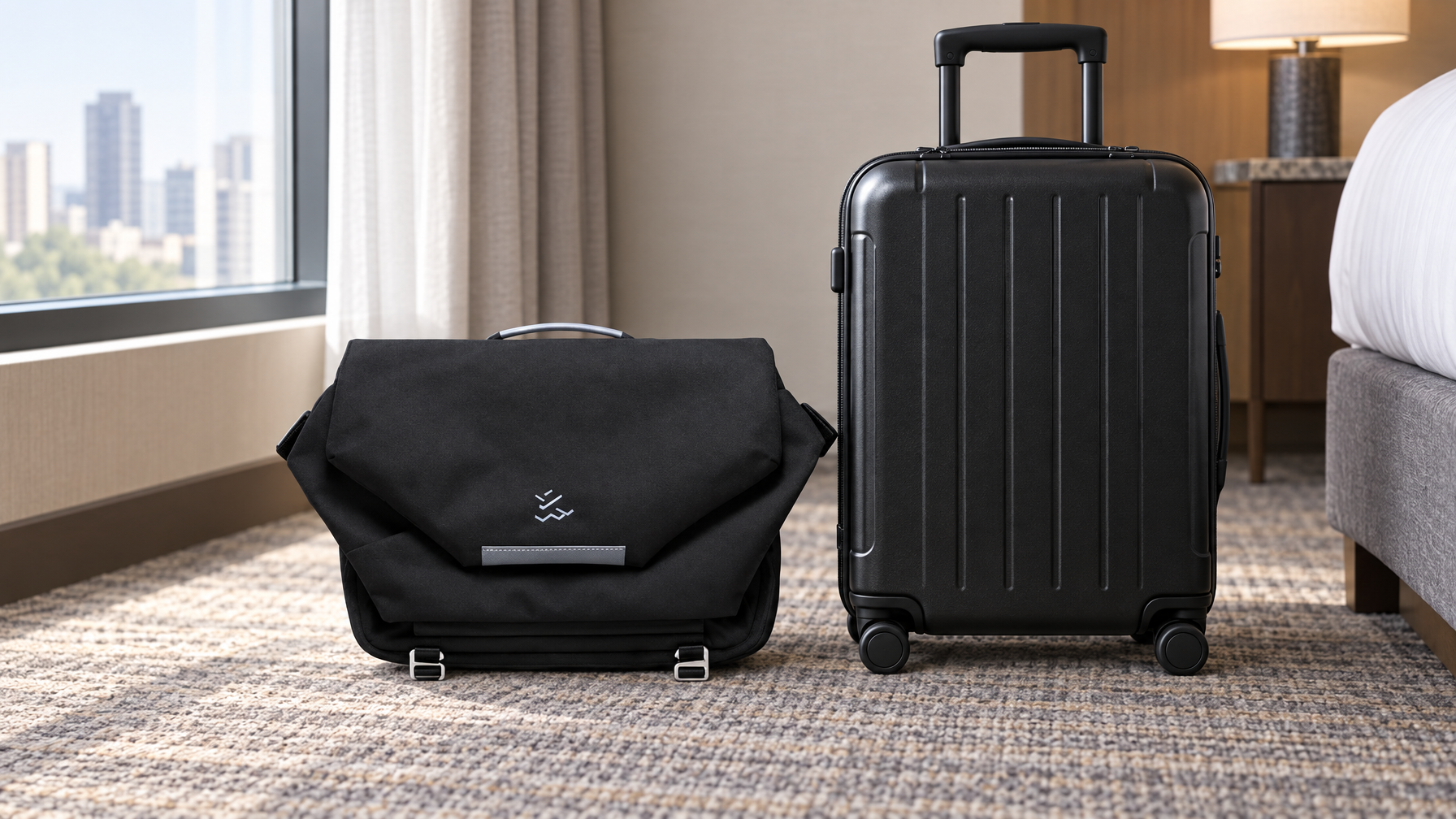
Live facts for the Summit Messenger: about 16.5 × 4.7 × 11.8 in (42 × 12 × 30 cm), about 1.76 lb (0.8 kg), 600D Oxford exterior with polyester lining, fold-over flap with G-hook buckles, padded laptop/tablet sleeve (variants for about 12.9 inch tablet and about 14 inch laptop), interior zip and slot pockets, strap pocket for cards or transit passes, reflective detail on the front, luggage strap on the back, adjustable padded shoulder strap. Live prices: $129 and $149 by device variant.
Materials and Care on the product page is the weather rule: water-resistant for daily use and light rain; not fully waterproof or submersible. Wipe dry after moisture. Do not invent sealed storm ratings or anti-theft vault language. Do not claim the strap cures shoulder pain.
Summit is the right load class when:
- You already roll a carry-on and need the laptop bag to piggyback
- The machine fits the about 14 inch sleeve story
- You want a messenger you will also wear on ordinary office days
- Night walking or cycling-adjacent commutes benefit from the reflective strip as listed
Summit is the wrong default when:
- You never travel with a rolling bag
- You need a 17 inch machine path (that is backpack territory: see Apex vs Lite)
- You wanted a small sling for phone-wallet-keys only (What Actually Fits in a Commuter Sling)
How to load the bag so the trolley ride stays stable
Keep dense weight against the suitcase, not swinging off the far side of the flap.
- Laptop in the padded sleeve, screen toward the wearer’s back when the bag is on the shoulder (and toward the suitcase when it is on the handle).
- Charger and brick in an interior pocket, not loose in the main well.
- Notebook flat against the laptop, not rolled.
- Transit cards and ID in the strap pocket so you do not open the flap in a security line.
- Leave bottles and heavy extras in the rolling bag. The messenger should stay a defined work kit.
If the bag leans hard to one side on the handle, you overloaded one pocket. Unload before you walk the length of the terminal. This is a stability check, not a medical claim.
A related daily-load problem, without the suitcase, is two devices in one pack (Two-Device Days). Do not use Summit as a two-laptop backpack. One machine in the rated sleeve is the story.
Security, jet bridge, and rideshare: take it off
The sleeve is for rolling. It is a liability when:
- TSA / security bins: you need the bag in your hands, zipper and flap under your control
- Jet bridge stairs or broken escalators
- Rideshare trunks: the suitcase goes in the back; the messenger stays on you
- Cobblestones or curb cuts where the trolley chatters and the bag can hop the handle
Wear the padded strap for those minutes. Put it back on the handle for the long indoor walk. That is the whole skill.
For a tighter “what stays on the body in a car” setup, see The Rideshare Commute Bag Setup. Different job: no rolling bag required.
Size: luggage strap is not a personal-item guarantee
A trolley sleeve does not change the outside dimensions. Summit’s listed footprint is about 16.5 × 4.7 × 11.8 in. Airlines still measure the bag you carry on, not the bag that was piggybacking five minutes ago.
If your plan is under-seat only with no rolling bag, start with the personal-item article, not this one. If your plan is carry-on roller plus a work messenger, confirm both sizes against the carrier you actually booked. Do not treat Field & Ash copy as an airline rule.
When a backpack is still the better second bag
Choose a backpack (Lite, Apex, Transit Pack) instead of a strap-on messenger when:
- The kit is two devices plus a brick every day
- You will walk more without the suitcase than with it
- You want both shoulders for a heavier load (Shoulder Fatigue Checklist)
Choose Summit when the week is mostly one laptop, you already own or rent a roller, and you want the work bag to disappear onto the handle between gates.
Haven remains the lighter everyday messenger when you are not buying for trolley hardware. Do not default every commute article to Haven. This piece is specifically the luggage-strap job.
A simple pre-trip check
The night before:
- Confirm the sleeve actually fits your handle (some very thick handles are tight)
- Pack the laptop and charger once; do not rebuild at 5 a.m.
- Wear the bag around the house for five minutes so the strap length is already set
- Put the bag on the handle and walk a hallway. If it hops, empty the swingy pocket
Related habit work: The Night-Before Bag Prep.
FAQ
Does every messenger have a luggage strap? No. Many daily messengers skip it. Summit lists a luggage strap on the back. Check the PDP, not a category assumption.
Can I use it as my only bag? You can wear it as a messenger. The strap is extra for travel days. It does not add backpack volume.
Is the shell waterproof? Product care language: water-resistant for daily use and light rain, not fully waterproof. Wipe dry after exposure.
Will it fit a 16 inch laptop? The listed laptop variant is about 14 inches. Do not force a larger machine.
The rolling bag should carry the trip. The work bag should ride it until you need your hands on the laptop. That is the luggage-strap job. If that is your week, look at Summit Messenger as the messenger built for it.