


Client Day Carry: What to Pack When Every Meeting Matters

A client day is not a normal workday with nicer shoes. It is a sequence of rooms, handoffs, and small credibility moments: lobby check-in, first meeting, a café reset, a second building, a late train home. The bag either supports that sequence or turns every transition into a rummage.
This guide is a packing system for local client days and back-to-back external meetings. It is not a multi-day conference travel setup. For overnight work trips and conference weeks, see the conference bag guide. For the fixed weekday desk kit, see Office EDC.
What a client day actually asks of your bag
Write the day as three short lists before you choose a bag.
Identity and access. Badge or visitor QR, government ID if the building requires it, payment method, keys, phone.
Work tools. Laptop only if you will open it, one charger path, earbuds, notebook or tablet if you still use one, any printed leave-behind that must stay flat.
Between-meeting comfort. Water if you will be out more than two hours, a light layer only when the forecast needs it, a small personal kit that does not expand into a toiletry bag.
If an item is not on those lists for a typical client Tuesday, it does not earn a permanent slot. Client-day carry fails when the bag becomes a second office drawer.
Build the kit the night before
Client mornings go wrong when staging happens at the door. Run a ten-minute night stage instead.
- Empty yesterday's receipts and dead cables.
- Stage tomorrow's fixed kit on one surface: laptop (if required), charger, badge, notebook, phone, wallet.
- Charge what must leave charged.
- Load zones once. Morning is confirmation, not reconstruction.
Pair this with a calm morning exit if your day starts at home: the morning commute routine.

The five-minute morning load
When the alarm goes off, do not redesign the kit.
- Dress for the first room you will enter.
- Confirm the staged surface is complete.
- Load only what is not already in the bag.
- One full close and strap check.
- Leave. Do not reopen the bag in the lobby "just to check."
If you reopen three times before the elevator, the night stage failed. Fix tonight's process.
During the day: protect the sequence
Keep high-frequency items in one outer zone. Phone, badge, payment. You should not open the main compartment for a building turnstile.
Do not unpack the whole bag on the café table between meetings. That habit creates the same morning rummage in a smaller seat.
Change rooms, not systems. The bag that worked in the first lobby should still work in the third without a full repack.

Match the bag to the client-day load
Once the lists are honest, choose the format that matches the heaviest normal client day, not the lightest.
Metro Laptop Brief ($79–$99). Presentation-heavy days
When the day is client-facing and you want a cleaner briefcase silhouette from the lobby to the conference room, the Metro Laptop Brief carries a structured laptop load without looking like a weekend backpack. Keep the same night-before staging. The format signals the room; the routine stays the same.
Haven Messenger ($89). Walking-heavy multi-building days
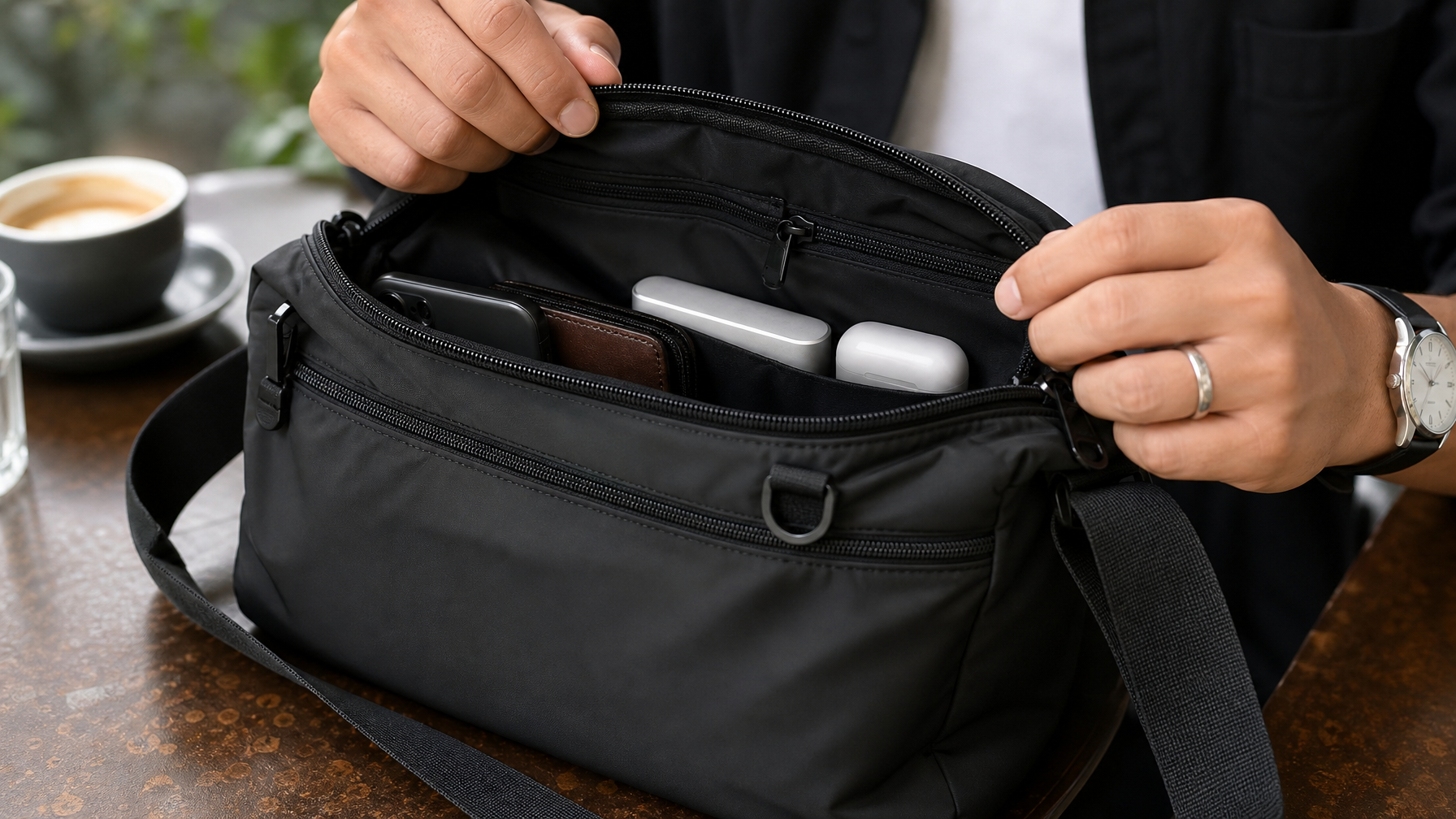
When most of the day is movement between buildings and you still need a laptop up to 14 inches, the Haven Messenger fits a crossbody client day: main compartment for the laptop, interior slip pockets and interior zip pocket for a reduced power kit, front pocket for phone, wallet, and card together, and a separate back pocket that fits a phone and wallet together against the body. The detachable pouch holds one small essential, such as AirPods. Access the front pocket while Haven stays at your side. Wide seatbelt-style strap keeps hands free on stairs and platforms.
Use it when the night stage already decided the kit. It is not a place to store a second desk.
Summit Messenger ($129–$149). Heavier full-day client loads
If the client day regularly includes more bulk than a slim messenger wants to hold, the Summit Messenger covers a larger structured messenger load while keeping a professional silhouette. Edit the kit first. Extra capacity is not permission to carry a second wardrobe.
A one-week client-day test
Run five external-meeting days without buying new gear mid-week.
| Day | Focus | Success signal |
|---|---|---|
| Mon | Night stage only | Tuesday morning opens with a complete kit already loaded |
| Tue | Outer-zone access only | Badge and phone never require a full unpack |
| Wed | Single activity between meetings | No full bag dump on the café table |
| Thu | Cut one dead-weight item | Bag feels lighter without a new purchase |
| Fri | Note remaining friction | One process change for next week, not five |
If Friday still feels chaotic, the problem is almost always inconsistent night staging or a kit that is still too large.
Common traps
Packing for every possible client request. Extra notebooks and adapters feel prepared. They slow every security line and café reset.
Using the conference bag rules for a local day. Overnight clothing and toiletries do not belong in a same-city client bag.
Changing bags mid-week before changing the sequence. A new bag with the old rummage habit becomes a nicer rummage.
Treating the bag as a mobile office drawer. Client days reward a short kit and clear zones, not maximum storage.

How this connects to the rest of your carry system
- Conference and multi-day work trips: The Conference Bag
- Fixed office everyday carry: Office EDC
- Morning exit sequence: Morning Commute Routine
- Inside-the-bag zones: How to Organize Your Bag
Client day carry works when the kit is short, staged the night before, and matched to the rooms you will actually enter. Pack for the sequence, not for every possible meeting that might appear on the calendar.