


The Morning Commute Routine That Makes the Rest of the Day Easier

A difficult morning rarely starts on the train. It starts at the door: keys missing, badge in yesterday’s jacket, charger still on the desk, bag half-packed from the night before. By the time you reach the platform, the day already feels behind.
A better morning commute routine is not a motivational speech. It is a short sequence you can run on low energy. The goal is simple: leave the house once, with everything you need, without opening every pocket twice.
This guide is for people who move the same route most weekdays. It covers the night-before setup, the five-minute morning run, what belongs in the bag versus by the door, and how to keep the system from decaying by Friday.
Why most morning routines fail before the commute
Most advice piles habits onto an already crowded hour: stretch, journal, cold shower, deep work before email. Those can be useful later. They do not fix the friction that actually makes people late or stressed.
The real failure points are mechanical:
- Decision load at the door. Every morning becomes a fresh inventory of “did I pack X?”
- Scattered homes for essentials. Phone charger on the nightstand, transit card in a coat, earbuds in a random bowl.
- A bag that forces digging. If nothing has a permanent zone, every departure becomes a rummage.
Fix those three and the commute gets quieter even if traffic does not.
Step 1: Close the day the night before (10 minutes)
Do this once, after dinner or before bed. It is the highest-leverage part of the routine.
Empty and reset the bag. Dump receipts, dead cables, and anything that did not earn its place today. Wipe the interior if it needs it. Return items that belong in a drawer.
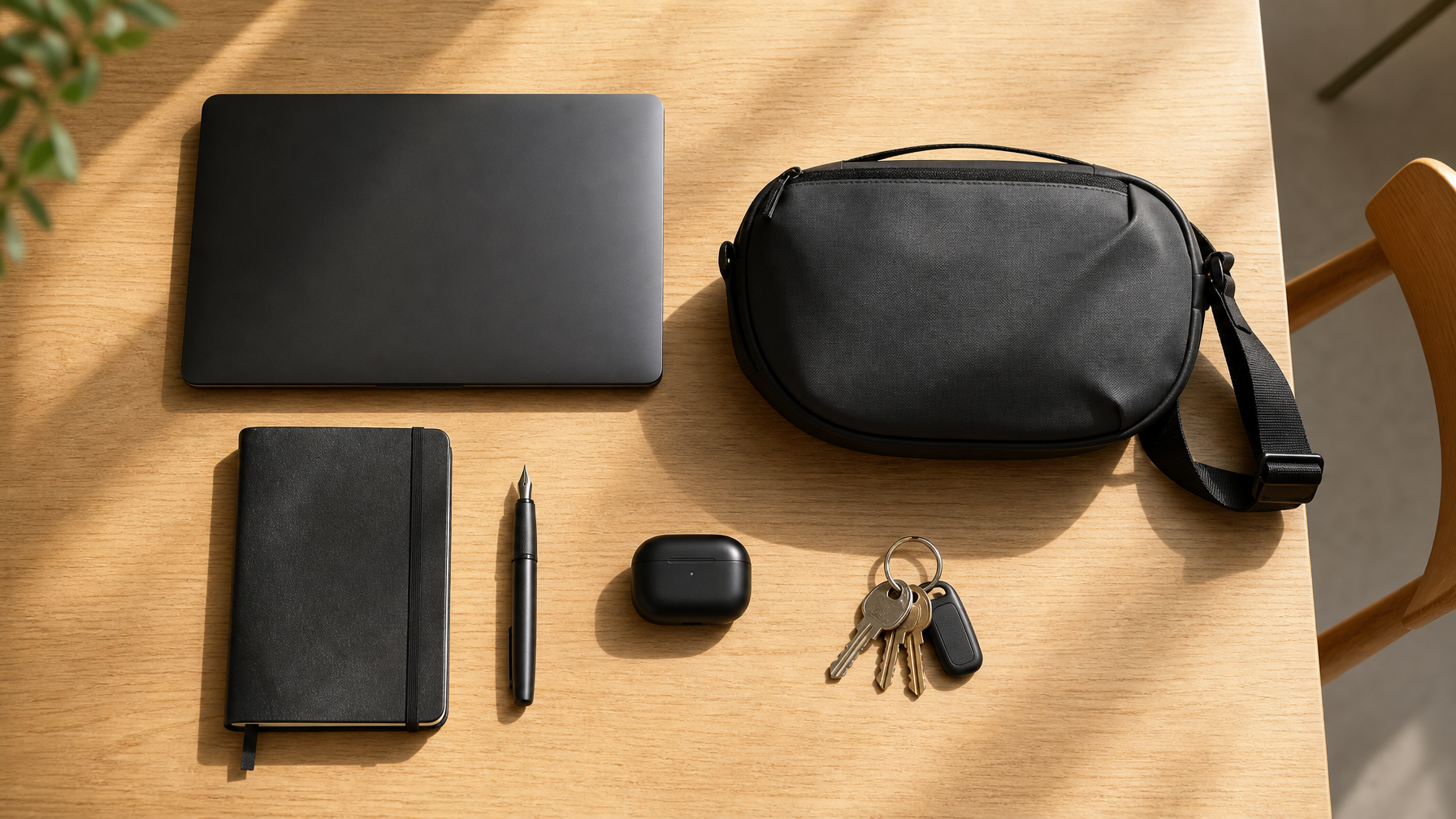
Stage tomorrow’s fixed kit on one surface. Laptop (if required), charger, keys, wallet, transit pass or badge, earbuds, any medication you take daily. Not a pile on three rooms. One surface by the door or on the desk.
Charge what must leave charged. Phone and laptop on the same surface or the same strip so you are not hunting cables at 7:40 a.m.
Lay out the bag open. If the bag is already loaded in its zones, morning becomes “pick up and go,” not “rebuild from scratch.”
If you already run a weekly reset, this night step is the daily version of the same idea. For a fuller weekly system, see the Sunday bag reset. For zone structure inside the bag, see how to organize your bag.
Step 2: Define a default exit kit (and stop renegotiating it)
Write a short list of what leaves the house on a normal workday. Keep it boring on purpose.
Typical default kit
- Phone and earbuds
- Wallet, keys, badge or transit card
- Laptop only on days you will open it
- One charger path that covers phone and laptop when both are required
- Water bottle if you actually drink it in transit
- Lightweight layer only when the forecast needs it
Everything else is situational. Client adapters, gym shoes, extra notebooks, “just in case” cables belong in a drawer or a separate pouch you grab only when the calendar says so.
The morning is the wrong time to redesign the kit. Redesign happens on Sunday or after a week of honest notes about what you never used.
Step 3: Run a five-minute morning sequence
When the alarm goes off, the sequence is fixed. No improvisation unless something broke overnight.
- Clothes and hygiene first. Do not open the bag until you are dressed enough to leave.
- Confirm the staged surface. Phone off charge, laptop off charge if needed, keys and badge visible.
- Load only what is not already in the bag. If the night reset worked, this is seconds.
- One full zip and strap check. Front pocket for phone/wallet/card access if that is how you carry. Main compartment closed. Strap adjusted once.
- Door. Leave. Do not reopen the bag in the hallway “just to check.”
If you find yourself reopening the bag three times before the elevator, the night stage failed. Fix tonight’s process instead of blaming willpower.
Step 4: Use the commute as a single mode, not a second office rebuild
On the train, bus, or walk, protect the calm you just created.
Pick one primary activity. Email triage, a podcast, a chapter, or nothing. Switching modes every three minutes recreates the morning chaos in a smaller seat.
Keep high-frequency items in one outer zone. Phone, transit card, earbuds. You should not open the main compartment for a station transfer.
Do not unpack the whole bag on your lap. That habit spills time and creates the exact rummage you avoided at home.
For laptop-specific transit friction (weight, access, weather), pair this routine with how to commute with a laptop every day.

Step 5: Match the bag to the routine (not the other way around)
Once the sequence is stable, the bag’s job is to hold zones without argument.
Haven Messenger ($89). Default laptop commute days
When most weekdays include a laptop up to 14 inches, the Haven Messenger fits a crossbody morning exit: main compartment for the laptop, interior slip pockets and interior zip pocket for the reduced power kit, front pocket for phone, wallet, and card together, and a back pocket that sits against the body when worn. The detachable pouch holds one small essential, such as AirPods. Wide seatbelt-style strap keeps hands free on stairs and platforms.
Use it when the night stage already decided the kit. It is not a place to store a second desk.
Commuter Sling ($89). Light days without the laptop
When the laptop stays home, the Commuter Sling matches a smaller exit kit: phone, wallet, earbuds, one slim charger if needed. At 0.66 lb empty it keeps the morning sequence short because there is less bag to manage.
Metro Laptop Brief ($79–$99). Formal office or client-facing mornings
If the day is presentation-heavy and you want a cleaner briefcase silhouette from the door to the conference room, the Metro Laptop Brief carries a larger laptop load with a structured profile. Keep the same night-before staging. The format changes; the routine does not.
A one-week test (so the routine sticks)
Run the system for five workdays without upgrading gear mid-week.
| Day | Focus | Success signal |
|---|---|---|
| Mon | Night stage only | Tuesday morning opens with a full kit already loaded |
| Tue | Five-minute morning sequence | No second trip back inside |
| Wed | Transit single mode | Main compartment stays closed until desk |
| Thu | Cut one dead-weight item | Bag feels lighter without a new purchase |
| Fri | Note what still caused friction | One process change for next week, not five |
If Friday still feels chaotic, the problem is almost always inconsistent night staging or a kit that is still too large, not a missing productivity app.
Common traps
Overpacking “for productivity.” Extra notebooks and chargers feel prepared. They slow the door check.
Rebuilding the bag every morning. That is a new project daily. Move the project to night.
Changing bags before changing the sequence. A new bag with the old rummage habit becomes a nicer rummage.
Treating the commute as bonus deep work every day. Some days the win is arriving calm. That still counts.
How this connects to the rest of your carry system
- Organization inside the bag: How to Organize Your Bag
- Weekly reset: Sunday Bag Reset
- Laptop transit specifics: Commuting with a Laptop
- Lighter overall philosophy: The Case for Carrying Less
The morning commute routine that makes the rest of the day easier is the one you can repeat when you are tired. Stage at night. Keep a default kit. Run a short morning sequence. Let the bag hold zones instead of decisions. Everything after the door gets simpler when the door is no longer a crisis.