


Hot-Desking Carry: What Stays in the Bag When the Desk Isn’t Yours

TLDR: Hot-desking means the desk is never yours overnight. Keep a mobile kit that leaves with you every evening. Put the laptop on the shared surface while you work, not as permanent desk property. Carry only what you will open, charge, or show ID with. Leave the second office (extra brick, drawer junk, "maybe" notebooks) at home. If the bag still feels like a filing cabinet, the problem is inventory, not the floor plan.
A fixed desk lets you stash a charger, a spare cable, and a stack of paper and pretend they live at work. A hot desk does not. Whatever you leave on the surface becomes someone else's clutter by morning, or it walks.
This piece is about that constraint: nothing personal stays overnight. It is not a general coworking bag roundup (Best Bags for Coworking Spaces). It is not the owned-desk split in Desk Stash vs Commute Bag, where a real drawer can hold stationary gear. Here the desk is shared, temporary, and empty when you leave.
What hot-desking actually requires
Write the day in one line: book a seat, open the laptop on that surface, work, pack every personal item, leave the surface clean.
Hot-desk day. No assigned drawer. No permanent monitor you own. No overnight charger on the table.
Not a hot-desk day. A reserved private office, a home desk, or a team bay where your brick is allowed to live. Those jobs allow a desk stash. This article does not.
Not a hot-desk day. "I will just leave the adapter under the monitor." That is how adapters disappear.
The test before you zip the bag at home: name each item and where it will sleep tonight. If the answer is "on the hot desk," remove it.
The three layers (and only three)
1. On-body. Phone, wallet, keys, badge. These never depend on the desk.
2. On-desk while working. Laptop (or tablet) open on the shared surface. One short cable to the machine. Thin notebook if you write. Water if the floor has no fountain nearby.
3. In the bag. Everything from layers 1-2 when you stand up, plus the power brick you actually use on this route. Nothing else.
There is no layer 4 called "leave it under the monitor."
What stays in the bag (the mobile kit)
Build the kit once. Run it every hot-desk day.
Always:
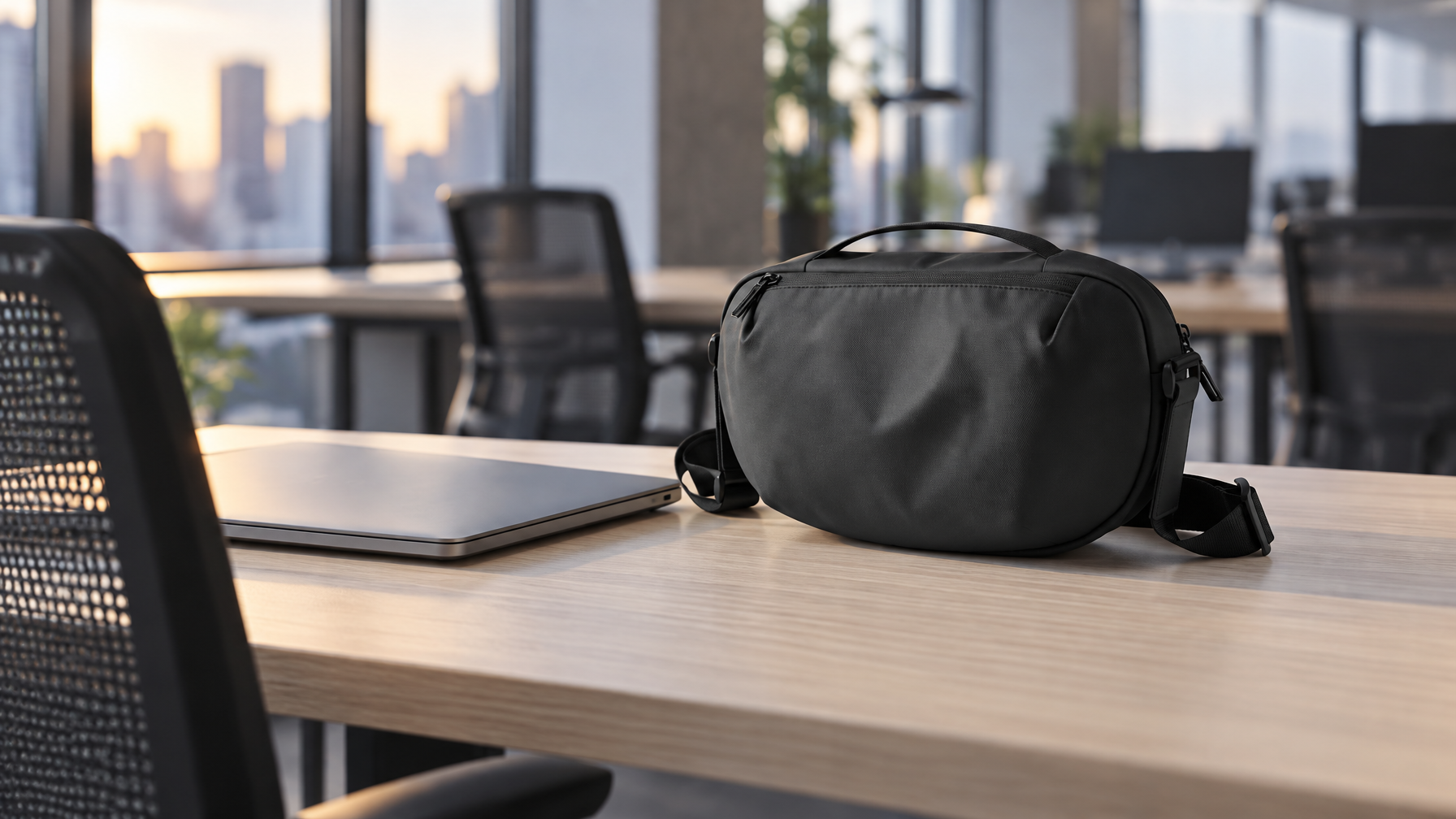
- Device you will open (laptop on the desk while working; not permanently stored in a thin crossbody)
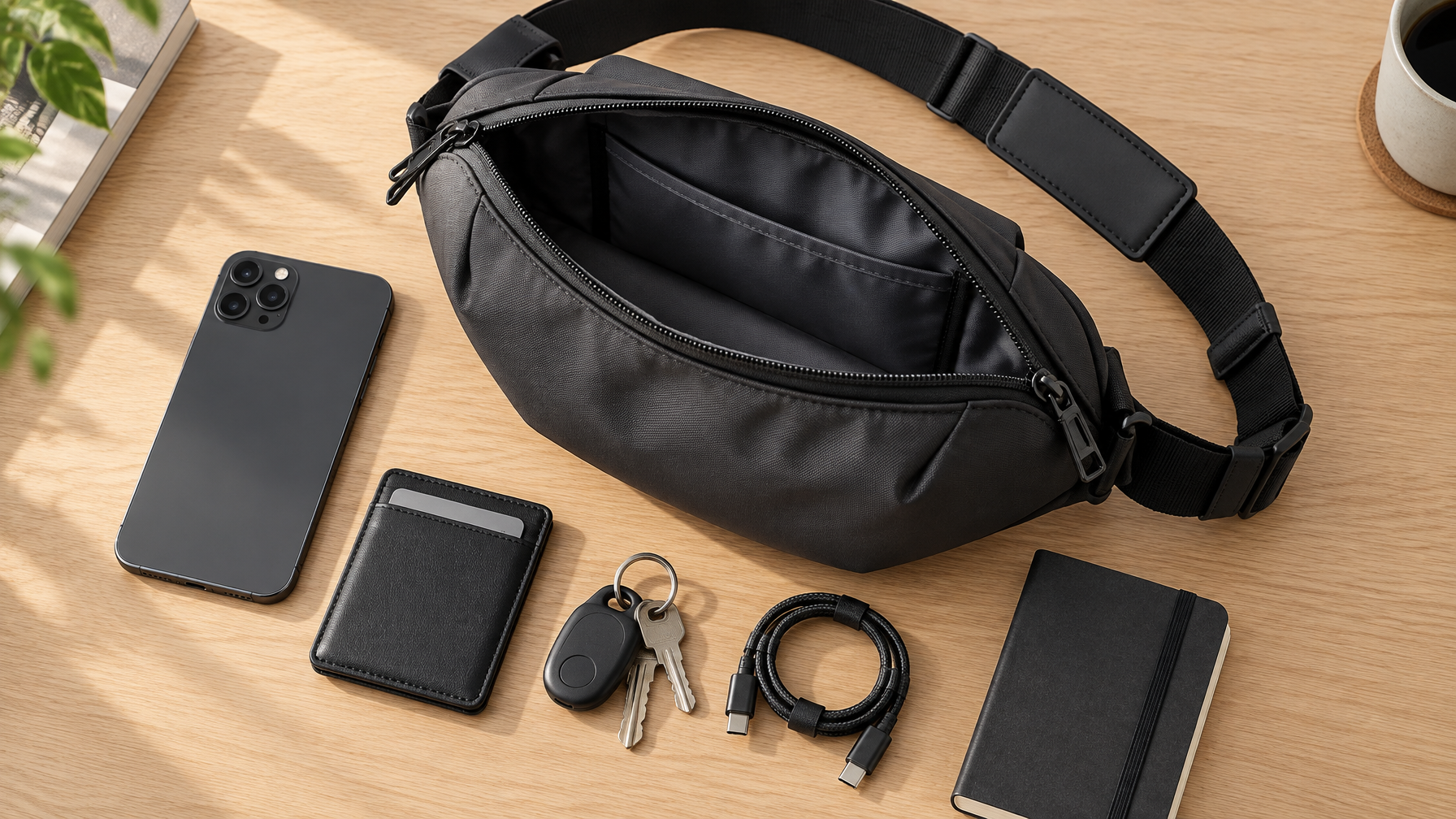
- Phone, wallet, keys, badge
- One power path: one brick, one short cable that matches the device
- Thin notebook or one slim folder of today's paper only
Sometimes:
- Wired or compact earbuds if you take calls on the floor
- A light layer if the room is known to be cold
- A small lock for a day locker if the space provides one and you will use it the same day
Never for hot-desk nights:
- Second brick "for the desk"
- Full desk drawer: stapler, permanent markers, spare mouse you will not pair
- Yesterday's printouts
- Gym shoes that turn the bag into a second commute problem
- A permanent monitor stand, desk plant, or anything that claims the surface after 6 p.m.
Why a slim crossbody fits this job
Hot-desking punishes bulk. You walk the floor, stand for coffee, move between booth and desk, and leave with everything on you. A large backpack can work for a heavy laptop day, but many hot-desk days are laptop-on-desk plus a light personal kit.
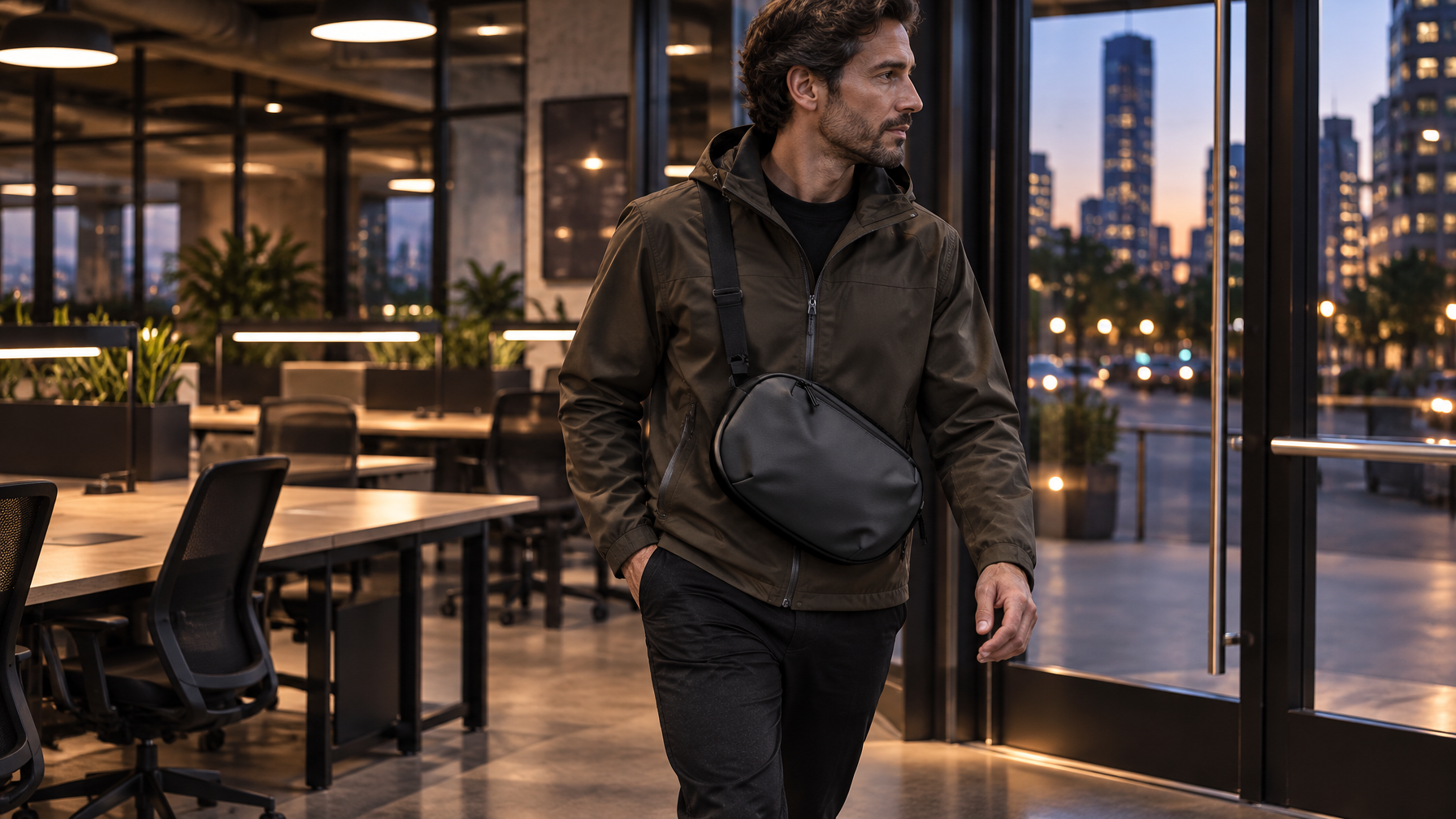
The Transit Crossbody is the catalog's compact crossbody: about 13.4 × 2 × 7.9 inches, about 0.8 lb, $69, dual-zip main, interior slot and zip pockets, adjustable crossbody strap, Black or Gray. It is built for phone, wallet, keys, tablet-class small gear, and daily essentials. It is not a laptop bag and has no dedicated laptop sleeve. Keep the laptop on the desk while you work; park thin essentials in the crossbody when you stand.
Water-resistant Oxford fabric is fine for ordinary commute weather. Do not call it waterproof. Do not invent anti-theft claims.
If the day is a true heavy laptop commute plus hot desk, pair a light two-shoulder pack for the machine and keep the crossbody for the mobile layer, or use a single honest laptop bag and still empty the desk at night. Do not force a 15-inch workstation into a crossbody.
Temporary storage beats fake ownership
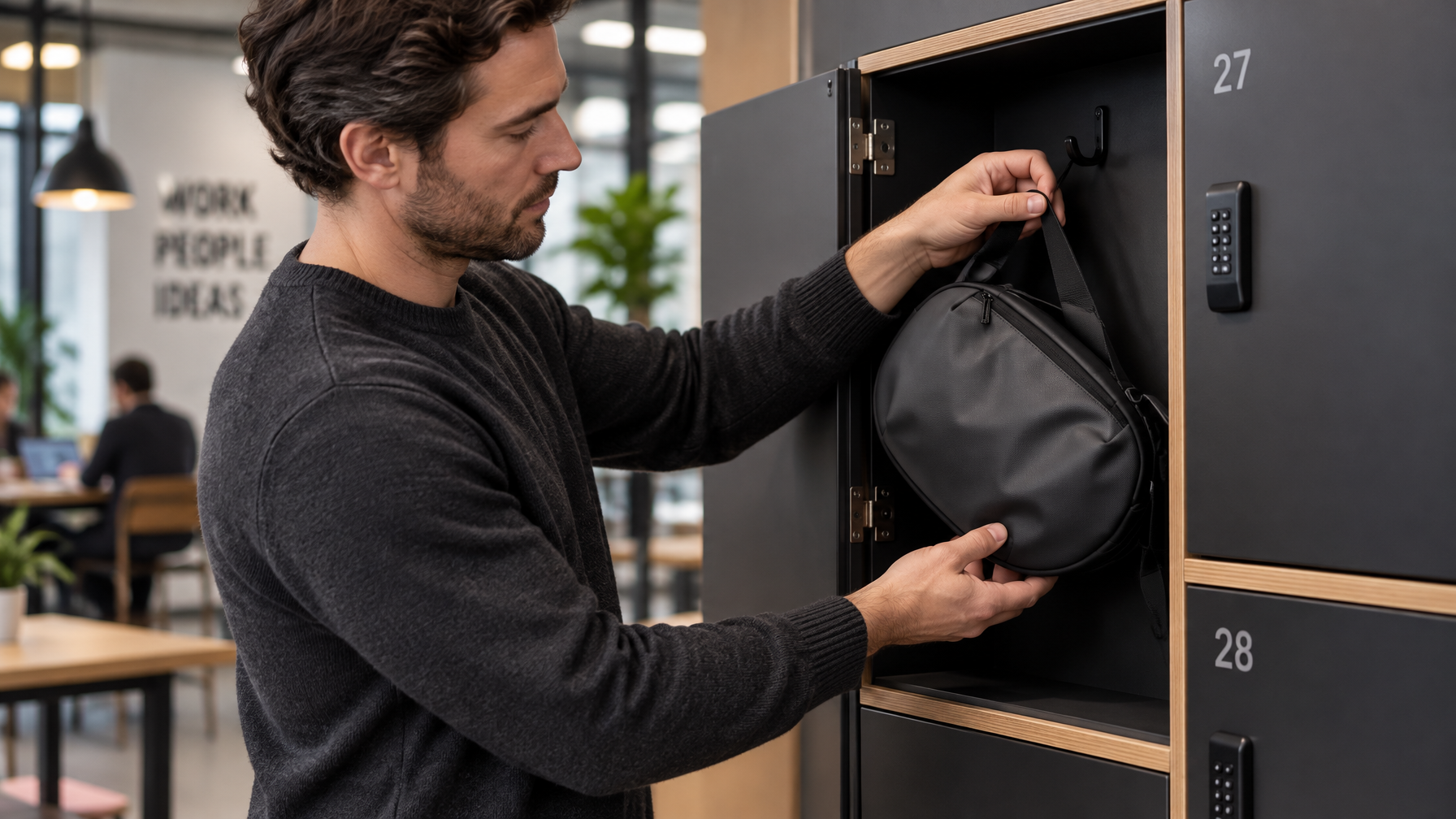
Some floors offer day lockers or bag hooks. Use them for the hours you are on site, not as a second home.
OK: Lock the crossbody while you are in a long meeting on the same floor, same day.
Not OK: Leaving the brick in a locker "until Thursday." Hot-desking still ends when you leave the building for the night.
A five-minute close-out
Before you walk out:
- Desk surface. Laptop closed and into your leaving kit. No cable left dangling on the shared table.
- Chair and floor. No jacket, no bag under the chair "for tomorrow."
- Bag inventory. Phone, wallet, keys, badge, brick, cable, notebook. Count them once.
- Visual pass. The hot desk should look available for the next stranger.
If close-out takes more than five minutes, the kit is too big.
How this differs from related guides
| Situation | What changes | Read |
|---|---|---|
| You own a drawer or fixed desk | Stationary gear can live at work | Desk Stash vs Commute Bag |
| You choose bag format for mixed office types | Format and capacity | Coworking bag guide |
| Hybrid week office vs remote | Day-type bag choice | Hybrid work bags |
| Shared desk, nothing overnight | Mobile kit + empty surface | This article |
What this guide will not solve
A full workstation laptop plus lunch plus gym load is not a crossbody problem. That is a heavier pack day with the same empty-desk rule. A tablet you never unlock is still clutter. Medical shoulder issues need a clinician, not a packing list.
Do not treat any Field & Ash bag as a secure vault. Hot-desking security is process: keep valuables on you or in a same-day locker, and leave nothing personal on the surface overnight.
FAQ
Can I leave a charger if I book the same desk all week?
Only if the space explicitly assigns you storage. Booking a seat is not ownership of the power strip.
What if I need a laptop every day?
Work on the desk; carry the machine when you leave. Use a bag with a real laptop path on heavy days. Transit Crossbody remains the light personal layer, not the laptop vault.
Is a backpack better?
For heavy devices, often yes. For a thin personal kit on a laptop-provided floor, a crossbody keeps the leave ritual short. Match the bag to the actual load.
How is this different from desk stash?
Desk stash assumes something can stay. Hot-desking assumes nothing personal stays overnight.
Close
Name what sleeps at home. Pack a mobile kit. Work on the shared surface. Empty it when you go. The Transit Crossbody is the starting point when the personal layer should stay light and the desk should stay nobody's.